
UV degradation is the slow damage sunlight does to plastic: ultraviolet light breaks down the polymer, so a print fades or yellows, goes chalky and loses toughness. The most effective protection is the material you print in. ASA is the standard outdoor filament, with Prusa describing it as UV stable and saying it will not turn yellow; PETG and PLA come with no UV claim from their makers. A UV-resistant clear coat or paint can add protection on top, but it cannot fix a material that is wrong for the job.
This guide ranks the filaments by what their makers and two lab studies actually say, compares the coating types with the data their makers publish, and lists what a coating will not fix. We give no lifetime in years: none of the sources we found supports one, and the old claims of “5 to 10 years” for a coating do not hold up without test data.
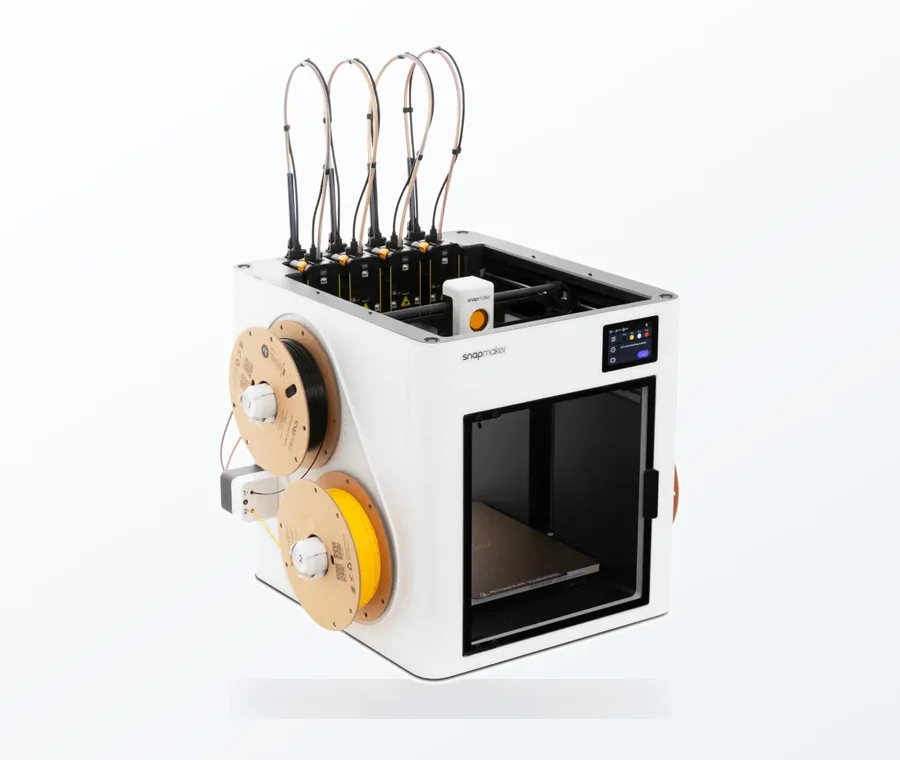
The consumer toolchanger 3D printer: the SnapSwap 4-toolhead system swaps heads in 5 seconds for true multi-color and multi-material printing, with smart calibration and auto filament loading.
- 4 toolheads · 5 s swap
- Up to 500 mm/s · 20,000 mm/s²
- 270 mm cube build volume
- Multi-color & multi-material
Outdoor 3D prints: what to decide, in order
- Choose the material for the job: ASA for parts that must live in sun, PETG only for shaded or short-term parts, PLA for indoor or very short outdoor use.
- Check the heat limit as well as UV. A dark part in direct sun can run much hotter than the air, so the material’s heat resistance matters as much as UV stability.
- Print the part so it is strong to begin with (orientation, walls, layer bonding), because UV only makes weak plastic weaker.
- Add paint or a clear coat if you need color retention, then test a scrap print outdoors before coating the real part.
Material comparison for sun exposure
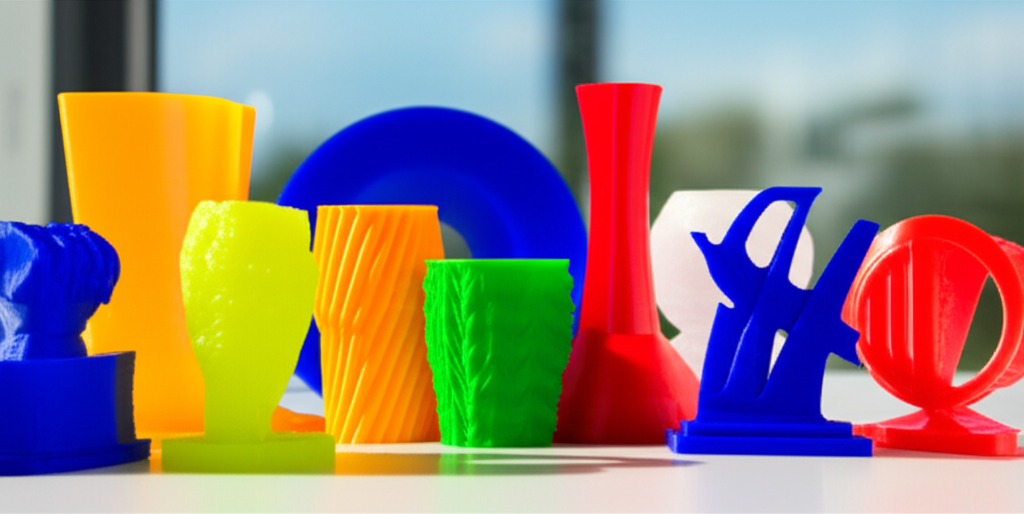
| Filament | What the maker says | Heat figure from the maker | Notes |
|---|---|---|---|
| PLA | Prusament PLA datasheet makes no outdoor or UV claim | Heat deflection temperature 55 °C | Easy to print, but softens first in a hot car or in direct sun |
| PETG | Prusament page recommends indoor and outdoor use for mechanical parts; no UV statement | “Temperature resistance” 68 °C | Lab data below shows a strength loss under UV |
| ASA | Prusament page: “UV stable”, “will not turn yellow”, suited to long-term outdoor use. Polymaker calls PolyLite ASA an alternative to ABS with improved weather resistance | Prusa: no deformation up to about 93 °C. Polymaker: glass transition 98 °C, heat deflection 100 °C at 1.8 MPa | Prints at 260 °C; Prusa says large parts can still warp at a 110 °C bed, so use an enclosure or a tall skirt |
| ABS | Polymaker positions ASA as the weather-resistant alternative to ABS | No maker figure compared here | Same warping demands as ASA; not the usual outdoor pick |
Neither Prusa nor Polymaker publishes a number for how much UV the material survives, and Polymaker’s own page gives no quantitative UV data. A maker’s “UV stable” is a positioning statement, not a test result. If a part must last, buy the filament of a maker that publishes weathering data and check the data sheet for it.
For stronger options such as PC, nylon and composites, see the high-strength filament comparison. If you are printing ASA or ABS for the first time, ABS warping and cracking explains the enclosure and bed settings, and the PETG print settings cover the other option.
What lab tests show, and what they do not
Two open studies give a rough ranking, but neither gives years of life:
- **PLA and PETG under UV-B (Polymers, 2021):** printed bars went through 24 hours of UV-B cycles at 50 °C. The blue PLA lost about 5.3 % of its tensile strength, the natural PETG about 36 %. Stiffness barely changed in either, and the authors describe the exposure as roughly equivalent to several months outdoors, which they note is an estimate. Each group had five samples and a single filament, so another brand may behave differently.
- **ASA, PETG and PLA in a QUV chamber (2026):** the abstract reports that ASA kept its ductility and showed improved strength, which the authors read as high UV resistance, while PETG lost strength moderately and PLA stiffened. The abstract gives no numbers.
The consistent signal is that ASA holds up better than PETG, and that PETG can lose strength under UV even while it looks fine. Lamp tests are not sunshine plus rain and freezing, so read them as a ranking, not a warranty.
Coating types and the data makers publish
A coating is a sacrificial skin: it absorbs or blocks UV before the plastic sees it, and it keeps a painted color from fading. Which type fits depends on the part.
| Coating | What the maker page says | What to watch |
|---|---|---|
| Acrylic UV-resistant clear (spray) | Krylon UV-Resistant Clear Coating: “protects surfaces from damaging UV light rays”, non-yellowing, interior and exterior; dry to touch in 10 minutes, dry to handle in 5 hours; best at 55 to 75 °F and under 60 % humidity | Plastic is not in the page’s list of surfaces (wicker, wood, metal, glass, plaster, ceramic, paper, papier-mâché, dried flowers), and it gives no recoat window. Test adhesion on a scrap print |
| 2K polyurethane clear | A two-component product: resin and hardener are mixed by activating the can, and the working time after that is limited and set by the product | Read the label and safety data sheet: polyurethane hardeners usually contain isocyanates, so outdoors or with the respirator the sheet names |
| Epoxy coat (e.g. XTC-3D) | Smooth-On: fills print striations, gives a smooth glossy finish, works on PLA and ABS; mix 2 parts A to 1 part B by volume | The page gives no UV or outdoor data. Treat it as a smoothing coat, and add a UV-rated clear over it for outdoor use |
| UV-rated paint plus clear coat | Paint gives color; the clear carries the UV protection | Two products must be compatible; see the painting and primer guides below |
The old advice that acrylic lasts “1 to 3 years” and 2K polyurethane “5 to 10” has no maker data behind it, so we left those figures out. What the published data does support is that 2K coatings are harder to apply and need more safety care, and that single-component acrylic sprays are the easy start.
Applying a coat, step by step
- Print in the material you chose, remove supports and strings, and sand the surface. Grit sequences are in the sanding guide.
- Clean with isopropyl alcohol and let it dry. Dust and finger oil cause fisheyes and poor adhesion.
- Prime if you are painting; the primer and filler guide explains filler primer and how to fix runs.
- Spray several thin coats rather than one wet one, in the temperature and humidity range the can states (Krylon’s is 55 to 75 °F and below 60 % humidity). Follow the label for time between coats.
- Cure for the time on the label before the part goes outside; “dry to touch” is earlier than “dry to handle”.
- Add color first with painting 3D prints techniques, then seal with the UV clear.
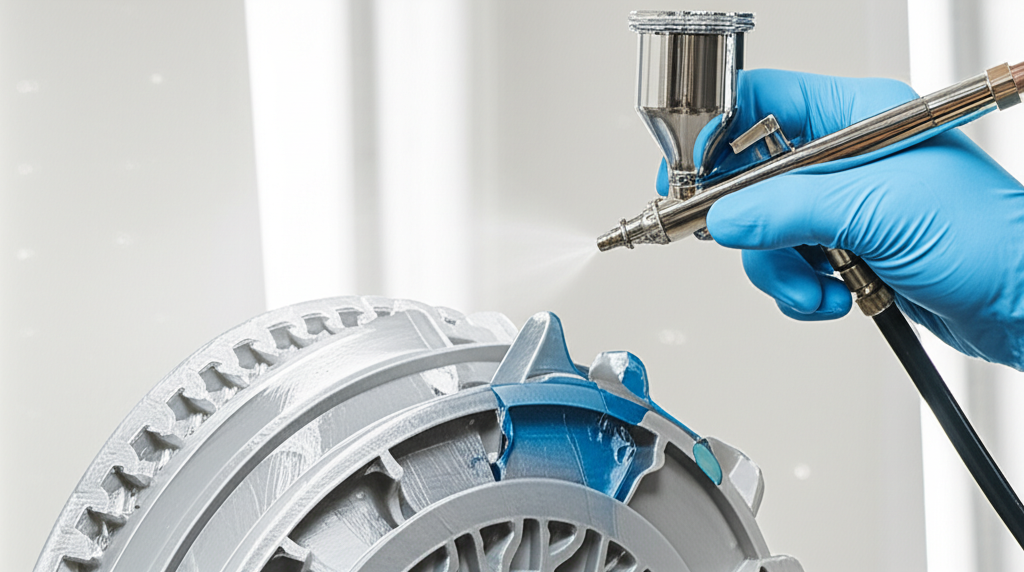
Ventilate for any aerosol or solvent-based coating and wear the respirator and gloves the safety data sheet specifies. A dust mask does not protect against vapors.
What a coating cannot fix
- **Heat softening.** A coat does not raise the heat resistance of the plastic. A PLA part with a heat deflection temperature of 55 °C still sags on a hot day, coated or not.
- **Weak layers.** UV makes brittle plastic more brittle, and a coat will not bond layers or close cracks. Strengthen the part first; see weak layer adhesion.
- **A poor bond to the plastic.** A film that peels lets UV reach the surface in patches. Test adhesion on scrap, and inspect the coat for chalking, yellowing or flaking at least once a season.
- **Warping from the wrong print setup.** An ASA part printed without an enclosure can crack or lift; fix that at the printer, not with a finish.
Common mistakes
- Treating any hardware-store spray as a UV coating. Only a product that states UV resistance on the can or maker page counts.
- Coating a PLA part and leaving it in a car or on a south-facing window, where heat, not UV, is the problem.
- Skipping the scrap test, so you discover on the finished part that the coat does not bond or that the solvent attacks the plastic.
- Using a 2K product without the respirator and ventilation its safety data sheet calls for.
Frequently asked questions
Can PLA be used outdoors?
For short, shaded or decorative use, yes, but plan for fading and brittleness over time. Prusament PLA has a heat deflection temperature of 55 °C, so a part in a hot car or in direct sun can soften before UV is the problem. For parts that must last, print in ASA.
Is PETG UV resistant?
Prusa’s page recommends PETG for indoor and outdoor mechanical parts but makes no UV claim. In a 2021 chamber test, a natural PETG lost about 36 % of its tensile strength after 24 hours of UV-B, against about 5.3 % for a blue PLA. Results vary by filament, so test the one you use.
Do I still need a coating on ASA?
Not necessarily. Prusa describes ASA as UV stable and Polymaker as having improved weather resistance, so a bare ASA part is a reasonable start. A UV clear coat or paint helps if you want the color to stay, but it has to bond to the ASA, so test first.
How long does a UV coating last?
We found no maker or independent data that gives a reliable figure, because it depends on the product, the climate and the plastic underneath. Inspect the surface regularly, and recoat or sand and refinish when it chalks, yellows or flakes.
Sources
- Prusament ASA material page: UV stable, 93 °C, print settings
- Polymaker PolyLite ASA technical data sheet
- Prusament PLA technical datasheet
- Prusament PETG material page
- Accelerated aging effect on mechanical properties of common 3D-printing polymers (Polymers, 2021)
- Effect of accelerated aging on FFF-manufactured polymers (Manufacturing Technology, 2026)
- Krylon UV-Resistant Clear Coating product page
- Smooth-On XTC-3D product page