
A high-strength filament is a material whose printed parts resist the load you actually put on them: pulling, bending, impacts or heat. There is no single “strongest filament”. In Bambu Lab’s datasheets, PC holds about 56 MPa across the layers against roughly 31 MPa for PLA Basic, ASA and ABS absorb more impact than PLA, and carbon-fibre nylon (PAHT-CF) keeps its shape up to around 194 °C where PLA softens at about 57 °C. Pick the property first, then the material.
For most hobby functional parts the practical ladder is: PETG when PLA cracks or creeps, ASA when the part lives outdoors or in a hot car, PC when it needs stiffness, toughness and heat together, and fibre-reinforced nylon when it must stay rigid at high temperature. Each step up needs a hotter nozzle, often an enclosure and dry filament. The figures below come from manufacturer technical data sheets (TDS), linked at the end; they describe lab specimens, not your part.
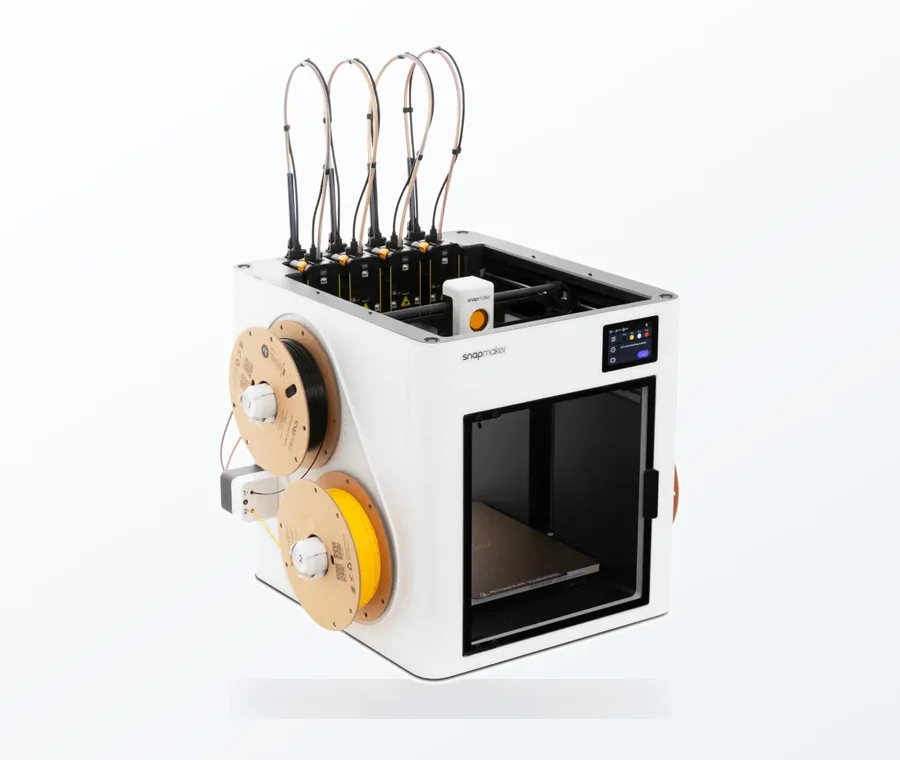
The consumer toolchanger 3D printer: the SnapSwap 4-toolhead system swaps heads in 5 seconds for true multi-color and multi-material printing, with smart calibration and auto filament loading.
- 4 toolheads · 5 s swap
- Up to 500 mm/s · 20,000 mm/s²
- 270 mm cube build volume
- Multi-color & multi-material
Quick decision list
- Brackets, clips and jigs indoors that snap or crack: try PETG first. It is barely harder to print than PLA.
- Parts in sunlight, a car or near a motor: ASA (or ABS indoors). Both need an enclosure to print well.
- Load across the layers, such as hooks and mounts: PC has the best layer strength in the table below, but orientation still matters more than material.
- Stiff parts that must survive heat above 100 °C: carbon-fibre or glass-fibre nylon, printed from dry filament with a hardened nozzle.
- Rigid, accurate parts at room temperature with no impacts: PLA is often enough. Its weak points are heat and brittleness, not stiffness.
Which “strength” does your part need?
Datasheets list several numbers, and they rank materials differently. Match the number to how the part fails:
- Tensile strength (MPa): the stress at which a bar pulled apart breaks. On Bambu Lab’s sheets it is given twice: X-Y (along the printed lines) and Z (across the layers). The Z value is what a hook or a vertical post relies on.
- Impact strength (kJ/m²): the energy a specimen absorbs in a Charpy pendulum test. Notched values are lower and show how a part behaves with a crack or sharp corner. Brittle parts that shatter when dropped need a higher impact figure, not a higher tensile one.
- Heat deflection temperature (HDT, °C): where a loaded bar starts to bend (ISO 75, at 0.45 or 1.8 MPa). Use it for anything in a car, near a heater or next to a motor.
- Stiffness (modulus, MPa or GPa): how much a part flexes under load. Fibre fillers raise it sharply; they do not always raise toughness.
High-strength filaments compared: TDS values
To keep the comparison fair, every row comes from the same manufacturer’s datasheets with the same test methods (ISO 527 tensile, ISO 179 impact, ISO 75 HDT). Bambu Lab printed the specimens at 100% infill and, for most of these materials, annealed and dried them before testing, so a normal print with walls and partial infill will come out lower.
| Material (Bambu Lab) | Tensile X-Y | Tensile Z (across layers) | Impact X-Y, unnotched | HDT at 0.45 MPa | Nozzle range |
|---|---|---|---|---|---|
| PLA Basic | 35 MPa | 31 MPa | 26.6 kJ/m² | 57 °C | 190–230 °C |
| PETG Basic | 51 MPa | 35 MPa | 34.2 kJ/m² | 71 °C | 230–260 °C |
| ABS | 33 MPa | 28 MPa | 39.3 kJ/m² | 87 °C | 240–270 °C |
| ASA | 37 MPa | 31 MPa | 41.0 kJ/m² | 100 °C | 240–270 °C |
| PC | 62 MPa | 56 MPa | 34.8 kJ/m² | 112 °C | 260–280 °C |
| PAHT-CF (carbon-fibre nylon) | 92 MPa | 47 MPa | 57.5 kJ/m² | 194 °C | 260–290 °C |
Three things stand out. First, the Z column is always lower than X-Y: PAHT-CF loses about half its strength across the layers (92 vs 47 MPa), while PC keeps most of it (62 vs 56 MPa). Second, the notched impact values change the order again: Bambu Lab lists 7.9 kJ/m² for PLA Basic and 7.5 kJ/m² for PC, against 19.6 for ASA, 21.5 for ABS and 22.8 for PAHT-CF. Third, heat resistance separates the groups more clearly than any strength figure.
Do not compare these numbers with another brand’s sheet. Test settings differ: Prusament’s PLA datasheet, for example, gives 51–59 MPa tensile yield strength for its own specimens, far above Bambu Lab’s 35 MPa for PLA Basic. Compare materials within one manufacturer’s sheets, and compare brands only when they publish the same test at the same settings.
PETG, ABS and ASA: the everyday upgrades
PETG is the usual first step from PLA. In the table it gains tensile and impact strength and about 14 °C of heat resistance while printing on open-frame machines. Its weak side is stringing; temperatures, fan and retraction are in the PETG settings guide.
ABS and ASA are not stronger than PETG in tension, but they are tougher on impact and handle more heat: 87 °C and 100 °C HDT in Bambu Lab’s sheets. ASA is the pick for outdoor parts; Bambu Lab describes it as offering UV and weather resistance. Both shrink as they cool, so they tend to warp and split without an enclosure, and printing them calls for good ventilation.
PC and fibre-reinforced nylon: when heat and load combine
Polycarbonate has the most even strength in Bambu Lab’s data and an HDT above 110 °C. The cost is printing difficulty: a 260–280 °C nozzle, a 90–110 °C bed and, per the same sheet, a 45–60 °C chamber. That usually means an enclosed printer with an all-metal hotend. The PC print settings guide covers bed surfaces and warping.
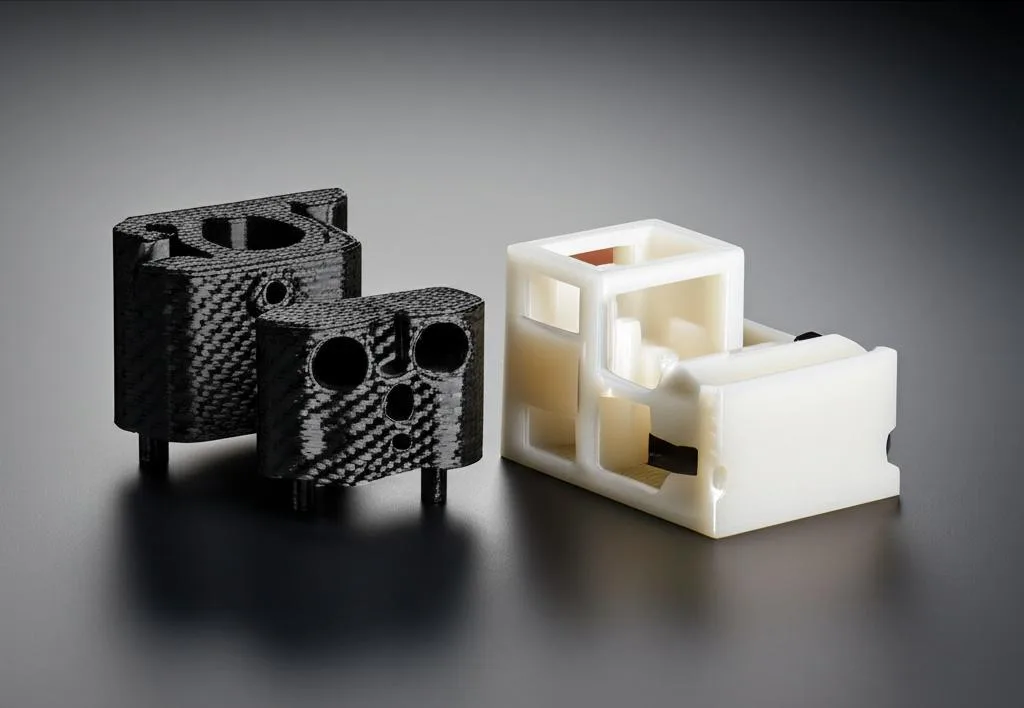
Carbon-fibre and glass-fibre composites use short fibres in a base polymer (nylon, PET, PC and others). They are much stiffer and hold dimensions well, which suits jigs, fixtures and brackets near heat. They are also abrasive, and the fibres do nothing for layer bonding: note the large gap between the X-Y and Z strength of PAHT-CF. The carbon vs glass fibre comparison explains the trade-off between stiffness, toughness and nozzle wear.
Unfilled nylon is tough and wear-resistant but absorbs water quickly and warps; its datasheet values vary a lot between grades and moisture states. If you go that way, start with printing nylon without warping. Bambu Lab asks for PAHT-CF to be dried at 80 °C for 8–12 hours in a forced-air oven and kept below 20% relative humidity while printing and in storage.
What each step up asks of your printer
| Material | Enclosure | Hotend | Drying before printing (Bambu Lab TDS) |
|---|---|---|---|
| PLA Basic | No | Any | 50 °C, 8 h in a forced-air oven if it has absorbed moisture |
| PETG Basic | No | Any that reaches 260 °C | 65 °C, 8 h |
| ABS / ASA | Strongly recommended | Reaches 270 °C | 80 °C, 8 h |
| PC | Yes, with a warm chamber | Reaches 280 °C | 80 °C, 8 h |
| PAHT-CF | Yes, 45–60 °C chamber | Reaches 290 °C, abrasion-resistant nozzle | 80 °C, 8–12 h; keep below 20% RH |
Bambu Lab’s sheets also warn that a kitchen oven or microwave is not suitable for drying or annealing: they call for an oven with even temperature and enough volume, such as a forced-air drying oven, with the spool kept away from the heating element.
Design and slicer settings matter as much as material
A PC part printed in the wrong direction can fail at a lower load than a well-oriented PETG part, because the Z value is the one that breaks. Before switching to a harder material, check these:
- Orientation: lay the part so the main load runs along the layers, not across them. The print orientation guide shows how for hooks, brackets and pins.
- Walls before infill: extra perimeters usually add more strength per gram than extra infill, because the outer shell carries most bending and twisting loads.
- Layer bonding: too low a nozzle temperature or too much fan weakens the Z direction for every material. If parts split along a layer, work through weak layer adhesion first.
- Stress raisers: sharp inside corners concentrate load. A fillet at the root of a hook or tab is a free strength gain in any material.
Common mistakes when choosing a strong filament
- Buying on the X-Y tensile number alone. It is the most flattering value on the sheet. For printed parts, the Z strength, the notched impact value and HDT usually decide whether a part survives.
- Comparing brands’ datasheets directly. Specimen settings differ, so the same material can show very different numbers. Compare within one brand or look for identical test conditions.
- Printing engineering materials wet. Nylon, PC and composites lose strength and surface quality when damp, and a strong material printed wet can end up weaker than dry PETG.
- Skipping the enclosure for ABS, ASA or PC. Warping and layer splitting throw away the material’s advantage.
- Assuming “carbon fibre” means tougher. Fibres add stiffness; they can make a part more brittle across the layers, and they wear brass nozzles.
Frequently asked questions
What is the strongest filament for a normal 3D printer?
On an open-frame printer with a standard hotend, PETG is usually the strongest practical choice. It beats PLA on impact strength and heat resistance in Bambu Lab’s datasheets and does not need an enclosure. PC and fibre-filled nylon are stronger, but they need higher temperatures, an enclosure and dry filament.
Is PETG stronger than PLA?
It depends on the property. In Bambu Lab’s data PETG Basic shows higher tensile strength, impact strength and heat resistance than PLA Basic. Other brands publish different numbers, so check the datasheet of the spool you use.
Is carbon fibre filament stronger than regular filament?
It is stiffer and usually stronger along the layers, and carbon-fibre nylon handles far more heat. Across the layers the gain is smaller: Bambu Lab lists 47 MPa Z strength for PAHT-CF against 56 MPa for plain PC. Carbon-fibre filament also needs an abrasion-resistant nozzle.
Does 100% infill make a part as strong as the datasheet?
Not quite. Datasheet specimens are small, printed at 100% infill under fixed settings and often annealed or dried before testing. Real parts have walls, seams, holes and loads across the layers, so treat the datasheet as a ranking between materials rather than a value to design to.