
Nylon warps because it shrinks and crystallizes as it cools, and it delaminates mostly because it is wet or cooled too fast. The fix, in order: dry the spool (70–100 °C for 8 hours or more, depending on the brand) and keep it in a dry box while printing, put glue on a textured PEI or engineering plate, print in a closed printer, and keep the part cooling fan off or low. The four manufacturer guides below put the nozzle at 250–290 °C.
There is one big exception: some nylons are designed for a cool bed. Polymaker’s PolyMide CoPA wants the bed at 25–50 °C with the chamber doors open, the opposite of the usual “hot enclosure” advice. So read your spool’s data sheet before changing anything. Carbon-fiber nylon warps less than plain nylon, but its layers bond less well. This guide gives the settings from Prusa, Bambu Lab, Polymaker and eSUN side by side, then a symptom table. Where we give a starting point rather than a published figure, we say so.
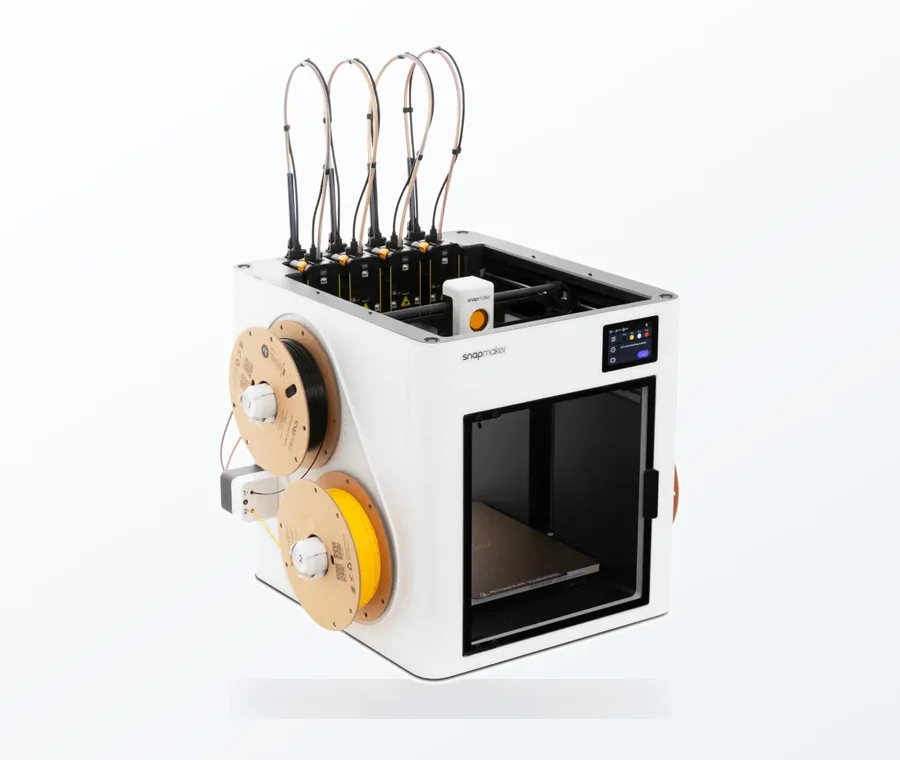
The consumer toolchanger 3D printer: the SnapSwap 4-toolhead system swaps heads in 5 seconds for true multi-color and multi-material printing, with smart calibration and auto filament loading.
- 4 toolheads · 5 s swap
- Up to 500 mm/s · 20,000 mm/s²
- 270 mm cube build volume
- Multi-color & multi-material
Nylon without warping: quick checklist
- Find your filament’s data sheet and note whether it wants a hot bed and enclosure, or a cool bed.
- Dry the spool at the manufacturer’s temperature and time, then print straight from a dry box or heated dryer.
- Clean the plate and apply glue stick (or a nylon adhesive such as Magigoo PA).
- Add a brim to parts with corners or a large flat base.
- Keep infill at or below 50% and walls at 6 or fewer.
- Fan off or low. If layers split, reduce it further before touching anything else.
- Listen for popping at the nozzle. If you hear it, stop and dry the filament again.
Why nylon warps and splits between layers
Bambu Lab lists three causes of warping in nylon and similar high-temperature materials: normal thermal shrinkage, internal stress built up during printing, and crystallization shrinkage. It says the last one is particularly strong in nylon: as it cools, the molecular chains pack tightly and the volume drops noticeably. The corners of the part pull up when that stress is stronger than the grip on the plate.
Delamination is the same stress acting higher up. Bambu Lab explains interlayer cracking as cooling stress that exceeds the bond between layers, and names PA-CF among the materials where it is common. Moisture makes it worse. Prusa describes polyamide as hygroscopic enough to absorb water weighing up to 10% of the filament weight if stored badly, and says moist nylon makes bubbles, which lead to uneven layers. Bambu Lab adds that water turning to vapor in the nozzle causes holes, rough surfaces and reduced strength.
Nylon settings from four manufacturers
| Setting | Prusa (generic polyamide) | eSUN ePA | Polymaker PolyMide CoPA | Bambu Lab PA6-CF |
|---|---|---|---|---|
| Nozzle | 285 °C | 250–290 °C | 250–270 °C | 260–290 °C |
| Bed | 110 °C | 70–90 °C | 25–50 °C | 80–100 °C |
| Part cooling fan | Not listed | 0% | Off | 0–60% |
| Print speed | Not listed | Under 150 mm/s | 50–200 mm/s | Under 100 mm/s |
| Enclosure / chamber | High ambient temperature helps a lot | Enclosed-chamber printing | Ambient only; keep doors open | 45–60 °C |
| Build surface | Prusa PA Nylon sheet | Heated bed required | PC or textured PEI, glue when needed | Engineering, High Temperature or Textured PEI plate, with glue |
| Drying | At least 4 h, below 90 °C | 70 °C, more than 12 h | 100 °C, 8 h | 80 °C, 8–12 h |
| Annealing | Not listed | Not listed | 80 °C, 6 h | Not listed |
The spread in bed temperature, from 25 °C to 110 °C, is not a typo. Formulations differ, and the right strategy depends on which one you have. Bambu Lab’s values are from its PA6-CF data sheet; its PAHT-CF lists the same temperatures with the fan at 0–40%. Polymaker gives a retraction of 3–6 mm at 40–60 mm/s for CoPA, longer than the 0.8–1.4 mm Bambu Lab lists for PA6-CF.
Drying nylon and keeping it dry while printing
Drying is the first thing to check when nylon delaminates, and the filament has to stay dry during the print too. Bambu Lab says freshly dried filament in a typical room at around 55% relative humidity can absorb enough moisture to affect print quality within 2–12 hours. Polymaker goes further for CoPA: print it only while it sits in a heated filament dryer.
- Use the manufacturer’s numbers. They range from 70 °C for more than 12 hours (eSUN ePA) to 100 °C for 8 hours (Polymaker CoPA). Prusa’s generic advice is at least 4 hours below 90 °C. Check that your dryer and spool can take the temperature.
- Use a forced-air oven or a filament dryer. Bambu Lab rules out microwaves and kitchen ovens because they heat unevenly. On its printers you can also dry on the heated bed at 90–100 °C for 12 hours, covering the spool with its box and flipping it every 6 hours.
- Don’t leave nylon out for months. Bambu Lab warns that PA-based filaments left in open air for around three months absorb so much moisture that a convection oven at 80–90 °C struggles to dry them.
- Store below 20% RH in a sealed box with desiccant, as Bambu Lab’s data sheets specify.
For a step-by-step drying routine, see our guide on how to dry nylon filament.
Hot enclosure or cool bed: two ways to stop nylon warping
Hot enclosure (most nylons). This is the approach in Prusa’s, eSUN’s and Bambu Lab’s guidance. A warm chamber reduces the temperature difference that drives shrinkage. Bambu Lab gives 45–60 °C for its carbon-fiber nylons. Without a chamber heater it suggests raising the bed temperature to warm the chamber, and preheating the bed at its maximum for 15 minutes on the X1C and P1S when the room is cold. Keep the door shut; Bambu Lab’s fixes for layer cracks include raising the bed 5–10 °C and reducing the fan. If you don’t have an enclosure yet, see our printer enclosure guide.
Cool bed (Polymaker’s Warp-Free nylons). Polymaker says its nylons are formulated so that the bed and the air around the part must both stay below 50 °C. Above that, it warns, you risk warping or ugly prints. Its FAQ says CoPA can be printed on a 30–40 °C bed without an enclosure. The part does not reach full strength straight off the printer: Polymaker anneals CoPA at 80 °C for 6 hours to finish crystallizing it.
Don’t mix the two. Running a Warp-Free nylon in a hot enclosure, or a standard nylon on a cool open bed, works against the way the material was designed.
Best bed surfaces and adhesives for nylon
- Prusa: its PA Nylon sheet gives the best adhesion for most polyamides.
- Bambu Lab: glue on the Engineering, High Temperature or Textured PEI plate. It strongly recommends cleaning the plate and applying glue stick before printing to minimize warping, and adding a brim.
- Polymaker: PC or textured PEI sheet, with glue stick or Magigoo PA if adhesion is a problem.
- Garolite (G10/FR4): popular with nylon users, but none of the manufacturer guides used for this article list it, so treat it as an option to test rather than a documented recommendation.
Geometry matters as much as the plate. Bambu Lab recommends keeping infill at or below 50% and walls at 6 or fewer, because more solid plastic means more shrinkage. For choosing between a brim and a raft on small-footprint parts, see brim versus raft.
Carbon-fiber nylon: what changes
Prusa explains that fibers improve dimensional stability and make a filament less prone to warping, and that its carbon-fiber PA11 warps far less than unfilled nylon and can be printed without an enclosure. The trade-offs, also from Prusa: fibers usually lower impact resistance and layer-to-layer adhesion, and they are abrasive, so you need a hardened nozzle. Prusa gives 0.4 mm nozzle and 0.2 mm layer height as the lowest values to avoid clogs; Bambu Lab recommends a 0.6 mm nozzle for its carbon-fiber nylons.
The data sheets show how much weaker the layer direction is:
| Filament (data sheet) | Tensile strength X-Y | Tensile strength Z | Impact strength X-Y | Impact strength Z |
|---|---|---|---|---|
| Bambu Lab PA6-CF | 102 ± 7 MPa | 48 ± 6 MPa | 40.3 kJ/m² | 15.5 kJ/m² |
| Bambu Lab PAHT-CF | 92 ± 7 MPa | 47 ± 5 MPa | 57.5 kJ/m² | 13.3 kJ/m² |
| eSUN ePA (unfilled) | 43.6 MPa | 41.5 MPa | 75.9 kJ/m² (Izod) | 4.4 kJ/m² (Izod) |
Along the layers, the carbon-fiber grades are more than twice as strong as unfilled ePA in tension. Across the layers, all three land between 41 and 48 MPa. Unfilled ePA holds its tensile strength across layers but loses most of its impact resistance and stretch: eSUN lists elongation at break of 165% along the layers and 10.8% across them. Test methods differ between brands, so compare the pattern, not the exact numbers. Moisture also differs: Bambu Lab lists saturated water absorption of 2.35% for PA6-CF and 0.88% for its nylon-12-based PAHT-CF (at 25 °C, 55% RH). Our carbon fiber vs glass fiber comparison goes deeper into filled filaments.
Nylon warping and delamination: symptom, cause, fix
| Symptom | Likely cause | Fix |
|---|---|---|
| Corners lift in the first layers | Weak grip on the plate, part cooling too fast | Clean plate, glue stick, brim; check the bed temperature against your data sheet |
| Part warps later in a long print, first layer still stuck | Chamber too cool for a standard nylon | Close the enclosure, preheat, reduce infill and walls |
| Warping with a “Warp-Free” or low-bed nylon in a hot enclosure | Bed or chamber above 50 °C | Bed 25–50 °C, doors open (Polymaker) |
| Popping at the nozzle, bubbles, rough or pitted walls | Wet filament | Dry at the data sheet temperature; print from a dryer or dry box |
| Layers crack apart on tall walls | Cooling stress greater than layer bond | Reduce the fan, raise the bed 5–10 °C, raise nozzle temperature or slow down (Bambu Lab) |
| Weak layers on carbon-fiber nylon only | Fibers reduce layer adhesion; partial clog | Hardened 0.6 mm nozzle, dry filament, clean the nozzle |
Annealing and moisture conditioning
Polymaker says a printed CoPA part does not reach full crystallization on the printer and anneals it at 80 °C for 6 hours. Annealing in an oven also dries the part out, so Polymaker recommends moisture conditioning afterwards: keep the part in a humid place, or in water, for 48 hours. Polymaker notes this also happens slowly on its own, because the part keeps absorbing moisture from the air.
Common nylon printing mistakes
- Drying once, then printing from an open spool. Nylon can pick up enough moisture to matter within hours at normal room humidity.
- Applying generic nylon advice to every brand. A 100 °C bed is right for some nylons and wrong for others.
- Fighting delamination with more infill. Denser parts shrink more. Fix drying, fan and chamber first, then see our layer adhesion guide for the remaining causes.
- Printing carbon-fiber nylon on a brass nozzle. Prusa lists a hardened nozzle as a requirement. A worn nozzle causes under-extrusion that looks like weak layers; see how a worn nozzle affects print quality.
Frequently asked questions
Do you need an enclosure to print nylon?
For most nylons, yes: Prusa says high ambient temperature helps a lot, eSUN recommends enclosed-chamber printing, and Bambu Lab lists a 45–60 °C chamber for its carbon-fiber nylons. Exceptions exist. Polymaker’s CoPA is designed for a 25–50 °C bed without a heated chamber, and Prusa says its carbon-fiber PA11 can be printed without an enclosure.
What bed temperature should I use for nylon?
It depends on the formulation: 70–90 °C for eSUN ePA, 80–100 °C for Bambu Lab PA6-CF, 110 °C in Prusa’s generic polyamide guide, but only 25–50 °C for Polymaker CoPA. Use the value from your spool’s data sheet and add glue stick on the plate.
How long should I dry nylon filament?
Manufacturer values range from 70 °C for more than 12 hours (eSUN ePA) to 80 °C for 8–12 hours (Bambu Lab PA6-CF) and 100 °C for 8 hours (Polymaker CoPA). After drying, print from a dry box or heated dryer, because nylon can reabsorb enough moisture to affect prints within hours.
Why does my nylon print split between layers?
The usual causes are wet filament, too much part cooling and a cold chamber, which lets shrinkage stress pull layers apart. Dry the filament, reduce the fan and keep the printer closed. With carbon-fiber nylon, weaker layer bonding is part of the material, so orient parts so loads don’t pull layers apart.