
Brittle PLA is PLA that snaps with little or no bending, either as filament on the spool or as a finished print. Some of it is the material itself: PLA has low impact strength, with an unnotched Charpy value of 13 kJ/m² in Prusament’s datasheet where Prusament PETG does not break at all. When PLA gets noticeably more brittle than it used to be, the usual causes are moisture in the filament and weak layer bonding, and the fix is to dry the spool (Prusa: 45 °C for 6 hours), store it sealed with desiccant and check print temperature and cooling.
Annealing is often suggested as a cure, but it does not solve brittleness. In Prusa’s annealing tests PLA gained tensile strength and heat resistance at 90 °C and above, yet stayed brittle in impact tests at every temperature and warped badly above 70 °C. This guide covers how to tell which problem you have, drying and storage values from Prusa and Bambu Lab, the print settings that matter, and what annealing can and cannot do.
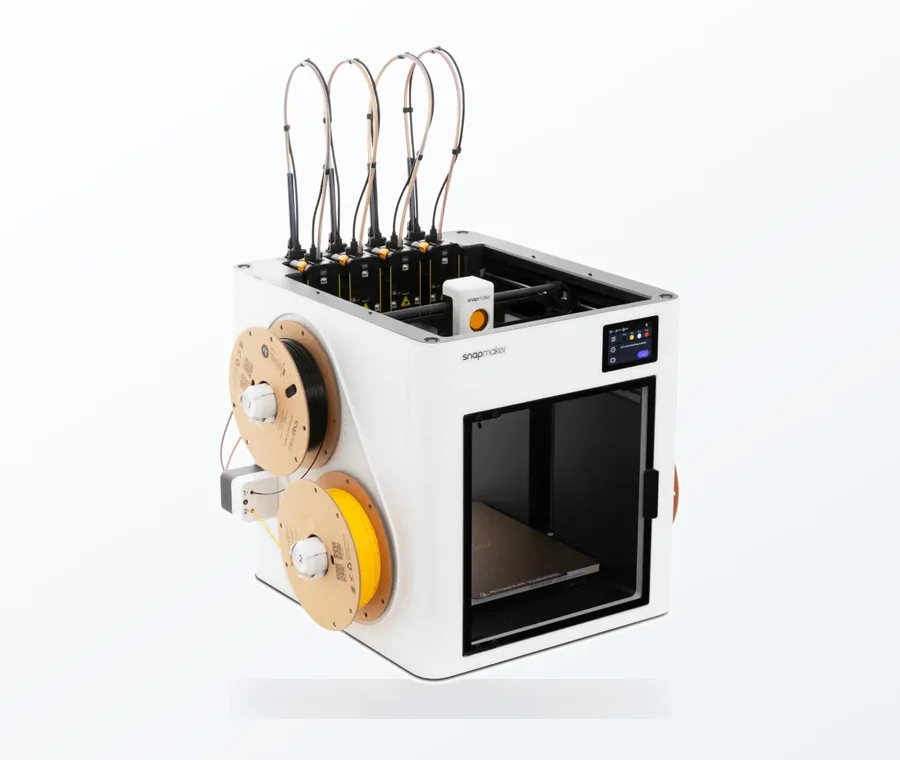
The consumer toolchanger 3D printer: the SnapSwap 4-toolhead system swaps heads in 5 seconds for true multi-color and multi-material printing, with smart calibration and auto filament loading.
- 4 toolheads · 5 s swap
- Up to 500 mm/s · 20,000 mm/s²
- 270 mm cube build volume
- Multi-color & multi-material
Fixing brittle PLA in five steps
- Decide what is brittle: the filament (snaps in the feed path or on the spool) or the prints (crack when loaded or dropped).
- Listen and look while printing. Popping, bubbles, stringing or a rough surface point to moisture.
- Dry the spool at the maker’s temperature: 45 °C for 6 hours for Prusament PLA, 50 °C for 8 hours in a forced-air oven for Bambu Lab PLA Basic.
- Print a test part. If it splits between layers, raise the nozzle temperature in 5 °C steps and reduce the fan.
- If a dry, well-bonded part still shatters under impact, PLA is the wrong material for the job. Move to PETG or a tougher filament.
Brittle PLA diagnosis table
| Symptom | Likely cause | Fix |
|---|---|---|
| Popping or hissing at the nozzle, bubbles, stringing, rough or blotchy surface, weaker parts than usual | Moisture in the filament | Dry the spool, then store it sealed with desiccant |
| Filament snaps in the feed tube or on the spool, especially an older, opened spool | Often moisture; age and long storage on a tightly wound spool are also commonly reported | Dry it. If it still snaps after a proper drying cycle, keep it for non-critical prints or replace it |
| Prints break cleanly along a layer line | Weak layer bonding: nozzle too cold, too much cooling, too fast | Hotter nozzle in 5 °C steps, less fan, slower outer walls; see weak layer adhesion |
| Snap-fit clips and thin tabs crack when flexed | PLA’s low elongation: 2.9% at yield in Prusament’s datasheet vs 5.1% for Prusament PETG | Thicker, longer clips, fillets at the root, or PETG |
| Dry, well-bonded part shatters when dropped | PLA’s inherently low impact strength | Change material (PETG, ASA, PC) rather than settings |
| Part softens or bends in a car or in sunlight | Heat: PLA’s heat deflection temperature is 55 °C in Prusament’s datasheet | Heat-resistant material; annealing only with the caveats below |
How moisture makes PLA brittle and weak
PLA absorbs water from the air slowly but steadily. Prusament’s datasheet lists 0.13% moisture uptake in 24 hours and 0.19% in 7 days at 24 °C and 22% relative humidity; Bambu Lab gives a saturated water absorption of 0.43% for PLA Basic at 25 °C and 55% RH. That sounds small, but Bambu Lab’s drying guide explains the effect: the water vaporises inside the hot nozzle, the melt expands and extrudes erratically, and you get bubbles, stringing, holes, rough surfaces and reduced strength.
Prusa lists the first signs of humid filament as poor surface quality, low layer adhesion, blobbing, and bubbling or smoke during extrusion. PLA is a polyester, and water can also slowly break down its polymer chains over long exposure. Drying removes the water but cannot repair that kind of damage, which is why a very old spool can stay brittle even after a correct drying cycle.
PLA drying temperatures and times
| Method | Temperature | Time | Source and notes |
|---|---|---|---|
| Filament dryer (Prusament PLA) | 45 °C | 6 h | Prusa. Do not exceed it, or the filament softens and sticks together |
| Forced-air oven (PLA Basic / Matte) | 50 °C | 8 h | Bambu Lab. PLA Silk: 55 °C for 8 h |
| Heated bed under a cover, enclosed Bambu printers | 60–70 °C bed | 12 h | Bambu Lab. Flip the spool every 6 h; not for open-frame printers |
| AMS 2 Pro / AMS HT | 45 °C | 12 h | Bambu Lab. Use rotation mode; static mode is not suitable for PLA |
Use the value for your brand where it exists; the two makers above differ by 5 °C for standard PLA. A kitchen oven is a poor dryer: Bambu Lab’s PLA datasheet calls for an oven with even temperature distribution, such as a forced-air drying oven, and says a kitchen or microwave oven is not suitable.
Storing PLA so it stays dry
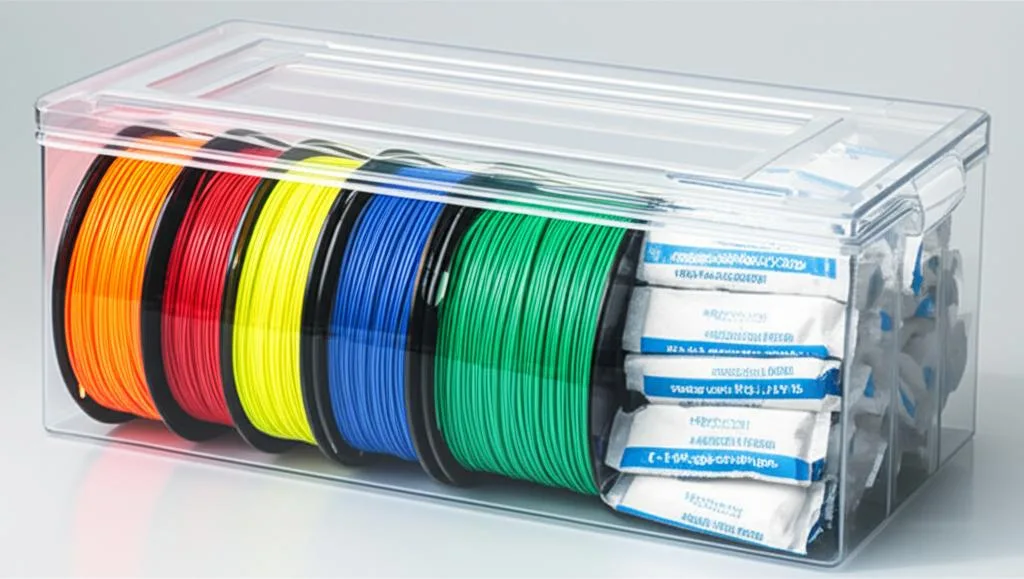
- Sealed box with desiccant. Prusa’s first recommendation is a closed box with desiccant inside. Bambu Lab’s PLA datasheet asks for storage below 20% RH, sealed with desiccant.
- Vacuum bags with desiccant for spools you will not use for a while; Prusa lists these as an alternative to dry boxes.
- A cheap hygrometer in the box tells you when the desiccant is spent. Indicating silica gel that changes colour does the same job.
- Back into storage after printing. A spool left on the printer for weeks in a humid room absorbs moisture again. Prusa notes that even PLA can pick up enough humidity to cause stringing on multi-tool printers where idle tools stay heated.
- Keep spools away from windows and heaters. Sunlight and warmth are commonly blamed for ageing filament, and it costs nothing to avoid them.
Print settings that make PLA parts brittle
The weakest direction of any PLA print is across the layers. Prusament’s datasheet shows it clearly: 51–59 MPa tensile yield strength along the layers, but only 17 MPa interlayer adhesion. Anything that weakens the bond between layers makes parts feel brittle:
- Nozzle temperature. Prusament PLA is specified at 210 ± 10 °C; Bambu Lab PLA Basic at 190–230 °C. If layers split, start in the middle of your filament’s range and go up in 5 °C steps.
- Cooling and speed. PLA needs the fan for overhangs and detail, but strong cooling and very high speeds leave less heat for each layer to fuse with the one below. On functional parts without steep overhangs, try less fan.
- Orientation. A hook printed standing up breaks along a layer at a much lower load than the same hook lying flat. See print orientation for strength.
- Walls. Thin parts with two perimeters and sparse infill crack easily. More walls and fillets at sharp inside corners help more than extra infill.
Annealing PLA: what it improves and what it doesn’t
Annealing heats a finished print above its glass transition temperature (about 65 °C for PLA, per Prusa) so the polymer chains can rearrange into a more ordered, partly crystalline structure. Prusa annealed 100% infill PLA, PETG, ASA and ABS samples for 30 minutes in an electric oven at 70 to 170 °C and measured the results:
- Tensile strength: PLA was the strongest material when annealed at 90 °C and above.
- Heat resistance: PLA’s heat deflection temperature rose dramatically at 90 °C and above.
- Impact: PLA stayed too brittle at every annealing temperature. Only at 170 °C did its impact result approach the other materials, and by then the shape was ruined.
- Shape: PLA changed dimensions noticeably even at 70 °C and warped at higher temperatures. Samples shrank along their longest axis and grew in Z. At 170 °C they melted.

Bambu Lab’s PLA Basic datasheet is far more cautious: it suggests annealing at 50–60 °C for 6–12 hours, warns that some prints may deform and warp, and again calls for a forced-air oven rather than a kitchen oven. If you want to try it, treat these as a starting point:
- Print a small test piece in the same filament, with the same walls and infill, and measure it with calipers.
- Place it on a flat, stable tray in an oven you have checked with a separate thermometer.
- Use your filament maker’s annealing value if it publishes one; otherwise start low and raise it in small steps between tests.
- Let the part cool down slowly, as Prusa did with its samples.
- Measure again and scale the real model to compensate for the shrinkage you saw.
Anneal for heat resistance or stiffness, not to stop PLA shattering. For toughness, Prusa’s same tests favoured PETG, which it rated the best overall choice for annealing at 110 °C.
When to stop fixing PLA and switch material
If the filament is dry, the layers bond and the part is oriented well but still cracks, the part needs a tougher material. PETG is the easy next step on the same printer; the PETG print settings guide covers temperatures and stringing. For parts that must take impacts, heat or sunlight, compare the options in choosing a high-strength filament.
Common brittle PLA mistakes
- Drying too hot. Above the maker’s value the spool softens and the windings fuse. Prusa warns against exceeding 45 °C for its PLA.
- Expecting annealing to make PLA tough. It helps heat resistance and tensile strength, not impact.
- Blaming the filament for a settings problem. A clean break along a layer line is a bonding issue; drying will not fix it.
- Drying and then leaving the spool out. It starts absorbing moisture again straight away.
Frequently asked questions
Can you fix brittle PLA filament by drying it?
Often, if the cause is moisture. Dry it at the manufacturer’s temperature, for example 45 °C for 6 hours for Prusament PLA or 50 °C for 8 hours in a forced-air oven for Bambu Lab PLA Basic. If it still snaps after a proper cycle, the damage may be permanent and the spool is best used for non-critical prints.
Why does my PLA filament snap on the spool?
Moisture is the cause manufacturers document; older spools that have been open for a long time are the usual victims. Dry the spool and store it sealed with desiccant. If a fresh spool from the same brand behaves normally, the old one has probably degraded.
Does annealing make PLA stronger?
Stronger in tension and more heat resistant, yes, in Prusa’s tests at 90 °C and above. It did not make PLA less brittle in impact tests, and parts shrank and warped. Test on a small piece first and expect to adjust dimensions.
How should I store PLA filament?
In a sealed box or vacuum bag with desiccant, as both Prusa and Bambu Lab recommend. Bambu Lab specifies below 20% relative humidity for storage. Put spools back after printing instead of leaving them on the printer for weeks.