Polycarbonate prints reliably when four things are in place: a nozzle at 250–285 °C, a bed at 90–115 °C with glue stick on the plate, an enclosed printer that keeps the air around the part warm, and filament dried at 75–85 °C right before printing. Those ranges come from the data sheets for Prusament PC Blend, Bambu Lab PC and Polymaker PolyLite PC. Keep the part cooling fan off or low: Polymaker says off, Prusa uses 20%.
Get those right and PC pays you back: Bambu Lab lists a heat deflection temperature of 112–117 °C for its PC, against 57 °C for its PLA Basic. The catch is warping and cracking between layers, because PC shrinks a lot as it cools. Below: manufacturer settings side by side, enclosure and bed choices, strength along and across layers, and a fix table. Where a value is a starting point rather than a published figure, we say so.
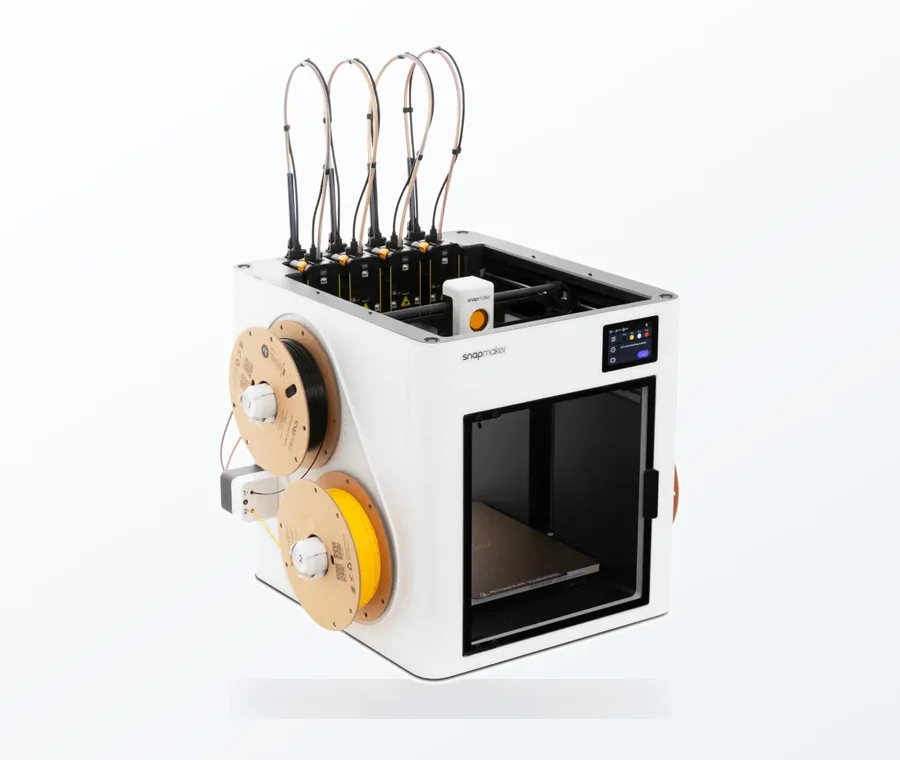
The consumer toolchanger 3D printer: the SnapSwap 4-toolhead system swaps heads in 5 seconds for true multi-color and multi-material printing, with smart calibration and auto filament loading.
- 4 toolheads · 5 s swap
- Up to 500 mm/s · 20,000 mm/s²
- 270 mm cube build volume
- Multi-color & multi-material
PC printing checklist
- Dry the spool: 75–85 °C for 5–8 hours, depending on the brand.
- Print from a sealed box with desiccant, not from an open spool holder.
- Use a textured or satin sheet with glue stick. Never bare smooth PEI.
- Close the enclosure and let the heated bed warm the chamber for 10–15 minutes before starting.
- Start from your filament’s profile: nozzle in the middle of its range, fan off or low.
- Add a brim on parts larger than about 5 cm, and keep infill at or below 50%.
- Leave the door closed until the part has cooled, or anneal it straight away.
What your printer needs for polycarbonate
- An enclosure. Bambu Lab lists PC as requiring an enclosed printer, and Polymaker says PolyLite PC needs an enclosed printer that can trap heat. Prusa, whose PC Blend is easier to print, still notes that PC warps a lot even with additives and that printing inside an enclosure helps. If you are choosing one, see our guide to building a printer enclosure.
- A hotend rated for the temperature. Polymaker asks for an all-metal hotend that reaches at least 250 °C. Prusament PC Blend runs at 275 ± 10 °C, so check your hotend’s maximum. Our article on all-metal hotend upgrades covers what changes.
- A bed that holds 110 °C. Prusa notes that its printers may throw a “bed thermal runaway” error with PC when the room is below 18 °C, because the bed cannot hold temperature.
Prusa explains that pure polycarbonate is not suitable for 3D printing because of poor bed adhesion and high thermal expansion, so additives are usually mixed in to make it printable. That is why the settings below differ noticeably between brands.
PC print settings from three manufacturers
| Setting | Prusament PC Blend | Bambu Lab PC | Polymaker PolyLite PC |
|---|---|---|---|
| Nozzle temperature | 275 ± 10 °C | 260–280 °C | 250–270 °C |
| Bed temperature | 110 ± 10 °C (Prusa KB: 110 °C first layer, 115 °C after) | 90–110 °C | 90–105 °C |
| Part cooling fan | 20% (0–30%) | 0–60% | Off |
| Print speed | Up to 200 mm/s | Under 300 mm/s | 50–200 mm/s |
| Chamber | Enclosure recommended | 45–60 °C | Enclosure required; actively heated chamber of at least 60 °C highly recommended |
| Build surface | Satin sheet; smooth PEI or powder-coated sheet with glue stick | Engineering, High Temperature or Textured PEI plate, with glue | Textured PEI, glue when needed |
| Drying | 85 °C, 5 h | 80 °C, 8 h | 75 °C, 6 h |
| Annealing | Not listed | Not listed | 90 °C, 2 h |
The Prusament drying value is from Prusa’s filament drying article; the others are from each data sheet. The high speeds assume a fast printer; on an older machine, use its own PC profile. Polymaker also caps PolyLite PC at a maximum volumetric speed of 12 mm³/s and gives a retraction of 1–3 mm; Bambu Lab lists 0.8–1.4 mm for its PC.
Fan settings are where the brands disagree most. Prusa explains that 20% or more helps overhangs and bridges, while larger prints without bridges can do better with the fan off. Polymaker says to keep cooling fans off and print “slow and hot”. If your part splits between layers, the fan is the first thing to turn down.
Enclosure and chamber temperature for PC
Bambu Lab describes why PC warps: it shrinks as it cools, and its high glass transition temperature means internal stress builds up when the surrounding air is much colder than the part. A warmer chamber reduces that stress. Its data sheet gives 45–60 °C for PC on printers with chamber heating.
If your printer has no chamber heater, the bed has to do the job:
- Preheat before printing. Polymaker suggests setting the bed to 105 °C for 10–15 minutes before starting. Bambu Lab suggests preheating the bed to its maximum for 15 minutes on the X1C and P1S when the room is cold.
- Keep the doors and lid closed during the print. Bambu Lab’s fix for cracks between layers includes closing the front door and top lid to keep the chamber temperature stable.
- No enclosure at all? Prusa’s workaround is to place the object in the middle of the bed and set the skirt as high as possible, which creates a slightly warmer microclimate around the part. Prusa presents it as a way to improve your chances, not as a replacement for an enclosure.
Bed surface and adhesion for polycarbonate
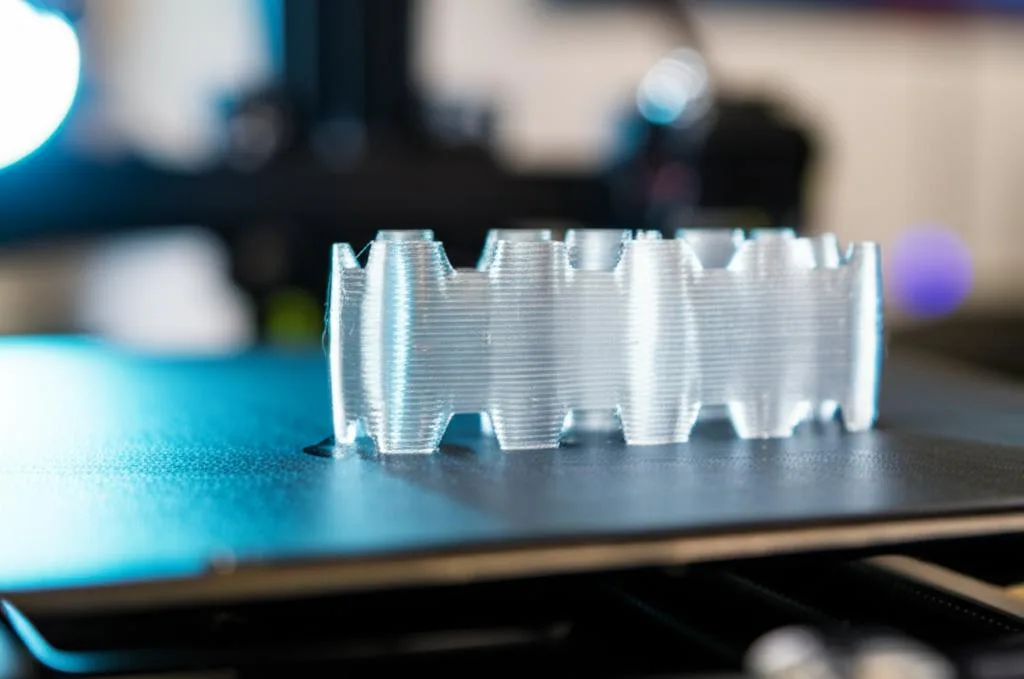
PC can grip a smooth PEI sheet hard enough to damage it. Prusa does not recommend PC on smooth PEI, and if you have to use one, apply glue stick as a separation layer. Its best adhesion comes from a powder-coated textured or satin sheet with glue stick. The satin sheet works without glue for occasional PC prints, but Prusa still recommends glue if you print PC regularly to prevent wear. Bambu Lab lists glue as required for PC on all compatible plates and says PC is not compatible with its Low-Temp Engineering Plate.
- Brim: the Prusament PC Blend data sheet recommends a 4 mm brim for parts bigger than 5 cm, and says a brim of 3 mm or more improves adhesion of edges and corners on larger objects.
- Geometry: Prusa notes that rounded edges warp less than sharp corners, and that more material inside the part (denser infill, more perimeters) increases warping on large PC models.
- Infill and walls: Bambu Lab recommends staying at or below 50% infill and 6 walls; for non-structural parts its default 2 walls and 15% infill are enough.
- Adhesives: Polymaker recommends Magigoo PC for bed adhesion with PolyLite PC.
Drying and storing PC filament
Bambu Lab classes drying as required for PC and desiccant protection during printing as required too. Wet filament vaporizes in the hot nozzle, and Bambu Lab lists the results as stringing, bubbles, holes, rough surfaces and reduced strength. Its storage guidance is below 20% relative humidity in a sealed container. At a typical indoor 55% RH, it says freshly dried filament can pick up enough moisture to affect print quality within 2–12 hours, depending on the material.
- Temperatures: 75–85 °C for 8 hours in a forced-air oven (Bambu Lab), 85 °C for 5 hours (Prusament PC Blend), 75 °C for 6 hours (PolyLite PC). Bambu Lab warns against microwaves and kitchen ovens because the heat is too uneven.
- Don’t dry it over and over. Bambu Lab notes that PC filament can become brittle after repeated heating and cooling cycles. It does not weaken the printed part, but the filament is more likely to snap in the feed path. Dry once, then keep the spool sealed.
How strong and heat resistant PC parts are
Bambu Lab publishes values for its PC in both directions: X-Y (along the layers) and Z (across the layers). The gap shows where PC parts fail.
| Property (Bambu Lab PC data sheet) | X-Y, along layers | Z, across layers |
|---|---|---|
| Tensile strength (ISO 527) | 62 ± 2 MPa | 56 ± 2 MPa |
| Bending strength (ISO 178) | 108 ± 4 MPa | 55 ± 2 MPa |
| Impact strength, unnotched (ISO 179) | 34.8 ± 2.1 kJ/m² | 9.0 ± 0.4 kJ/m² |
| Elongation at break | 3.8 ± 0.3% | 2.1 ± 0.4% |
Pulling straight across layers, PC keeps most of its tensile strength. Bending and impact across layers are a different story: roughly half the bending strength and about a quarter of the impact strength. Bambu Lab tested 100% infill specimens that were annealed and dried at 80 °C for 12 hours, so treat these as best-case figures. Orient the part so bending loads and knocks act along the layers. Our guide to part orientation for strength shows how to plan that.
For heat, the figure to compare is the heat deflection temperature (HDT). Bambu Lab’s PC data sheet gives 112–117 °C, depending on the load. Prusament PC Blend is 113 °C at 0.45 MPa and 93 °C at 1.8 MPa. For comparison, Bambu Lab lists 57 °C for PLA Basic, 69 °C for PETG HF and 87 °C for ABS, all at 0.45 MPa.
Annealing PC parts
Polymaker says PolyLite PC needs annealing after printing, especially if you don’t have a heated chamber of 90 °C or more: 90 °C for 2 hours in an oven. The important detail is timing. Put the part in the oven as soon as the print finishes, without letting it cool. Polymaker gives this as the answer to parts cracking along layer lines, together with keeping the chamber as warm as possible and letting the part cool slowly.
Check your brand’s own data sheet before annealing, because Prusa and Bambu Lab don’t publish an annealing schedule for their PC. Hotter is not better: 120 °C, a figure that turns up in older guides, is above the heat deflection temperatures listed in the next section, so a loaded part could sag.
PC print problems and fixes
| Symptom | Likely cause | Fix |
|---|---|---|
| Corners lift during the print | Part shrinking in cool air, weak bed grip | Glue on the plate, add a brim, preheat the chamber, lower infill density |
| Cracks between layers, often on tall walls | Cooling stress exceeds layer bond (Bambu Lab) | Reduce the fan, raise the bed 5–10 °C, close the door and lid; raise nozzle temperature or slow down |
| Cracks appear after the part comes off | Residual stress from fast cooling | Cool slowly in the closed printer or anneal immediately (Polymaker: 90 °C, 2 h) |
| Popping at the nozzle, bubbles, stringing, rough surface | Wet filament | Dry at 75–85 °C, then print from a sealed box |
| Filament snaps in the feed path | Brittle after repeated drying cycles | Keep dried spools sealed instead of re-drying before every print |
| Part tears pieces out of the sheet | PC on bare smooth PEI | Glue stick as a separator, or a textured or satin sheet |
| Bed thermal runaway error | Cold room, bed can’t hold 110 °C+ (Prusa) | Enclosure or a warmer room above 18 °C |
Common polycarbonate mistakes
- Using a PLA or PETG fan profile. High cooling is the fastest way to get PC layers to split. The full list of causes is in our layer adhesion guide.
- Opening the door to check the print. The chamber temperature drops quickly and the part shrinks unevenly.
- Printing large, dense parts as a first PC print. Polymaker says large, dense parts require a heated chamber. Start small, with rounded corners.
- Going straight back to PLA. PC residue won’t melt at PLA temperature. Flush hot first; our cold pull guide lists 290 °C after PC.
- Choosing PC when ABS would do. Bambu Lab lists an HDT of 87 °C for its ABS. If that is enough for your part, ABS is easier to print. See how to print ABS without warping.
Frequently asked questions
What temperature should I print polycarbonate at?
Manufacturer data sheets put the nozzle at 250–285 °C and the bed at 90–115 °C. Prusament PC Blend uses 275 °C and 110–115 °C, Bambu Lab PC 260–280 °C and 90–110 °C, and Polymaker PolyLite PC 250–270 °C and 90–105 °C. Start from your own brand’s range and adjust in 5 °C steps.
Can you print PC without an enclosure?
Small parts in modified PC such as Prusament PC Blend can work without one, using a high skirt and a brim to keep the part warm. Bambu Lab and Polymaker both treat an enclosure as required for their PC. For large or dense parts, expect warping and cracked layers without one.
How long should I dry PC filament?
Bambu Lab recommends 75–85 °C for 8 hours in a forced-air oven, Prusa 85 °C for 5 hours for PC Blend, and Polymaker 75 °C for 6 hours for PolyLite PC. Store it sealed with desiccant afterwards, because repeated drying can make PC filament brittle.
Can I print polycarbonate on a PEI sheet?
Textured PEI with glue stick is a common choice and is listed by Bambu Lab and Polymaker. Avoid bare smooth PEI: Prusa warns that PC can bond hard enough to damage it, so use glue stick as a separation layer if you have to print on one.