
Choose carbon fiber filament when stiffness along the layers matters most, and glass fiber when the part has to survive knocks or loads across the layers. In Polymaker’s data sheets for two nylon 6 composites on the same base, the carbon fiber grade (Fiberon PA6-CF20) had a tensile modulus of about 8,640 MPa in the print plane against about 5,360 MPa for the glass fiber grade (PA6-GF25), roughly 60% stiffer. The glass fiber grade was stronger between layers, with more than twice the unnotched impact strength in the Z direction.
Several things people assume about the difference don’t hold up in manufacturer data: both grades had nearly the same density, both showed the same very high surface resistivity (over 10¹² Ω), and Polymaker gives the same brass nozzle life of about 9 hours for each. Both need a hardened nozzle. The numbers below come from Polymaker, Bambu Lab and Prusa documentation, linked at the end. They describe specific products, not every CF or GF filament.
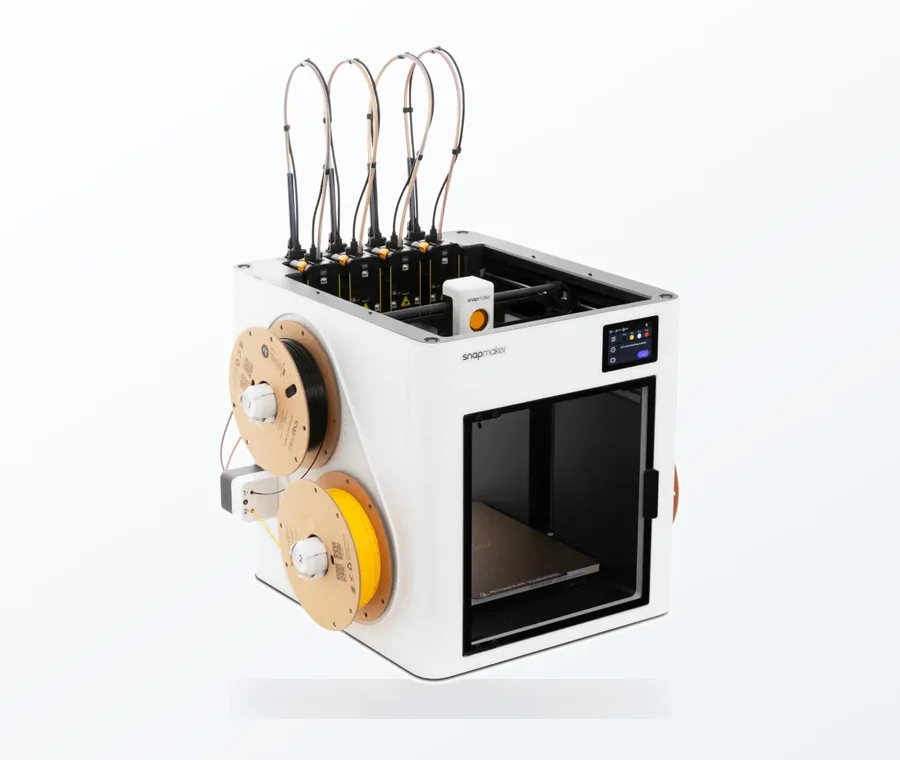
The consumer toolchanger 3D printer: the SnapSwap 4-toolhead system swaps heads in 5 seconds for true multi-color and multi-material printing, with smart calibration and auto filament loading.
- 4 toolheads · 5 s swap
- Up to 500 mm/s · 20,000 mm/s²
- 270 mm cube build volume
- Multi-color & multi-material
Carbon fiber or glass fiber: quick decision
- Brackets, arms, jigs that must not flex: carbon fiber. Higher in-plane stiffness and bending modulus.
- Clips, housings, parts that get dropped or loaded across layers: glass fiber. Better Z-direction impact strength, strength and elongation.
- Parts near heat: compare heat deflection temperatures on the data sheet. The base polymer matters more than the fiber.
- You need guaranteed electrical insulation or static dissipation: don’t pick by fiber type. Check the resistivity on the data sheet, or buy a grade rated for it.
- Your printer has a brass nozzle and no enclosure: neither yet. Fit a hardened nozzle first, and check whether the base polymer needs an enclosure.
What adding fibers does to a filament
Carbon, glass and aramid (Kevlar) fibers are chopped and mixed into a base polymer such as PLA, PETG, nylon, PC or PP. Prusa’s summary of what that changes applies to both fiber types:
- Better: dimensional stability, less warping, higher temperature resistance and tensile yield strength, and often lower weight.
- Worse: Charpy impact resistance and layer-to-layer adhesion usually drop, the filament is more brittle, and the risk of nozzle clogging goes up.
Not every fiber-filled filament is built for strength. Prusa states that its Prusament PETG Carbon Fiber is filled with carbon fibers for looks. “CF” on a label tells you the fiber, not how much stiffer the part will be.
The base polymer also outweighs the fiber. In Bambu Lab’s own comparison, PA6-GF reached a flexural strength of 120 MPa, while ABS-GF reached 68 MPa, barely above plain ABS at 62 MPa. So compare a carbon and a glass grade on the same base polymer, as in the table below, rather than a CF nylon against a GF PETG.
PA6-CF vs PA6-GF: data sheet comparison
Polymaker publishes both grades on the same nylon 6 base, printed and tested the same way (dry, annealed at 100 °C for 16 hours). X-Y means along the printed layers, Z means across them.
| Property (dry) | Fiberon PA6-CF20 (carbon) | Fiberon PA6-GF25 (glass) | Better |
|---|---|---|---|
| Tensile modulus, X-Y | 8,637 MPa | 5,357 MPa | Carbon |
| Tensile strength, X-Y | 109.3 MPa | 80.1 MPa | Carbon |
| Bending modulus, X-Y | 7,038 MPa | 4,314 MPa | Carbon |
| Tensile strength, Z | 54.0 MPa | 60.7 MPa | Glass |
| Bending strength, Z | 71.3 MPa | 99.9 MPa | Glass |
| Elongation at break, Z | 1.9% | 4.0% | Glass |
| Charpy impact, Z, unnotched | 7.5 kJ/m² | 16.2 kJ/m² | Glass |
| Charpy impact, X-Y, notched | 11.0 kJ/m² | 10.0 kJ/m² | Similar |
| Heat deflection temp. (1.8 MPa) | 173 °C | 157 °C | Carbon |
| Density | 1.17 g/cm³ | 1.20 g/cm³ | Similar |
| Surface resistivity | >10¹² Ω | >10¹² Ω | Same |
| Brass nozzle life (Polymaker estimate) | About 9 h | About 9 h | Same |
This is one manufacturer’s pair of products, with its own fiber loadings, so read it as a pattern rather than a rule for every brand. It does show the trade-off clearly: carbon fiber wins along the layers, glass fiber wins across them.
Stiffness and in-plane strength
Stiffness is where carbon fiber earns its reputation. With a bending modulus about 60% higher than the glass fiber grade, a carbon fiber arm of the same shape deflects noticeably less under the same load. For a camera mount, a drone arm or a fixture that has to hold a position, that matters more than peak strength.
Those gains are along the print plane. Z-direction tensile modulus for the carbon grade was 3,760 MPa, less than half its X-Y figure, so part orientation decides whether you actually get the stiffness you paid for.
Toughness and layer adhesion
Glass fiber’s advantage shows up in the Z direction. In Polymaker’s data the glass grade stretched about twice as far before breaking across the layers, had about 40% higher Z bending strength and more than double the unnotched Z impact strength. For snap-fits, clips and housings that might be dropped, that is the more useful profile.
Along the layers the picture is closer. Notched X-Y impact strength was 11.0 kJ/m² for carbon and 10.0 kJ/m² for glass, so “glass fiber is tougher” is only clearly true for loads that try to split the layers.
Weight, heat and electrical properties
- Weight. Carbon fiber filament is often sold as the light option, but the two Polymaker grades measure 1.17 and 1.20 g/cm³. A difference of under 3% is too small to matter for most hobby parts.
- Heat. Both grades handle heat well, with heat deflection temperatures of 173 °C (carbon) and 157 °C (glass) at 1.8 MPa in these data sheets. Bambu Lab’s PA6-GF lists 182 °C at the lower 0.45 MPa load, so always compare values at the same load.
- Electrical. Carbon fiber filament is often assumed to be conductive, so unsuitable for electronics enclosures. Polymaker’s data doesn’t support that for its nylon grades: surface resistivity measured above 10¹² Ω for both PA6-CF20 and PA6-GF25, far from conductive. Static-dissipative filaments are sold as separate ESD grades, such as Polymaker’s Fiberon PETG-ESD. If insulation or conductivity is a safety requirement, use a grade with a stated value and test the part.
- Moisture. Nylon composites lose a lot of stiffness when wet. After soaking, Polymaker’s PA6-CF20 test bars dropped from 8,637 to 2,508 MPa X-Y modulus, and the GF25 bars from 5,357 to 1,794 MPa. Dry the filament, and expect nylon parts to be softer in humid use.
Printing CF and GF filament: nozzle, drying, enclosure
The printing requirements are the same for both fibers, and they come from the fibers themselves, not from the choice between them.
- Fit a hardened nozzle. Prusa describes carbon, glass and Kevlar fibers as highly abrasive and says a hardened nozzle is necessary. Bambu Lab lists hardened steel for abrasive filaments such as PA-CF, PLA-CF and PETG-CF, and stainless steel only for non-abrasive ones. Polymaker estimates a brass nozzle lasts about 9 hours on either of its PA6 composites. Bambu Lab also reports that its tungsten carbide nozzles wear significantly less than hardened steel.
- Use a bigger nozzle if you can. Bambu Lab recommends 0.6 mm for its fiber-filled filaments to reduce clogging and does not support 0.2 mm for PA6-GF. Prusa gives 0.4 mm and 0.2 mm layers as the lowest optimal values.
- Clean the nozzle first. Prusa suggests a cold pull before printing composites so the nozzle starts clean.
- Dry the filament. Nylon composites are very moisture-sensitive: Polymaker specifies 100 °C for 10 hours for its PA6 grades, and Bambu Lab 80 °C for 8–12 hours in a convection oven for PA6-GF. Store below 20% RH. Our nylon drying guide covers the practical side.
- Match the base polymer’s needs. Polymaker prints both PA6 grades at 280–300 °C. Bambu Lab requires an enclosed printer for PA6-GF, uses glue on the plate, and recommends a warmer chamber to limit warping.
- Protect your hands. Bambu Lab warns that glass and carbon fiber filaments can have microscopic barbs on the surface and cut ends, and recommends cut-resistant gloves and safety goggles when handling filament, removing supports or sanding.
Common mistakes when choosing a composite
- Buying CF for “strength” when the part fails between layers. If parts split along layer lines, a glass fiber grade or better orientation helps more than carbon.
- Assuming glass fiber is gentle on nozzles. Polymaker’s brass nozzle estimate is the same for both. A worn nozzle quietly ruins dimensions; see how a worn nozzle affects print quality.
- Comparing across base polymers. A CF nylon against a GF PETG tells you about nylon vs PETG, not carbon vs glass.
- Relying on fiber type for electrical behavior. Check the resistivity value instead.
- Skipping drying. Wet nylon composites print with bubbles and weak layers. If you are fighting warping, delamination or clogs, work through common composite print failures.
Not sure you need a composite at all? Choosing filament for high-strength prints compares the unfilled engineering options too.
Frequently asked questions
Is carbon fiber filament stronger than glass fiber filament?
Along the printed layers, usually yes: in Polymaker’s nylon 6 pair the carbon grade had higher tensile strength and about 60% higher stiffness. Across the layers the glass fiber grade was stronger and more than twice as impact resistant. Which is “stronger” depends on how the part is loaded.
Do I need a hardened nozzle for glass fiber filament?
Yes. Prusa describes both glass and carbon fibers as highly abrasive, and Polymaker estimates a brass nozzle lasts about 9 hours on its glass fiber nylon, the same as on its carbon fiber nylon. Use hardened steel or another wear-resistant nozzle.
Is carbon fiber filament electrically conductive?
Not necessarily. Polymaker measured surface resistivity above 10¹² Ω for its PA6-CF20, the same as its glass fiber grade, which is far from conductive. Static-dissipative filaments are sold as separate ESD grades. If you need a specific electrical behavior, buy a grade with a stated resistivity.
Is carbon fiber filament lighter than glass fiber filament?
Slightly, but the difference is small because most of the filament is polymer. Polymaker’s PA6-CF20 is 1.17 g/cm³ and its PA6-GF25 1.20 g/cm³. For weight-sensitive parts, wall and infill settings make a bigger difference than the fiber choice.