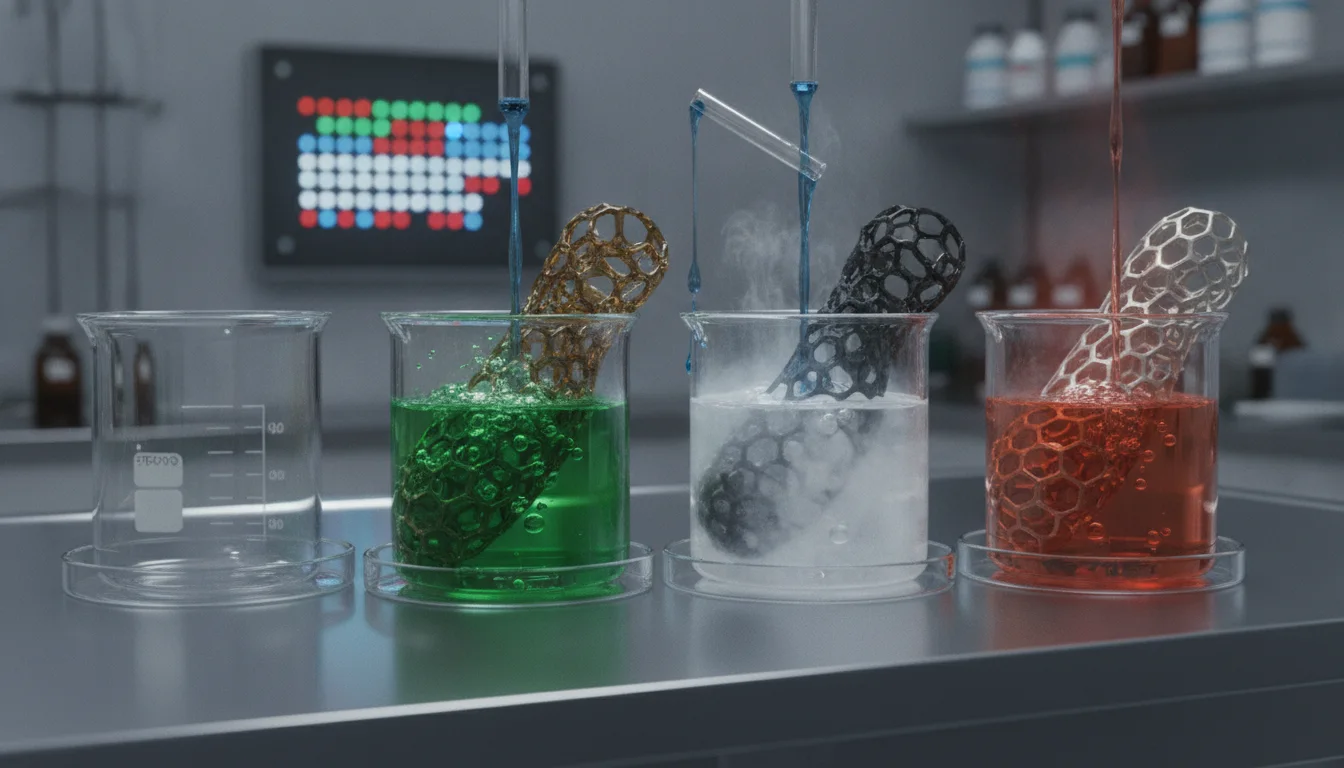
Chemical resistance is a material’s ability to keep its weight, shape and strength while in contact with a substance, such as a solvent, an acid or a cleaner. Among common FDM filaments, polypropylene (PP) scores best on Prusa’s chemical compatibility chart, nylon (PA) handles alcohols and acetone but not strong acids, PETG, ASA and PC sit in the middle, and PLA is the weakest. Acetone is the big exception to watch: in Prusa’s chart it destroys PLA, ABS and ASA, while PP and nylon resist it.
No chart can promise that your part will survive your chemical. Ratings depend on concentration, temperature, exposure time, load on the part and the exact grade of filament or resin. Use the manufacturer data below to shortlist two or three materials, then soak a test print in the real liquid before you trust it. All values here come from Prusa, Bambu Lab, Formlabs and Forward AM documentation, linked at the end.
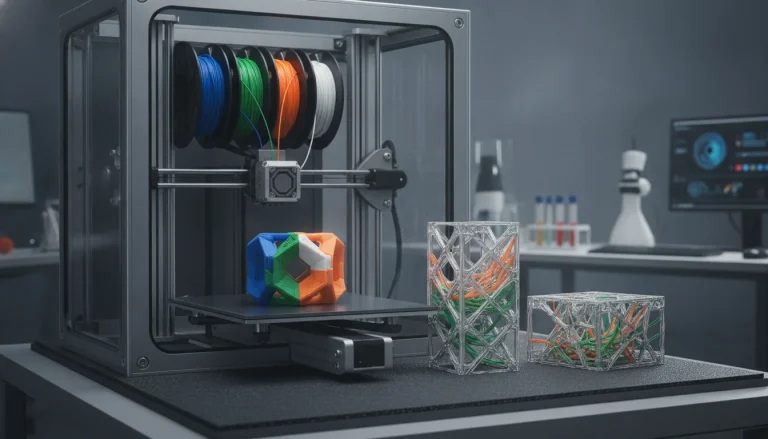
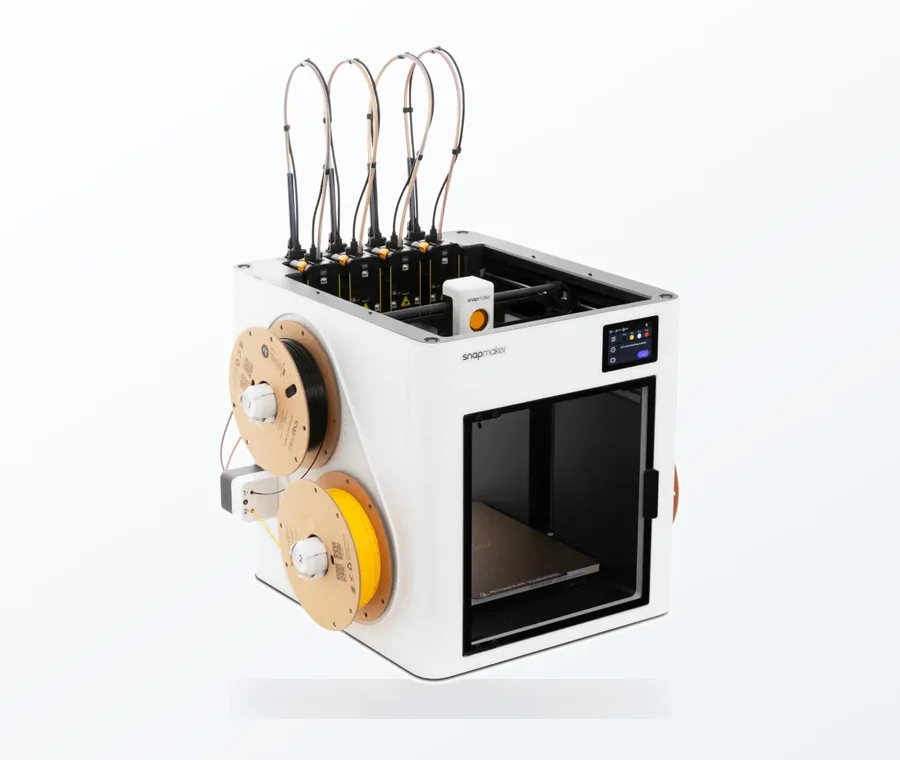
The consumer toolchanger 3D printer: the SnapSwap 4-toolhead system swaps heads in 5 seconds for true multi-color and multi-material printing, with smart calibration and auto filament loading.
- 4 toolheads · 5 s swap
- Up to 500 mm/s · 20,000 mm/s²
- 270 mm cube build volume
- Multi-color & multi-material
Choosing a chemical-resistant material in six steps
- Write down the exact chemical, its concentration, the temperature and how long the part will be in contact (splashes, daily wipes or permanent immersion).
- Check the chart below and the chemical resistance lines in your filament’s technical data sheet (TDS).
- Shortlist materials rated well for that chemical that your printer can actually print.
- Print small test pieces with the same settings as the real part: same walls, infill and layer height.
- Weigh and measure them, then expose them the way the part will be exposed, for at least as long as a realistic use cycle.
- Check again for weight gain, swelling, softening, cracks and brittleness. Try to bend or snap a treated and an untreated piece by hand and compare.
Filament chemical resistance chart (Prusa, 23 °C)
Prusa published an indicative compatibility table for the most common printing polymers, built from its own lab measurements and a scientific publication. Ratings are based on the change in weight and dimensions after immersion at 23 °C:
- A resists very well: under 1% change in weight and dimensions after a week’s immersion.
- B resists moderately to well: 2–3% change.
- C resists poorly: 4–5% change with prolonged exposure.
- D does not resist: over 5% change, severe swelling or destruction.
| Substance | PLA | PETG | ASA | ABS | PC | PA | PP |
|---|---|---|---|---|---|---|---|
| Water | A | A | A | B | A | A | A |
| Isopropyl alcohol 99% | C | B | B | B | B | A | A |
| Ethanol | C | B | B | A | B | A | A |
| Vinegar (acetic acid 8%) | B | A | A | B | A | C | A |
| Diluted bleach cleaner (sodium hypochlorite, 1:10) | B | A | A | – | B | A | A |
| Ethylene glycol coolant | B | A | A | – | A | – | – |
| Hydrochloric acid 37% | C | A | C | C | A | D | A |
| Sulphuric acid 96% | D | D | – | – | D | D | A |
| Acetone | D | C | D | D | C | A | A |
A dash means the combination was not rated. Prusa’s full table also covers salt water, citric acid, hydrogen peroxide, phosphoric and nitric acid and PVB. Prusa itself calls the table indicative and says more extensive testing is needed; treat a single letter as a starting point, not a specification.
What the strength tests showed for PLA, PETG, ASA and PC
Weight change is only half the story. Prusa also printed test bars from its own PLA, PETG, ASA, PC Blend and PVB (100% infill, 2 perimeters, 0.2 mm layers), soaked them in nine household and workshop liquids for 1 hour to 7 days at about 23 °C, then measured tensile strength (ISO 527) and Charpy impact toughness (ISO 179):
- PLA: strength dropped slightly in water, fell quickly in ethylene glycol coolant within 1 hour, and declined gradually in IPA after more than 24 hours. The test bar collapsed in acetone.
- PETG: tensile strength changed by only a few percent in most liquids, but toughness fell noticeably in IPA, vinegar, acetone and coolant. Only water left toughness almost unchanged.
- ASA: held up in water, citric acid, coolant and diluted bleach, lost more strength in ethanol and IPA, and collapsed in acetone.
- PC Blend: the most stable of the five, with little strength loss in most liquids. Acetone was its weak point: strength dropped significantly after 24 hours.
- PVB: softened and partly dissolved in ethanol, IPA and acetone within 1 hour.
Note the mismatch: PETG gets an A for vinegar in the weight-based chart, yet its toughness dropped in vinegar in the strength test. A part can look and weigh the same and still become more brittle. That is why a hand test after soaking matters.
What filament datasheets say about acids, alkalis and oils
Bambu Lab’s technical data sheets include four short chemical resistance lines. They are qualitative, with no concentration or time, but they are useful as a first filter:
| Bambu Lab filament | Acid | Alkali | Organic solvents | Oil and grease |
|---|---|---|---|---|
| PLA Basic, PETG Basic | Not resistant | Not resistant | Not resistant to some | Resistant to most |
| ABS, ASA | Resistant | Resistant | Not resistant to some | Not resistant to some |
| PC | Not resistant | Not resistant | Not resistant to some | Resistant to most |
| PAHT-CF, PA6-CF (carbon-fibre nylon) | Not resistant | Not resistant | Not resistant to some | Resistant to most |
These lines do not always agree with Prusa’s chart (PETG and PC, for example, rate A for 37% hydrochloric acid at Prusa but “not resistant” to acid at Bambu Lab). Different grades, additives and test conditions explain part of that. When two manufacturers disagree, assume the worse rating until your own soak test says otherwise.
Polypropylene for harsh chemicals
PP is the only filament in Prusa’s chart rated A for every substance it was tested with, including 96% sulphuric acid and acetone. Forward AM describes its Ultrafuse PP as standing up to aggressive solvents and acids, and lists 220–240 °C nozzle, 60–80 °C bed and PP tape or a PP adhesive as the build surface. PP barely sticks to ordinary print sheets and tends to warp, so expect some trial and error with bed adhesion.
Nylon: good with solvents, poor with strong acids
Nylon rates A for alcohols and acetone in Prusa’s chart but C for vinegar and D for strong acids and 30% hydrogen peroxide. It also absorbs water from the air, which changes its properties. If you choose it, see printing nylon without warping. For heat plus moderate chemical exposure, polycarbonate settings are the other common route.
Resin prints: Formlabs solvent data
Formlabs tests its resins by weighing and measuring printed, post-cured 1 cm cubes before and after 24 hours of immersion, and publishes the weight gain in percent. Five examples:
| Formlabs resin | Acetone | IPA | Isooctane (gasoline) | Bleach ~5% | Conc. HCl | Water |
|---|---|---|---|---|---|---|
| Clear V5 | 5.1% | 0.3% | <0.1% | 0.7% | 0.5% | 0.9% |
| Tough 2000 V2 | 22.92% | 4.21% | 21.24% | 0.11% | 1.96% | 0.19% |
| Durable V2 | Sample cracked | 5.1% | <1% | <1% | Sample distorted | <1% |
| Rigid 10K | <0.1% | <0.1% | 0% | 0.1% | 0.2% | <0.1% |
| Flexible 80A | 37.4% | 11.7% | 1.6% | 0.6% | 28.6% | 0.7% |
Two practical lessons. Tough and flexible resins absorb far more solvent than rigid ones, so a “tough” resin is not automatically a chemically resistant one (see standard vs tough resin). And several resins take up IPA over 24 hours, which is one reason not to leave prints soaking in the wash; the washing and curing guide covers wash times. Other brands’ resins have their own chemistry, so use their data, not Formlabs’, for your bottle. Formlabs also notes it cannot guarantee that biocompatible materials stay biocompatible after exposure to solvents other than those in its manufacturing guide.
Why a printed part fails sooner than the chart suggests
- Temperature: Prusa notes that chemical degradation of polymers increases exponentially with the temperature of the substance. A room-temperature rating says little about hot water or a warm engine bay.
- Concentration: higher concentration usually speeds up the attack. A rating for 8% vinegar is not a rating for glacial acetic acid.
- Load: a part under stress in an aggressive liquid can crack below its normal yield strength, which Prusa describes as cracks forming and growing into the material.
- Print structure: gaps between lines and layers let liquid into the part. Prusa points out that corrosive substances can penetrate a print and shorten its life, so walls, infill and layer bonding count as much as the polymer.
Common chemical resistance mistakes
- Cleaning ABS, ASA or PLA parts with acetone. It is the substance these materials resist least. It is used on purpose for acetone vapour smoothing, which shows how quickly it softens the surface.
- Reading “chemical resistant” on a spool as a guarantee. Ask which chemicals, at what concentration and temperature. If the datasheet does not say, test.
- Testing only for a few minutes. Several effects in Prusa’s tests appeared after 24 hours or 7 days.
- Using a chemical resistance chart as a food-safety check. Resisting a liquid is not the same as being safe in contact with food. That depends on the material, additives, hardware and regulations; see the food safety checklist.
Frequently asked questions
What is the most chemical-resistant 3D printing filament?
Of the common filaments in Prusa’s chart, polypropylene is the only one rated A for every substance it was tested with, including concentrated sulphuric acid and acetone. It is also one of the harder materials to get to stick and print flat. For specialist chemicals, ask the filament maker for its chemical resistance data.
Is PETG resistant to isopropyl alcohol?
Partly. Prusa rates PETG A for 75% IPA and B for 99% IPA by weight change, but its strength test showed a clear loss of toughness after longer contact with IPA. A quick wipe is a much lighter exposure than those soaks; the losses showed up with longer immersion.
Does acetone dissolve PLA?
In Prusa’s test, a PLA test bar immersed in acetone collapsed, and PLA rates D for acetone in its chart. Acetone attacks ABS and ASA just as badly. PP and nylon are the filaments in the chart that resist it.
Are resin prints chemical resistant?
It depends heavily on the resin. In Formlabs’ 24-hour soak, Rigid 10K gained under 0.1% in acetone, while Tough 2000 gained almost 23% and Durable cracked. Check your resin maker’s solvent data before using a print near fuels or solvents.
Sources
- Prusament: Chemical resistance of 3D printing materials
- Formlabs Support: Solvent compatibility
- Bambu Lab: PLA Basic technical data sheet, PETG Basic technical data sheet and ABS technical data sheet
- Bambu Lab: PC technical data sheet, PAHT-CF and PA6-CF technical data sheets
- Forward AM: Ultrafuse PP