No country we checked has a separate rulebook for 3D printed food. A printed chocolate, protein snack or purée is regulated as ordinary food, and the printer is regulated as food processing equipment. In practice a startup has to satisfy three sets of rules at once: food hygiene and hazard control (FSMA preventive controls or state food codes in the US, Regulation (EC) No 852/2004 in the EU, HACCP-based procedures in the UK), the legal status of every ingredient in the “food ink”, and food contact rules for every printer part the food touches (FDA food contact substance authorisations in the US, Regulations (EC) No 1935/2004 and (EU) No 10/2011 for plastics in the EU).
The hardware is where 3D food printing differs most from a normal kitchen. Capsules, nozzles, pistons and build plates need documented food contact compliance, and they have to be smooth and easy to clean. A consumer filament printer with a stainless nozzle does not meet that standard on its own. This guide covers the US, the EU and the UK, and links the official texts. It is general information, not legal advice: requirements depend on what you make, where and how you sell it, so confirm your plan with your local food authority or a food law specialist.
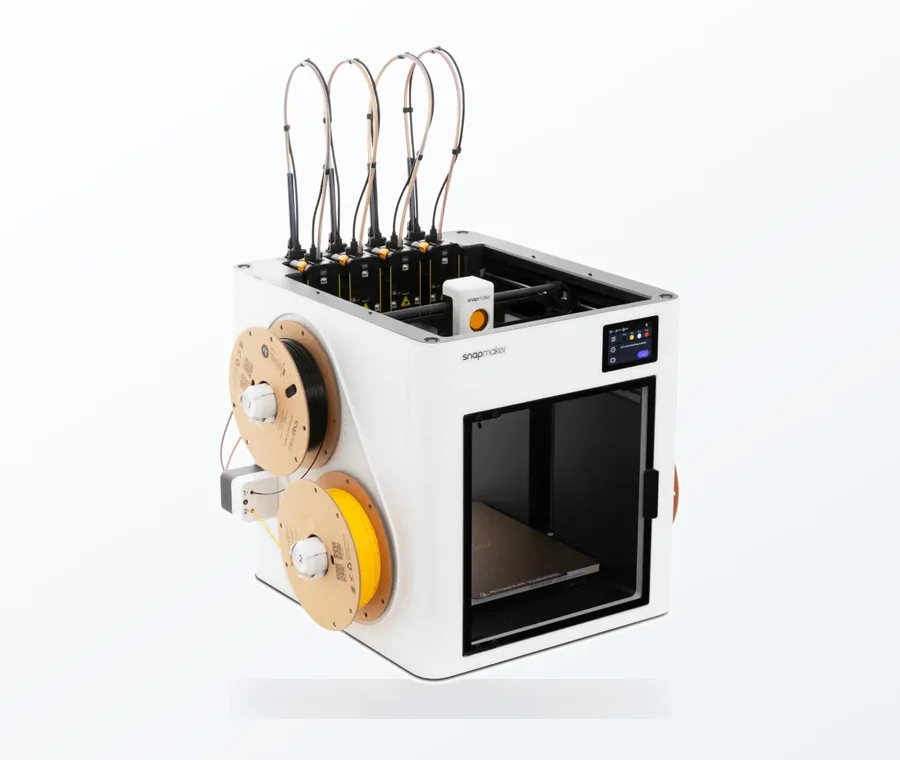
The consumer toolchanger 3D printer: the SnapSwap 4-toolhead system swaps heads in 5 seconds for true multi-color and multi-material printing, with smart calibration and auto filament loading.
- 4 toolheads · 5 s swap
- Up to 500 mm/s · 20,000 mm/s²
- 270 mm cube build volume
- Multi-color & multi-material
Food printing compliance: the short version
- Decide where you sell and what kind of business you are (manufacturer, caterer, restaurant, retailer). That decides which authority regulates you.
- Register the business with the right authority before trading. In England, Wales and Northern Ireland that is at least 28 days before you start.
- Check the legal status of every ingredient in your food inks. In the EU, anything not eaten to a significant degree before 15 May 1997 may be a novel food that needs authorisation.
- Get written food contact documentation for every printer part that touches food, from the printer or parts supplier.
- Write a hazard analysis and food safety plan (HACCP or FSMA preventive controls) that covers capsule filling, printing, post-print handling and storage.
- Label allergens correctly and control allergen cross-contact between capsules and print runs.
Which food safety rules apply in the US, EU and UK
| Topic | United States | European Union | England, Wales, Northern Ireland |
|---|---|---|---|
| Hygiene and hazard control | FSMA Preventive Controls for Human Food rule (21 CFR 117) for facilities that must register with FDA; restaurants and retail follow state or local codes based on the FDA Food Code | Regulation (EC) No 852/2004: permanent procedures based on the seven HACCP principles | HACCP procedures or a HACCP-based food safety management system |
| Registration | Food facility registration with FDA, renewed every other year, for facilities that manufacture, process, pack or hold food for US consumption | Notify the competent authority of each establishment (Art. 6(2), 852/2004) | Register with the local authority at least 28 days before trading; free |
| New ingredients | Check each ingredient’s regulatory status with FDA before use | Novel foods need pre-market authorisation under Regulation (EU) 2015/2283 | In Great Britain, novel foods need authorisation under assimilated Regulation (EU) 2015/2283 through the FSA’s regulated products process |
| Printer parts touching food | Components must be legally authorised: 21 CFR 174–179 regulations, GRAS, prior sanction, threshold of regulation exemption or an effective food contact notification | Regulation (EC) No 1935/2004 for all materials; Regulation (EU) No 10/2011 for plastics | Materials and Articles in Contact with Food Regulations 2012 (separate versions for each nation) |
| Allergens | Nine major allergens, including sesame since 1 January 2023 | Allergens in Annex II of Regulation (EU) No 1169/2011, emphasised in the ingredients list | FSA allergen guidance |
Scotland has its own regulator, Food Standards Scotland; the GOV.UK guidance quoted here applies to England, Wales and Northern Ireland. In the US, the FDA Food Code is a model, not federal law. It only applies once a state, local, tribal or territorial jurisdiction adopts it, and they may amend it, so a caterer or café should check its own health department’s version.
US: FSMA preventive controls in brief
If your facility has to register with FDA, the Preventive Controls for Human Food rule requires a written food safety plan: a hazard analysis (biological, chemical, physical), preventive controls for process, allergens and sanitation, a supply-chain program where a supplier controls a hazard, and a recall plan. Businesses averaging less than $1 million a year in sales (adjusted for inflation) count as very small businesses with modified requirements; check the rule before assuming an exemption.
Food ink ingredients, novel foods and allergens
Printable inks often rely on less common ingredients. Each one needs a legal status check in every market you sell to:
- EU novel foods. The European Commission defines a novel food as food “that had not been consumed to a significant degree by humans in the EU before 15 May 1997”. It needs authorisation under Regulation (EU) 2015/2283 before it goes on sale, and authorised novel foods are listed in the Union list. The printing process doesn’t make a food novel; the ingredients might.
- US allergens. FDA recognises nine major food allergens: milk, eggs, fish, crustacean shellfish, tree nuts, peanuts, wheat, soybeans and sesame. The allergen source has to be declared in the ingredient list, for example “flour (wheat)”, or in a “Contains” statement.
- EU allergens. Regulation (EU) No 1169/2011 requires allergens listed in its Annex II to be emphasised in the ingredients list, for example in bold or a different background colour.
Allergen cross-contact is a real risk with capsule-based printers. If one printhead handles a nut paste in the morning and a nut-free purée in the afternoon, your cleaning procedure between runs is an allergen control and belongs in the food safety plan. For ingredient ideas and their practical limits, see our overview of novel ingredient food inks for savoury dishes.
Food contact rules for 3D food printer hardware
Every part the food touches, including capsules, pistons, seals, nozzles, tubing and the build surface, is a food contact material. The rules work differently on each side of the Atlantic.
EU. Article 3 of Regulation (EC) No 1935/2004 is the core rule. Materials must be made under good manufacturing practice so that, under normal or foreseeable conditions of use, they don’t transfer their constituents to food in quantities that could endanger health, change the food’s composition unacceptably or spoil its taste and smell. Suppliers must keep traceability records. Where a specific measure exists, a written declaration of compliance is required. Plastic parts fall under Regulation (EU) No 10/2011: only substances on the Union list may be used intentionally in plastic layers, and the overall migration limit is 10 mg of constituents per dm² of food contact surface. The European Commission lists specific EU measures for plastics, recycled plastics, ceramics, regenerated cellulose film and active and intelligent materials. For other materials, such as metals and silicones, national rules may apply in addition to the framework regulation.
US. FDA authorises food contact substances by identity, intended use and conditions of use, not whole machines. According to FDA’s guide to regulatory status, a component can be used legally if it complies with a regulation in 21 CFR 174–179, is GRAS, has a prior sanction, qualifies for the threshold of regulation exemption, or is covered by an effective food contact notification (FCN). An FCN is effective only for the manufacturer or supplier named in it, so “the same polymer is approved” doesn’t automatically cover a different supplier’s grade.
Design and cleanability. Where it has been adopted, the FDA Food Code requires food contact materials to be safe, durable, corrosion-resistant and nonabsorbent, and not to let deleterious substances migrate or pass colours, odours or tastes into food (section 4-101.11). Multiuse food contact surfaces must be smooth, free of cracks, pits and crevices, and accessible for cleaning without tools or with common hand tools (4-202.11). The EU hygiene regulation similarly requires equipment that food touches to be effectively cleaned, disinfected and built to minimise contamination risk.
| Printer part | What to check | Documents to ask for |
|---|---|---|
| Plastic capsules, syringes, pistons | Resin grade authorised for your food type and temperature; migration testing for plastics in the EU | EU: declaration of compliance under 10/2011. US: regulatory status letter citing the 21 CFR section or FCN number |
| Nozzles and metal fittings | Corrosion-resistant grade, smooth bore, no brass or plated parts of unknown composition | Material specification; EU: statement of compliance with 1935/2004 and any national rules |
| Seals, O-rings, tubing | Food contact grade elastomer or silicone suitable for fats, acids and cleaning chemicals you use | Supplier compliance statement for the specific compound |
| Build plate or serving surface | Food contact material, smooth and cleanable, safe at printing or cooking temperature | Compliance statement; cleaning and sanitising instructions |
| 3D printed plastic parts made in-house | Layer lines and gaps are hard to reconcile with “smooth, free of crevices”; the filament must also have documented food contact status | Filament maker’s compliance documents, plus your own validation; many operations simply avoid printed food contact parts |
Our reading is that open layer lines on an FDM printed part are the kind of crevices the Food Code rules out; confirm with your inspector. When choosing a machine, see our guide to 3D food printer features for small catering businesses.
HACCP for 3D printed food: where the hazards are
Regulation (EC) No 852/2004 lists the seven HACCP principles: identify hazards, identify critical control points, set critical limits, monitor, take corrective action, verify, and keep records. The FSMA rule follows the same logic under different names. For a printing line, map these steps:
- Ink preparation: supplier approval, allergen segregation, time and temperature of prepared ink.
- Capsule filling: University of Arkansas researchers note that 3D food printing adds capsule loading and post-printing handling to normal food handling, creating more chances for contamination.
- Printing: time the ink sits at room temperature in the printhead, and cleanliness of nozzles and plate.
- Cooking or setting, if any: a kill step needs a validated time and temperature limit and monitoring records.
- Packaging and storage: storage temperature and shelf life.
- Cleaning between runs: disassembly and sanitising of capsules and nozzles, with records. This is also your allergen control.
Storage matters more than it looks. In a 2024 study, Hamilton and Gibson inoculated a protein cookie food ink with about 4 log PFU/g of Tulane virus, a surrogate for human norovirus, and stored it in capsules and as printed food. Fewer virus particles were recovered from capsules after 24 hours at 20 °C, and at 4 °C there was a significant drop between day 0 and day 1. The authors also cite earlier work that found no statistically significant reduction of human norovirus in pizza frozen at −18 °C for 7 and 14 days. Cold storage is not a kill step, so hygiene at filling and printing has to prevent contamination in the first place.
Compliance checklist for a 3D printed food startup
- List products, markets and sales channels, identify the regulator for each, and register before trading.
- Build an ingredient file: specification, supplier, allergens and regulatory status in each market.
- Build an equipment file: every food contact part, its material, the supplier’s compliance document and cleaning instructions.
- Carry out the hazard analysis, set critical limits for time and temperature, and keep monitoring records.
- Write and test cleaning procedures, including full disassembly between products with different allergens.
- Draft labels with ingredients, allergens in the local format, storage conditions and date marking.
- Set up traceability for suppliers and customers, a recall procedure and staff training records.
- Walk your local environmental health officer or health department through the plan before launch.
Common compliance mistakes with 3D food printers
- Treating “food safe” on a product page as proof. Ask for the declaration of compliance (EU) or the specific regulation or FCN the material relies on (US). An FCN only covers the named manufacturer.
- Converting a plastic filament printer. A new nozzle doesn’t change the extruder path, the printed parts or the cleanability of the machine.
- Relying on freezing for safety. Freezing slows spoilage, but the norovirus work cited in the Tulane virus study found no significant reduction after weeks at −18 °C.
- Making health claims for personalised nutrition without checking the claims rules in your market. If you’re planning texture-modified or personalised meals, start with our comparison of 3D food printing and traditional approaches for specific dietary needs.
Frequently asked questions
Do I need FDA approval for a 3D food printer?
FDA authorises food contact substances for specific uses, not finished machines, so there is no single approval for the printer. Each part that touches food must be made from materials that are legally authorised for that use, for example under a 21 CFR regulation, GRAS status or an effective food contact notification. Your food safety plan and your state or local health department then decide whether the equipment is acceptable in your operation.
Is 3D printed food a novel food in the EU?
Not because it is printed. A novel food is food that was not consumed to a significant degree in the EU before 15 May 1997, so the question is about the ingredients. Printing familiar ingredients such as chocolate or vegetable purée doesn’t make them novel, but an unusual protein or extract in the ink might need authorisation.
Can I sell food printed on a standard FDM printer with PLA parts?
It is very hard to justify. The food contact parts would need documented compliance for your specific material grade, and printed plastic has layer lines and gaps that conflict with requirements for smooth, crevice-free, easily cleaned surfaces. Most commercial operations use printers designed for food, with removable capsules and documented materials.
How far ahead do I need to register a food business in the UK?
In England, Wales and Northern Ireland you must register with your local authority at least 28 days before you start trading. Registration is free and can’t be refused. Scotland is covered by Food Standards Scotland, so check its guidance if you trade there.
Sources
- EUR-Lex: Regulation (EC) No 852/2004 on the hygiene of foodstuffs
- GOV.UK (Food Standards Agency): Starting a food business
- European Commission: Novel food
- US FDA: Food allergies
- Hamilton and Gibson, Tulane virus persistence and microbial stability in 3D food ink (Food and Environmental Virology, 2024)