

On-demand 3D printing means making a product only after it is ordered, from a digital file, instead of buying stock in advance. For a small business it swaps inventory for print time: you pay less for storage and unsold stock, and more in machine hours, labour, failed prints and post-processing. It suits small, personalised or hard-to-source items, and it rarely beats mass production for simple items in volume.
This guide covers the three ways to run it (own printers, a service, or both), how to price an order, the pitfalls of customised products (returns law, design licences, marketplace rules, quality), spare parts, and which sustainability claims you can support. It is general information, not legal advice. Rules on returns and selling vary by country, and the sources here are mainly UK and EU law and one marketplace policy.
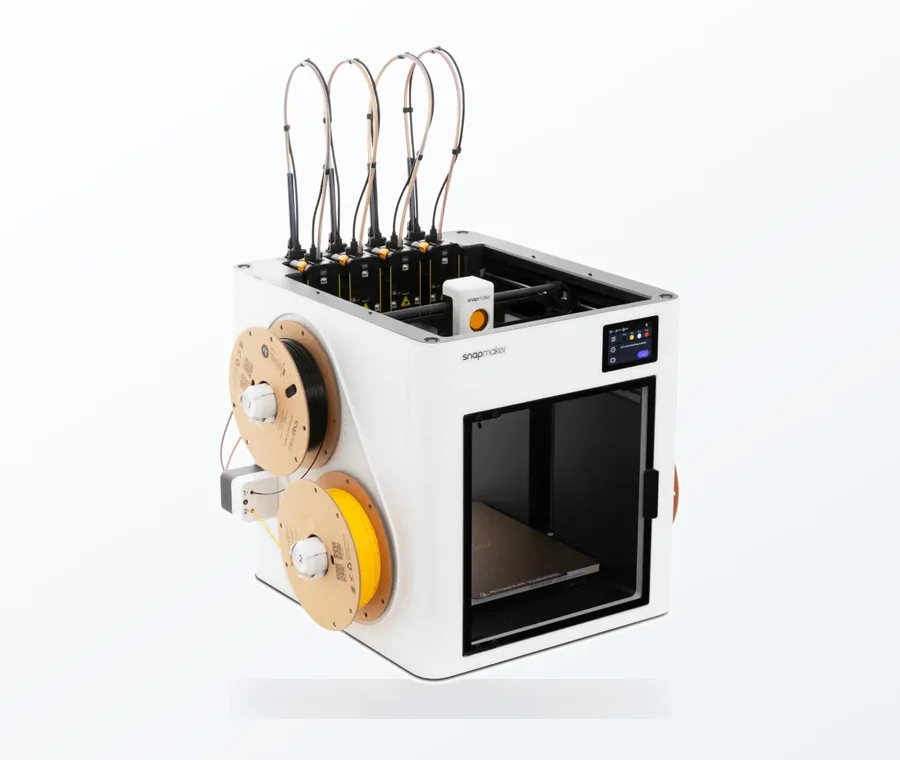
The consumer toolchanger 3D printer: the SnapSwap 4-toolhead system swaps heads in 5 seconds for true multi-color and multi-material printing, with smart calibration and auto filament loading.
- 4 toolheads · 5 s swap
- Up to 500 mm/s · 20,000 mm/s²
- 270 mm cube build volume
- Multi-color & multi-material
On-demand 3D printing in short
- Good fit: personalised items, small batches, prototypes and spare parts that are slow or costly to source.
- Poor fit: simple items you could order by the thousand. A 2017 review found additive manufacturing uses far more energy per unit of material than conventional processes and is favourable mainly for very small batches or redesigned parts.
- Biggest costs: machine time, failed prints, labour for file prep and finishing, and platform fees. Material can be the smallest part.
- Customisation risks: a returns exemption that is narrower than it sounds, licence terms on downloaded designs, and marketplace rules on whose design you may sell.
- Sustainability: make no "eco-friendly" claim without evidence for your product.
Three ways to run it
| Model | What you do | Strength | Weakness |
|---|---|---|---|
| In-house printers | Run your own printers and finish parts yourself | Control of quality, lead time and designs | Capital cost, machine downtime and your own labour. A handful of machines needs a queue system: see print farm software. |
| Outsourced service | Send files to a print service and ship from there or via them | No machines to buy or maintain | Per-part fees, less control over lead time and finish |
| Hybrid | Print most orders in-house, outsource materials or volumes you cannot handle | Flexible when demand spikes | Two quality standards to manage |
When one printer is no longer enough, see when to buy a second printer. To judge whether equipment pays back at your volumes, use the method in industrial printer ROI.
Pricing one order: a worked example with made-up inputs
Price from every cost the order causes, not from filament weight alone. The inputs below are invented for illustration. Replace them with your own printer’s hourly cost, your material price and your labour rate.
| Cost item | How to estimate | Example (assumed inputs) |
|---|---|---|
| Material | Part grams x price per gram | 40 g at 25 per kg = 1.00 |
| Machine time | Print hours x your hourly machine allowance (depreciation, electricity, maintenance) | 3 h at 1.50 per hour = 4.50 |
| Failed-print allowance | A percentage you set from your own failure log | 10% of the above = 0.55 |
| Labour | Minutes for file prep, removing supports, cleaning, packing x hourly rate | 15 min at 20 per hour = 5.00 |
| Platform and payment fees | Check the seller fee schedule of the platform you use | Varies |
| Shipping and packaging | Actual cost for typical destinations | Varies |
In this example the print job itself is about 6 and labour (5.00) is larger than machine time (4.50) and five times the material. The lesson is the structure, not the numbers: a business that prices only filament will lose money on small orders. Keep a log of failed prints for a month before you set the allowance.
Customisation pitfalls and what to do
| Pitfall | Why it happens | What to do |
|---|---|---|
| Customers expect to cancel a personalised order | UK Consumer Contracts Regulations, regulation 28(1)(b), exclude "goods that are made to the consumer’s specifications or are clearly personalised" from the cancellation right. EU Directive 2011/83, Article 16(c), uses the same wording. Commentators note courts have given little guidance on what counts, so the exemption may be narrower than it looks. | State at checkout which items are personalised, and get legal advice for your market. Check separately what applies to faulty goods. |
| Selling prints of designs you did not make | A Creative Commons NonCommercial licence defines commercial use as use "primarily intended for commercial advantage or monetary compensation" | Read the licence of every model. Do not sell prints of NonCommercial designs; buy a commercial licence or draw your own. |
| Marketplace rules change | In June 2025 Etsy updated its Creativity Standards so that 3D printed items must be based on the seller’s original design and are often personalised to a buyer’s specification. Reports at the time said enforcement was unclear. | Read the platform’s current policy before listing, and keep records of your own design work. |
| Inconsistent quality between orders | Layer-by-layer printing means surface finish and dimensions vary between machines, materials and batches | Fix one print profile per product, print a test piece when you change spool or setting, and inspect each part before shipping. See functional household prints for tolerance and wall rules. |
| Customer-supplied files that fail | Meshes with holes or non-manifold edges do not slice reliably | Ask for a file format you can check, and use the STL mesh error checklist before quoting. |
| Products with extra rules | Food contact and children’s products have their own legal requirements | Do not make safety claims for a printed material. For food contact, start with food safety rules. |
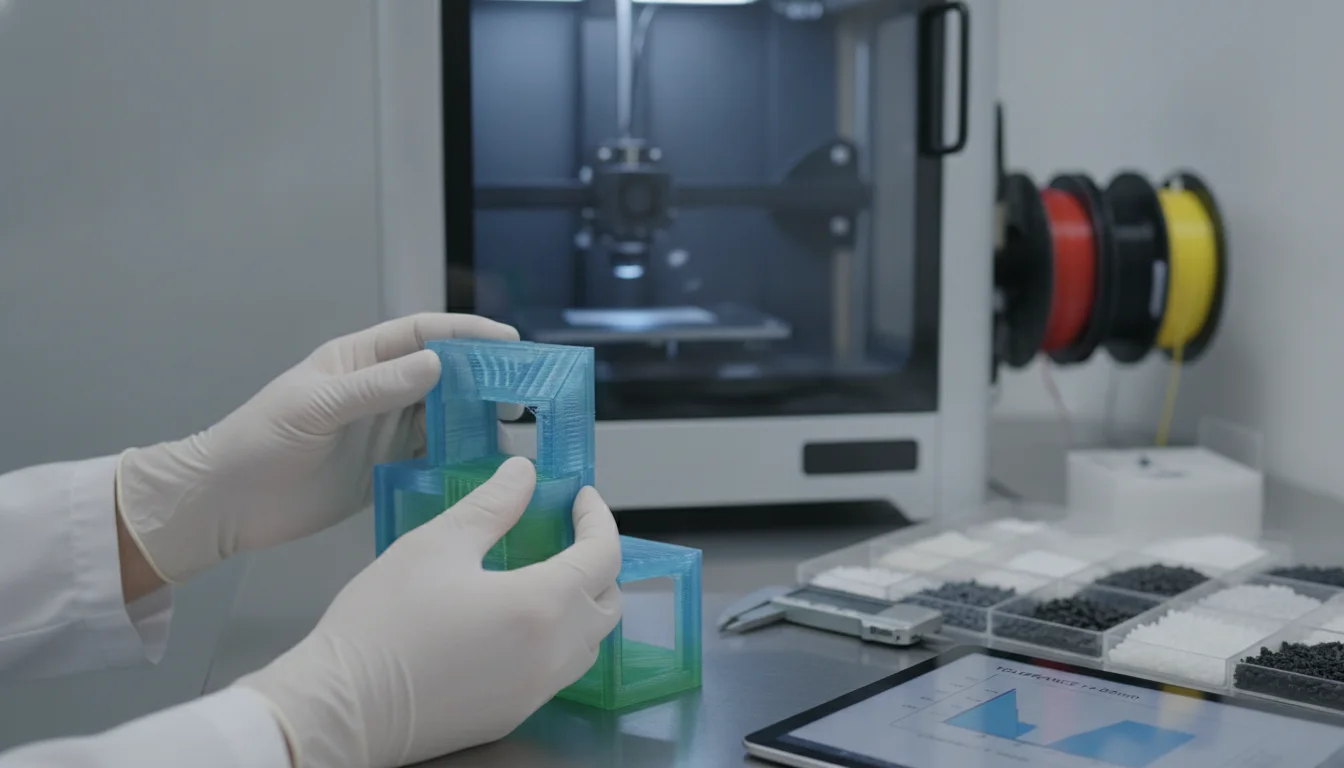
Material choice is part of the quality promise: a part that warps in a car or fades outdoors becomes a complaint. Strong filament options compares what each material is good for.
Spare parts: where on-demand printing earns its place
Spare parts are the clearest case for printing on demand, because demand is unpredictable and the original may be out of stock or discontinued. Deutsche Bahn is a named industrial example: a 2019 trade report described a wheelset bearing cover for a Class 294 locomotive, a model in service for over 50 years, where the original part took about nine months to deliver. DB keeps part designs in a digital spare parts warehouse. That example used a wire-based metal process, not a desktop printer, so it shows the logic rather than a workflow you can copy.
At small-business scale the same logic applies to low-volume plastic parts such as clips, covers, knobs and brackets. Measure and model carefully, and choose a material for the load, heat and moisture the part will see. The replacement vacuum clip walkthrough and the household print design rules show the process. If you sell spare parts for other people’s products, check whether a part is safety-related and whether the manufacturer’s warranty or your liability is affected before you offer it.
Sustainability claims you can and cannot support
A 2017 review in the Journal of Industrial Ecology reports that the specific energy of current additive manufacturing systems is one to two orders of magnitude higher than that of conventional processes. It concludes that additive manufacturing can be environmentally favourable for very small batch sizes, and where a redesign brings functional gains in use, such as lightweight parts or remanufacturing. It also notes that most life-cycle inventory work covers energy only.
- Supportable: printing only what is ordered means no unsold stock of that item. This follows from the method, and it is not a measured environmental saving.
- Not supportable without your own data: "greener than conventional", "carbon neutral", or "eco-friendly" on a product page. PLA being plant-derived does not on its own make a print environmentally better.
- Check your own waste: failed prints, supports and purge material. See recycling PLA and PETG for what is realistic.
Common mistakes
- Pricing from filament weight. Labour and machine time often outweigh material.
- Selling downloaded models without reading the licence. A NonCommercial licence rules out paid sales.
- Promising delivery dates before the first print is finished. Print time plus finishing plus failed attempts is the real lead time.
- Making sustainability claims you cannot document.
- Scaling machines before the process is stable. Fix the profile and the pricing on one printer first.
Frequently asked questions
Is on-demand 3D printing cheaper than buying stock?
Not automatically. You save on storage and unsold stock, but per-unit cost is usually higher than mass production, and labour and failed prints add to it. A 2017 review found additive manufacturing favourable mainly for very small batches or redesigned parts. Work out the full cost per order before comparing.
Can customers return a personalised 3D printed item?
In the UK and EU, the right to cancel a distance purchase does not apply to goods made to the consumer’s specifications or clearly personalised (UK regulation 28(1)(b), EU Directive 2011/83 Article 16(c)). Commentators say the exemption may be narrower than it looks, and other rules cover faulty goods, so get advice for your market.
Can I sell prints of models I downloaded?
Only if the licence allows commercial use. A Creative Commons NonCommercial licence rules out use primarily intended for commercial advantage or monetary compensation. Marketplaces can add their own rules: Etsy’s 2025 update requires 3D printed items to be based on the seller’s original design.
Is 3D printing good for spare parts?
It can be, especially for parts that are discontinued, slow to source or needed in small numbers. Deutsche Bahn’s digital spare parts warehouse is a named industrial example. For small businesses, check fit, material and liability, and avoid safety-critical parts unless you can document the design and testing.
Sources
- Kellens et al. (2017), Journal of Industrial Ecology 21(S1): Environmental dimensions of additive manufacturing
- 3D Printing Industry (June 2019): Deutsche Bahn and GEFERTEC 3DMP spare parts (trade report)
- UK Consumer Contracts Regulations 2013, regulation 28: exceptions to the right to cancel
- Directive 2011/83/EU, Article 16: exceptions from the right of withdrawal
- Creative Commons: Attribution-NonCommercial 4.0 deed
- 3Dnatives (June 2025): Etsy tightens rules on selling 3D printed goods (news report)