
A second 3D printer is worth buying when your first one is the bottleneck in a way a repair or upgrade cannot fix: jobs wait in a queue longer than you can accept, you need a material, size or process the first machine cannot do, or one printer being down stops work that matters. If the problem is poor print quality, a failing part or a missing feature that can be bolted on, repair or upgrade the printer you have first.
This guide is a set of decision criteria, not a ranking. It does not recommend a model or quote prices, which change by region and month. Where we name a printer or software it is only to show a feature, and the fact comes from the maker’s own page. It assumes you already own a printer; if you do not, start with our guide to choosing a first printer on a budget.
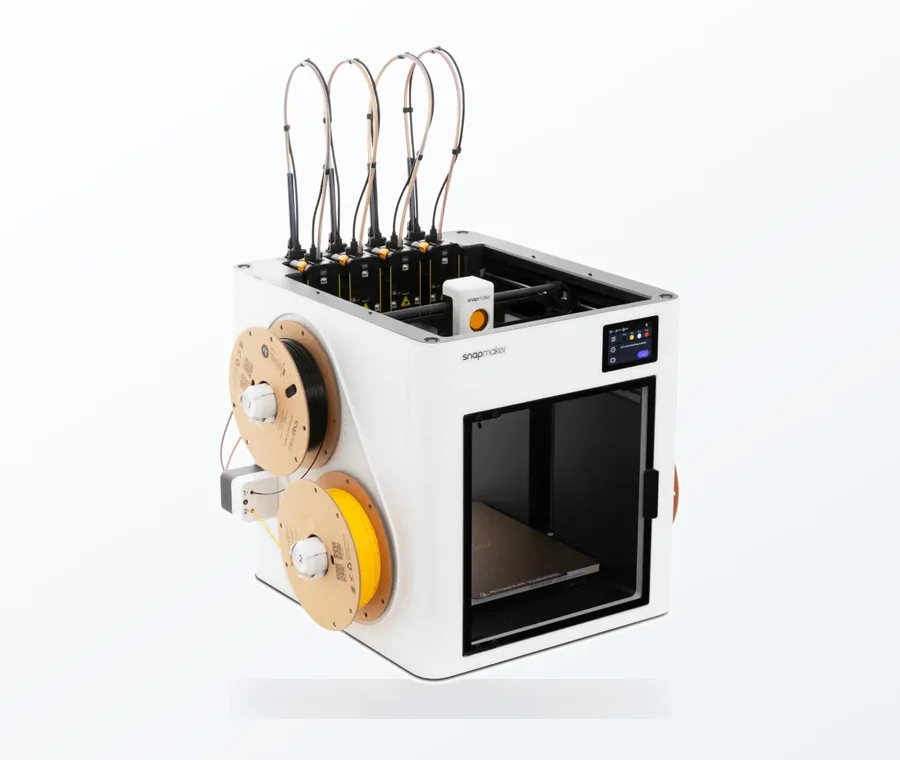
The consumer toolchanger 3D printer: the SnapSwap 4-toolhead system swaps heads in 5 seconds for true multi-color and multi-material printing, with smart calibration and auto filament loading.
- 4 toolheads · 5 s swap
- Up to 500 mm/s · 20,000 mm/s²
- 270 mm cube build volume
- Multi-color & multi-material
Should you buy a second printer? Five questions
- Is the printer busy most of the time and are you waiting on it? If jobs queue for days, capacity is the issue. If it sits idle between jobs, a second printer adds nothing.
- Is the limit the machine or the settings? Failed prints, stringing and layer shifts are usually calibration or maintenance problems that a second printer will repeat.
- Is there a job it cannot do at all? A bigger part, a material outside its rated range, or fine resin detail are reasons to add a different machine.
- What happens when it breaks? If a week of downtime costs you a deadline or a customer, a spare has real value.
- Do you have the space, ventilation and attention for two? More printers mean more filament, spares, noise, fumes and things to watch.
Upgrade, repair or buy a second printer
| Situation | Better move | Why |
|---|---|---|
| Prints fail or look rough, but the printer is otherwise fine | Calibrate and maintain | A new printer will not fix settings you have not learned yet |
| One worn part, such as a nozzle, hotend or build plate | Replace the part | A part costs a fraction of a machine |
| A missing feature that has a retrofit, such as direct drive or a stiffer frame | Upgrade if the frame is sound | You keep a known machine and its profiles |
| A queue of jobs that all suit the printer you own | Second printer, ideally the same type | Capacity doubles without new learning |
| A job needs another material, a bigger bed or another process | Second printer of a different type | It fills a gap instead of repeating what you have |
| Downtime would cost you work | Second printer as backup | No single point of failure |
Reasons that justify a second machine
Queue time and long prints
One printer finishes one part at a time. If a long print blocks small jobs, the cheapest fix is often scheduling, but if you regularly choose what not to print because the printer is occupied, that is the clearest sign you need capacity. Keep a note for two or three weeks of hours printed and hours waiting. If the queue is always longer than you want, a second machine of the same type is the simplest answer: the same slicer profile, the same spare parts and the same material settings.
A material or temperature range the first printer cannot handle
Check the maker’s list of supported materials, not just the maximum nozzle temperature. Some printers are specified for PLA and PETG only. If you need ABS, ASA, nylon or polycarbonate, you need a machine rated for them, and usually an enclosure. ABS in particular is hard to print on an open printer because it warps and needs a stable chamber temperature. Printing the engineering material on a second machine also keeps your everyday PLA printer free.
Bed size
Measure the largest part you printed in the last year. If you split many models into pieces and glue them, a larger bed removes seams. If almost everything fits with room to spare, a bigger machine buys little, and often costs more space and heating time.
Multi-color and multi-material work
Color is the one reason where a second printer may not be the answer, because several systems add multiple materials to a single printer. Compare the options before buying:
- Add a multi-material unit to the printer you have. Our MMU, ERCF and AMS guide covers setup. It keeps one machine, but color changes can still produce purge waste.
- Buy a toolchanger. Snapmaker says its U1 keeps each color or material in its own preheated toolhead and swaps whole toolheads instead of unloading and purging filament. Its page lists four toolheads, a 270 × 270 × 270 mm build volume, a typical swap time of 5 seconds and up to 85% less filament waste than shared-nozzle printers, all from Snapmaker’s own lab tests, so treat them as the maker’s claims. We cover it in our Snapmaker U1 article.
- Buy a second single-material printer if what you really need is speed and capacity, not many colors in one print.
Resin alongside filament
Adding a resin printer is a different step from adding a second filament machine. It gives finer detail on small parts, but it brings liquid resin, washing, curing, gloves and ventilation into your workspace. Read our comparison of FDM and resin printers first, and plan space, ventilation and protective gear before the box arrives. Keep the filament printer: the two technologies suit different parts.
A backup, or a dedicated machine
If you sell prints or depend on them for work, a spare means a repair does not stop you. Some people also dedicate one printer to one material or one nozzle size, so they never swap nozzles or purge between jobs. Both are legitimate reasons, but neither needs the newest machine.
Same model or a different one?
| Choice | Good when | Trade-off |
|---|---|---|
| Same model | The queue is the problem and you are happy with the first printer | You repeat its limits; any design weakness appears twice |
| Same maker, different model | You want shared accessories, slicer and software, with a different size or material range | Parts and profiles overlap only partly; check what is interchangeable |
| Different maker or technology | You need a capability the first printer lacks, such as an enclosure, toolchanger or resin | New software, new spares, new learning curve |
The “overlap” column is reasoning, not a tested result: always check whether nozzles, plates and profiles are actually interchangeable on the maker’s spare-parts page before buying on that assumption.
Running two printers: air, fire and software
Air. A second printer increases what you breathe, not just what you print. NIOSH’s guide to safe 3D printing treats printing in a small workspace or general office area as a higher-exposure activity, and a 2025 review of VOC studies notes that using more than one printer, long print times and poor ventilation can increase exposure. Plan ventilation or an enclosure for both machines.
Fire. Two printers mean two heaters, two power supplies and two things to leave unattended. Work through our 3D printer fire safety guide for both machines, including thermal runaway protection and smoke alarms, before running them in parallel overnight.
Software. Managing two printers by walking between them gets old quickly. Prusa Connect, for example, can be used with any number of printers, gives each registered printer its own print queue and has a timeline showing when each print finishes, according to Prusa’s January 2024 announcement. Other farm tools exist; our print farm software guide compares them.
Costs beyond the printer
- Space and furniture: a sturdy table, plus room to open an enclosure or a lid.
- Spares: a second set of nozzles, build plates and wear parts, unless the models share them.
- Filament and storage: two printers use more spools and you will want somewhere dry to keep them.
- Time: every printer needs maintenance, calibration and checking. Your hours are the cost people forget.
- Price: check the maker’s current price in your region and date any figure you write down; we do not quote prices here because they change.
Common mistakes when buying a second printer
- Buying to escape a problem you have not diagnosed. If the first printer has an unsolved quality issue, the second one will likely develop it too.
- Buying on a headline speed figure. Maximum speed is a ceiling; real print time depends on the model and settings.
- Ignoring the material list. A hotend that reaches a high temperature does not make a printer suitable for every filament.
- Forgetting where it goes. Ventilation, power, noise and fire safety are easier to plan before the box arrives.
- Selling the old printer too early. A spare that still works is often more useful than the sale price, at least until the new machine has proved itself.
Frequently asked questions
When should I buy a second 3D printer instead of upgrading my first?
Buy a second one when the limit is capacity, size, material range or downtime. Upgrade or repair the first one when the limit is a worn part or a missing feature with a retrofit, such as a nozzle, hotend or extruder. If quality problems persist, calibrate first, because a new machine often repeats them.
Should my second printer be the same model as my first?
If the aim is more capacity, the same model is the simplest choice because slicer profiles, settings and spares carry over, but verify on the maker’s spare-parts page that parts really are interchangeable. If the aim is a new capability, such as enclosed printing, a toolchanger or resin, a different machine fills the gap better.
Is a resin printer a good second printer?
It can be, if you need fine detail on small parts. It is a different process, with liquid resin, washing, curing and ventilation to plan for, so treat it as a new workflow rather than a faster filament printer. Keep the filament printer for functional and larger parts.
Do two 3D printers mean twice the fumes?
Not exactly, because emissions depend on material, temperature, enclosure and ventilation, but more printers and long prints do increase exposure, according to a 2025 review of VOC studies. Put both printers in a ventilated space or an enclosure, and treat the setup as one system, not two separate machines.