To calculate the ROI of an industrial 3D printer, compare what the parts cost you today (outsourced, machined or bought in) with the full in-house cost: the printer spread over its useful life, service and software, material, labor and failed builds. Divide the upfront investment by the net monthly saving to get the payback period, and discount the yearly savings to get a net present value (NPV). If the NPV is positive at your company’s discount rate, the purchase pays for itself on paper.
The number that decides the result is utilization: how many useful parts the machine makes per month. In the worked example below, the same $50,000 setup has a negative NPV at 10 parts a month and pays back in about 14 months at 50. The cost structure follows NIST’s review of additive manufacturing costs and Formlabs’ cost guides, and the case study figures come from UltiMaker and Formlabs, all linked at the end. Every number in the worked example is a stated assumption, not a market price.
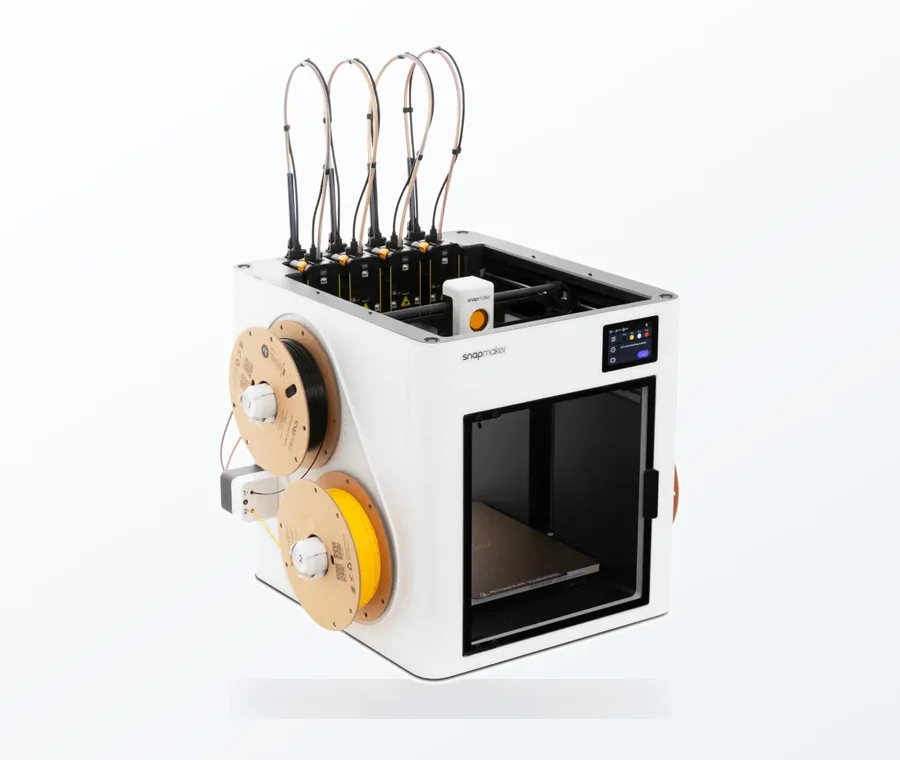
The consumer toolchanger 3D printer: the SnapSwap 4-toolhead system swaps heads in 5 seconds for true multi-color and multi-material printing, with smart calibration and auto filament loading.
- 4 toolheads · 5 s swap
- Up to 500 mm/s · 20,000 mm/s²
- 270 mm cube build volume
- Multi-color & multi-material
ROI calculation in five steps
- List the parts the printer would replace and what each costs today, including shipping and lead time.
- Add up the upfront investment: printer, post-processing equipment, installation, facility changes and training.
- Estimate the in-house variable cost per part: material (with waste), labor time and a reprint allowance.
- Add yearly fixed costs such as service plans and software, then calculate the monthly net saving at a realistic volume.
- Work out the payback, ROI and NPV at low, expected and high volumes before you decide.
The formulas: ROI, payback period and NPV
- Net saving per period = (current cost per part − in-house variable cost per part) × parts per period − fixed running costs per period.
- Payback period = upfront investment ÷ net saving per month. Quick to explain, but it ignores everything after the break-even point.
- Simple ROI = (total net saving over the evaluation period − upfront investment) ÷ upfront investment × 100%.
- NPV = the sum of each year’s net saving ÷ (1 + discount rate)year, minus the upfront investment. Your finance team sets the discount rate; a positive NPV means the investment beats that rate.
- Machine cost per part = (investment ÷ useful life in years + yearly fixed costs) ÷ parts per year. This is the figure most often left out of vendor comparisons.
For useful life, the studies NIST reviews use different assumptions: Hopkinson and Dickens depreciate the machine over eight years, and Atzeni and Salmi assume five. Use the period your accountants apply to comparable equipment.
What goes into the investment and running costs
NIST splits manufacturing costs into two groups. Well-structured costs such as material, labor and machine time are easy to put in a spreadsheet. Ill-structured costs such as build failures, machine setup and inventory are harder to measure, but NIST notes that some of the biggest savings from additive manufacturing may be hidden there.
| Cost item | What to include | How to estimate it |
|---|---|---|
| Equipment ownership | Printer, post-processing equipment, installation, service contract, maintenance | Formlabs: add up all fixed costs over the machine’s life and divide by the number of parts it will produce |
| Material | Filament, resin or powder per part, plus waste and support material | Material per part × price, plus waste. For SLS, Formlabs points to refresh rate: most systems need 30–50% fresh powder per build |
| Labor | Build setup, material changes, post-processing, inspection | Time each step on a sample part and multiply by your loaded hourly rate |
| Failures and reprints | Scrapped builds, operator time lost, delays | Start with an allowance (the example below uses 10%) and replace it with your own scrap rate after a trial period |
| Software and training | Build preparation, fleet management, design-for-AM training | Vendor quotes; include yearly renewals |
| Energy and floor space | Power, ventilation, space | In Hopkinson and Dickens’ model these came to under 1% of part cost, so they were left out; check this for high-power metal systems |
Formlabs’ rule of thumb: the higher the productivity and utilization of the printer, the lower the equipment ownership cost per part. NIST’s review shows the same pattern. In a stainless steel case study (Lindemann et al.), machine costs made up 62.9% of part cost on average across the scenarios, more than material.
Worked example: an in-house printer replacing outsourced fixtures
This is an illustration with round numbers. Replace every assumption with your own quotes and time studies.
- Upfront investment (assumption): $50,000 for the printer, post-processing kit, installation and training.
- Useful life (assumption): 5 years. Discount rate (assumption): 8% a year.
- Fixed running costs (assumption): $5,000 a year for a service plan and software.
- Current cost (assumption): $120 per outsourced fixture.
- In-house variable cost (assumption): $15 material + 0.5 h labor at $40/h = $35, plus a 10% reprint allowance = $38.50 per part.
At 25 parts a month the saving is 25 × ($120 − $38.50) = $2,037.50, minus $416.67 of fixed costs, so $1,620.83 a month or $19,450 a year. Payback is $50,000 ÷ $1,620.83 ≈ 31 months. Over five years the simple ROI is ($97,250 − $50,000) ÷ $50,000 ≈ 95%. Discounted at 8%, the five yearly savings are worth $77,658 today, so the NPV is about $27,700.
| Parts per month | Machine cost per part | Full in-house cost per part | Payback | 5-year simple ROI | NPV at 8% |
|---|---|---|---|---|---|
| 10 | $125.00 | $163.50 (more than outsourcing) | ~126 months, longer than the machine’s life | −52% | −$30,900 |
| 25 | $50.00 | $88.50 | ~31 months | 95% | $27,700 |
| 50 | $25.00 | $63.50 | ~14 months | 339% | $125,300 |
The part, the printer and the prices stay the same in all three rows; only the volume changes. That is why a realistic demand forecast matters more than a precise material price. If you cannot name the parts that make up the monthly volume, the calculation is a guess.
What manufacturers and vendors report
Published case studies help you check whether your assumptions are in the right range. All of these come from printer manufacturers, so they show successful projects, not typical ones.
| Case | What was printed | Reported result | Source |
|---|---|---|---|
| Volkswagen Autoeuropa | Assembly-line tools, jigs and fixtures on 7 FDM printers | Wheel protection jig €800 sourced vs €21 printed; liftgate badge tool €400 and 35 days vs €10 and 4 days; an estimated €150,000 saved in 2016; initial printer investment paid back in 2 months | UltiMaker |
| Pankl Racing Systems | SLA jigs for machining | Machined jig €40–50 (complex ones up to €300) vs €8.50–25 printed; lead time from 2–3 weeks to under a day; more than €150,000 in expected savings | Formlabs |
| Power drill casing prototype | 4 nylon SLS parts | $61.22 in-house (material and labor only) vs $752.50 from a service bureau; positive ROI in just over three months at the pace in the example (five builds a week), or a little over a year if used once a week | Formlabs |
Note what the drill casing figure leaves out: the $61.22 covers material and labor, not the printer. Formlabs itself shows how payback stretches from about three months to more than a year when the machine runs once a week instead of five times. Treat any single payback figure as dependent on volume.
Savings that don’t show up in cost per part
- Lead time. At Volkswagen Autoeuropa a new tool is printed overnight and tested on the line the next morning. If a late fixture stops a line, value that downtime and add it to the benefit side.
- Iteration. Outsourced parts that take weeks to arrive limit you to a few design rounds. Formlabs’ drill casing example compares ten iterations a week in-house with one every two weeks from a bureau.
- Inventory. NIST cites manufacturing inventories equal to 10% of 2011 revenue. Printing spare parts and tooling on demand can reduce stock you would otherwise hold. The guide to on-demand spare parts covers where this works.
These benefits are real but harder to prove. Show them as a separate line in the business case, so the decision does not rest on them alone.
Common ROI calculation mistakes
- Comparing material cost with a quote. A bureau price includes the machine, labor and margin. Your in-house figure has to include the machine cost per part too.
- Assuming full utilization from day one. The cost models in NIST’s review assume high utilization (57% in Ruffo et al., 90% in Hopkinson and Dickens). A new printer rarely starts there. Model a ramp-up.
- Ignoring failed builds. Scrap costs material, labor and machine time. Monitoring helps; see predictive analytics for print failures.
- Picking the wrong process or material. A printer that cannot meet the part’s heat, chemical or strength requirements saves nothing. Check material selection for industrial additive applications before you shortlist machines.
- Using one payback number. Show low, expected and high volume, as in the table above.
When buying a printer isn’t the right move yet
Formlabs, which sells SLS printers, still says outsourcing makes sense for one-off parts or when a company cannot fund a machine. If your volume sits near the break-even row, order the same parts from a service bureau for a few months. You get real data on demand, part performance and labor, and a stronger business case. If demand grows past one machine, plan for fleet software and scheduling early (see software for multi-printer production). For moving beyond tooling to end-use parts, read 3D printing end-use parts in production.
Frequently asked questions
How long does it take for an industrial 3D printer to pay for itself?
It depends mainly on how many useful parts the printer makes each month. Volkswagen Autoeuropa reported paying back its printers in 2 months, while Formlabs shows the same SLS example taking just over three months or more than a year depending on how often the machine runs. Calculate payback at your own low, expected and high volumes.
What is the formula for 3D printer ROI?
Simple ROI is total net savings over the evaluation period minus the upfront investment, divided by the upfront investment. Net savings are the current cost of the parts minus in-house material, labor, reprints and fixed running costs. For large purchases, also calculate NPV so the time value of money is included.
Should machine depreciation be included in cost per part?
Yes, if you compare in-house printing with outsourcing or machining. Spread the investment and yearly fixed costs over the parts the machine will make in a year. Without this, in-house parts look much cheaper than they are, especially at low volume.
Is it cheaper to outsource 3D printing than to buy a printer?
For occasional parts it often is, because you pay nothing when you don’t order. Buying makes sense once steady volume pushes the machine cost per part below the outsourced price and the NPV turns positive. Outsourcing first is also a low-risk way to collect the data for that calculation.
Sources
- NIST Special Publication 1176: Costs and Cost Effectiveness of Additive Manufacturing (Thomas and Gilbert)
- Formlabs: How much does a 3D printer cost?
- Formlabs: How to compare SLS 3D printer prices (in-house vs outsourcing example)
- UltiMaker: Volkswagen Autoeuropa 3D printed tools, jigs and fixtures
- Formlabs: Reducing costs and lead time with 3D printed jigs and fixtures (Pankl Racing Systems)