
Brittle resin prints usually have one of three causes: the resin is brittle by nature once fully cured, the part never reached full cure (and keeps curing later on a sunny windowsill), or the resin was too cold while printing. Post-curing raises strength and stiffness but lowers stretch. Formlabs’ Grey Resin V5 drops from 22% elongation at break straight off the printer to 13% after its recommended 15 minutes at 60 °C. That is normal, not a fault.
So the fix for a part that has to bend or survive a drop is rarely “cure it less”. Choose a resin whose data sheet shows high elongation, print it warm (Phrozen recommends 24–30 °C), and cure it fully to the manufacturer’s settings. This guide shows how to read those numbers, how to tell which cause you have, and what to change. Values come from Formlabs, Liqcreate and Phrozen documentation linked at the end.
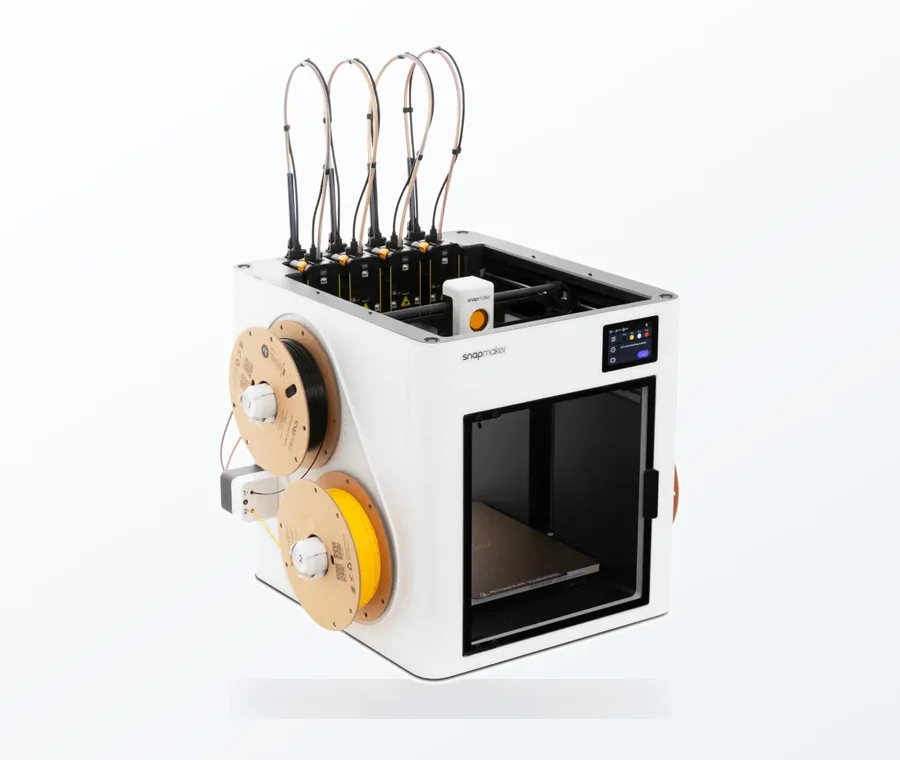
The consumer toolchanger 3D printer: the SnapSwap 4-toolhead system swaps heads in 5 seconds for true multi-color and multi-material printing, with smart calibration and auto filament loading.
- 4 toolheads · 5 s swap
- Up to 500 mm/s · 20,000 mm/s²
- 270 mm cube build volume
- Multi-color & multi-material
Brittle resin prints: the short checklist
- Open the resin’s technical data sheet and check elongation at break. Single-digit or low-teens values mean a stiff, snappy material however you cure it.
- Keep the resin and the room between 24 and 30 °C while printing.
- Wash, then let the part dry completely before it goes under UV.
- Post-cure with the time, temperature and wavelength the resin maker gives, not by guesswork or sunlight.
- Keep finished parts out of direct sun.
- For functional parts, switch to a tough or ABS-like resin instead of under-curing a standard one.
What resin data sheets reveal about brittleness
“Brittle” in data sheet terms means low elongation at break (the part stretches little before it snaps) and little energy absorbed in impact tests. Formlabs publishes values for its resins straight off the printer (“green”) and after post-curing, which shows what curing does to the same material:
| Grey Resin V5 (Formlabs TDS) | Green | Post-cured 5 min, ambient | Post-cured 15 min at 60 °C |
|---|---|---|---|
| Ultimate tensile strength | 46 MPa | 54 MPa | 62 MPa |
| Flexural modulus (stiffness) | 2,000 MPa | 2,450 MPa | 2,750 MPa |
| Elongation at break | 22% | 15% | 13% |
| Notched Izod impact | 36 J/m | 34 J/m | 32 J/m |
Strength and stiffness go up, stretch and notched impact go down. Formlabs puts it plainly: post-cured parts tend to be more brittle than green parts, because as modulus increases, elongation decreases.
An engineering resin follows the same pattern from a much higher starting point. Formlabs’ Tough 2000 Resin V2 goes from 149% elongation at break green to 79% after 12 minutes at 70 °C, while tensile strength rises from 26.1 to 40.4 MPa. Its Gardner impact energy falls from 4.8 J to 1.6 J and flex fatigue life from 11,900 to 3,560 cycles in Formlabs’ test. Even so, 79% elongation is about six times Grey V5’s 13%.
Don’t judge toughness by a single number. Tough 2000 V2’s notched Izod (25 J/m post-cured) is actually lower than Grey V5’s (32 J/m), yet it is the material Formlabs sells for parts that must resist shattering. Look at elongation, impact and fracture data together, and only compare values measured with the same test method.
Under-curing, over-curing and why parts get brittle later
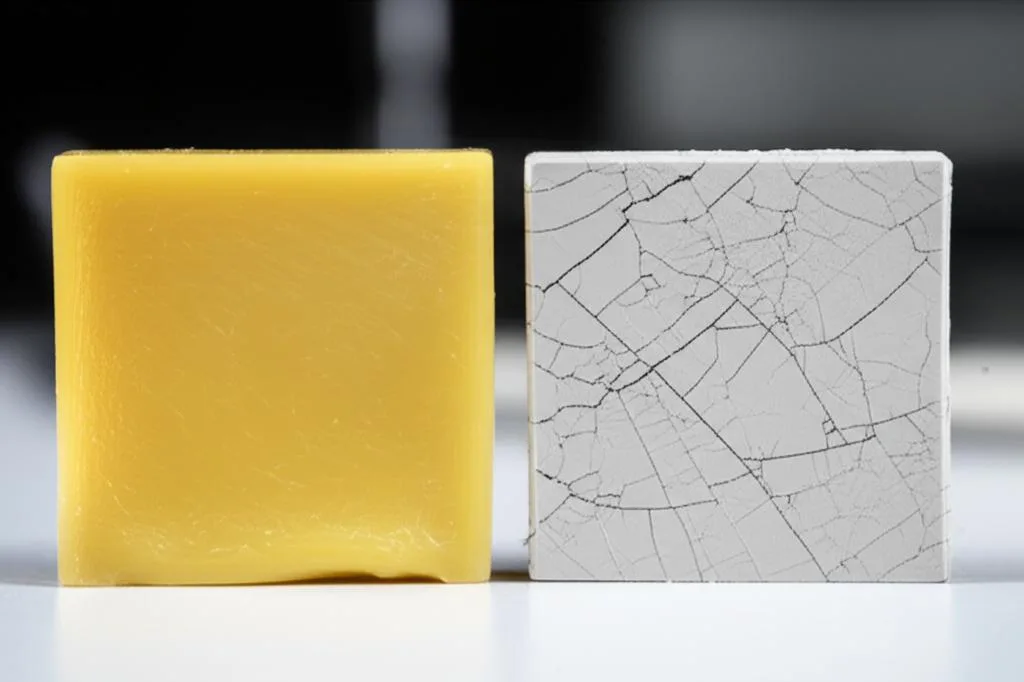
According to Liqcreate, a part leaves the printer at roughly 50–85% polymerisation, depending on the resin and printer. The best mechanical properties usually need more than 95%, which is what post-curing with UV light and heat is for.
Resin makers disagree on how much over-curing matters:
- Formlabs warns that over-cured parts can be undesirably brittle. For Rigid 4000 Resin it notes that curing beyond 15 minutes no longer changes properties but starts to yellow the part.
- Liqcreate argues that true over-curing in a normal curing unit is unlikely. What people call over-curing is usually a resin that is brittle when fully cured, which they under-cure to keep some flex. That part then carries on curing in sunlight or on a desk over weeks and becomes brittle anyway.
Both points lead to the same practical rule: cure to the resin maker’s settings, and if the fully cured part is too brittle for the job, change the resin rather than the cure. Liqcreate also notes that under-cured parts tend to be softer and weaker, and their properties can change over time.
Heat matters as much as light. Formlabs explains that light alone cannot post-cure much beyond the surface, which is why its Form Cure units heat the part as well. Thicker parts may need longer times or higher temperatures. In Liqcreate’s comparison, some entry-level curing boxes without heating could not fully cure its engineering resins even after 120 minutes. There are exceptions in the other direction too: Liqcreate’s longer 120-minute cycle at 60 °C for Strong-X improves heat resistance but makes the resin slightly more brittle. Always use the settings for your specific resin.
Resin temperature and exposure settings
Cold resin is thicker and less reactive, so the same exposure produces weaker layers. Phrozen’s guidance:
| Ambient temperature | Phrozen’s recommendation |
|---|---|
| 24–30 °C (75–86 °F) | Ideal range; most resins perform best above 24 °C |
| 18–24 °C (65–75 °F) | Increase exposure time by 20% |
| Below 18 °C (65 °F) | Printing not recommended; heat the resin or add a heater to the printer |
Phrozen also warns that a fluctuating temperature causes failures, so a heater needs a thermostat that holds a steady value. If you changed resin, room or season recently, re-run an exposure test before blaming the cure. Our exposure time calibration guide walks through it.
Why did this resin print break? Diagnosis table
| What you see | Likely cause | What to change |
|---|---|---|
| Fully cured part snaps cleanly like glass under light bending | Resin with low elongation at break | Switch to a tough or ABS-like resin with much higher elongation on its data sheet |
| Part feels soft or tacky, bends, then cracks | Under-cured or poorly washed (Liqcreate links surface stickiness to oxygen inhibition and incomplete washing) | Wash and dry properly, then post-cure to the resin maker’s time and temperature |
| Part was fine at first, became brittle after weeks near a window | Continued curing from daylight; long-term UV exposure | Cure fully at the start, store out of direct sun, use a tough resin for functional parts |
| Layers split or the print fails in a cold room | Resin below its working temperature | Warm the resin and room to 24–30 °C, or increase exposure as a stopgap |
| Thick parts are hard outside but weak inside | Light-only curing that does not reach the core | Use heat as well as UV, or extend the cure as the resin maker advises for thick parts |
| Engineering resin never reaches its data sheet strength | Curing unit without heating or with too little power | Check the resin maker’s settings for your curing unit; some resins need heated curing |
A post-processing routine that keeps parts tough
- Wash as the resin maker instructs, with the solvent and wash time given for that resin.
- Dry completely. Liqcreate’s sequence is clean, dry, then UV post-cure, so don’t put a part still wet with solvent into the curing unit. Blow out holes and cavities.
- Remove supports carefully. Thin features are easy to crack at this stage; see resin support removal techniques.
- Post-cure to the published settings. Match the time, temperature and wavelength. If your unit has no heater and the resin calls for heat, expect lower properties.
- Turn or flip the part in units without a turntable so every face gets light. This is a general tip rather than a manufacturer instruction.
- Store away from sunlight. Liqcreate notes that months in the sun can over-cure a part and cost it properties.
For the full wash and cure workflow, including sticky surfaces, see resin print washing and curing. Wear nitrile gloves and eye protection throughout; the resin PPE checklist covers the rest.
Design and storage factors
- Thin sections and sharp inside corners concentrate stress. On a stiff resin, thicken load-bearing areas and add fillets where the design allows.
- Hollow parts need drain and vent holes so uncured resin and solvent can get out before curing. Our guide to hollowing 3D models covers placement.
- Windowsills and outdoor use keep adding UV. A part that must live in sunlight needs a resin chosen for it, not just a longer cure.
Common mistakes with brittle resin parts
- Under-curing on purpose to keep flex. It works for a few days, then ambient light finishes the job.
- Curing in the sun. Liqcreate describes sunlight curing as undefined: the amount of UV and heat varies, and so do the results.
- Comparing impact numbers from different tests or different brands’ data sheets as if they were the same scale.
- Printing in a cold garage or basement in winter without warming the resin.
- Expecting a standard resin to behave like ABS. If the job needs impact resistance, read standard vs tough resin before changing anything else.
Frequently asked questions
Can you over-cure a resin print?
Technically yes, but Liqcreate argues it rarely happens in a normal curing unit. Formlabs notes that more curing raises stiffness and lowers elongation, so over-cured parts can be brittle. The safe approach is to use the resin maker’s time and temperature, and to choose a tougher resin if a fully cured part is still too brittle.
Why do resin prints become brittle over time?
A part that was under-cured keeps curing from daylight and room light, so it can turn brittle weeks later. Long exposure to direct sunlight can also cost a cured part some of its properties. Cure fully at the start and store parts away from windows.
What temperature should resin be when printing?
Phrozen recommends 24–30 °C (75–86 °F) and says most resins start to fail below 20 °C. Between 18 and 24 °C it suggests increasing exposure time by 20%, and below 18 °C it does not recommend printing without heating the resin.
Which resin is least brittle?
Look for tough, ABS-like or flexible resins with high elongation at break on the technical data sheet. For example, Formlabs lists 79% elongation for post-cured Tough 2000 Resin V2, compared with 13% for its Grey Resin V5. Compare several properties, not just one impact number.