

Resin printing PPE is the protective gear that keeps liquid photopolymer resin and its wash solvent off your skin, out of your eyes and, when ventilation isn’t enough, out of your lungs. The minimum kit is nitrile or neoprene gloves you change as soon as they get resin on them, sealed goggles or safety glasses, and long sleeves. A respirator is a backup to ventilation, not a replacement for it. If you need one, it has to be a half mask with organic vapour cartridges: an N95 filters particles and does not stop vapours.
Skin is the exposure that matters most for most hobbyists. Typical resin safety data sheets (SDS) carry the warning “May cause an allergic skin reaction” (H317), plus skin and eye irritation. This checklist follows the PPE sections of two resin SDSs, Formlabs’ safety guidance, and NIOSH and UK HSE rules for respirators, all linked at the end. Your own resin’s SDS always takes priority.
The consumer toolchanger 3D printer: the SnapSwap 4-toolhead system swaps heads in 5 seconds for true multi-color and multi-material printing, with smart calibration and auto filament loading.
- 4 toolheads · 5 s swap
- Up to 500 mm/s · 20,000 mm/s²
- 270 mm cube build volume
- Multi-color & multi-material
Resin PPE checklist
- Read the SDS for your resin: sections 2 (hazards), 4 (first aid), 7 (handling) and 8 (PPE).
- Gloves: nitrile or neoprene, fresh for each session, changed immediately after a splash.
- Eyes: tightly sealed goggles when pouring or washing; at least safety glasses for post-processing.
- Skin and clothes: long sleeves or a lab coat or apron you only use for resin work.
- Air: ventilate first. A respirator with organic vapour cartridges is for when ventilation falls short.
- At hand: soap and running water, paper towels, a lidded bin for resin waste, and the SDS.
What resin safety data sheets warn about
Two SDSs from different makers show the pattern. Elegoo’s Standard Photopolymer Resin SDS (2022) and Formlabs’ Clear V4.1 Resin SDS (2024) both list:
- H315 causes skin irritation and H319 causes serious eye irritation.
- H317 may cause an allergic skin reaction (skin sensitisation).
- P280, wear protective gloves and eye protection, and P261, avoid breathing vapours and mist.
Elegoo’s SDS also lists H335, may cause respiratory irritation. Formlabs’ SDS adds that contaminated work clothing should not leave the workplace and must be washed before reuse. Sensitisation is the reason to take gloves seriously: an allergy can develop after repeated contact, and Prusa notes that some resins may trigger a reaction, especially in people with eczema or sensitive skin. Formulations differ, so check your bottle’s SDS rather than relying on these two.
PPE by task
| Task | Main hazard | Gloves | Eyes | Breathing |
|---|---|---|---|---|
| Pouring resin, topping up the vat | Splashes and drips on skin and eyes | Nitrile or neoprene | Sealed goggles | Ventilation; respirator only if ventilation is poor |
| Removing the build plate and parts | Liquid resin on hands and tools | Nitrile or neoprene | Goggles or safety glasses | Ventilation |
| Washing in IPA | Resin and solvent on skin; solvent vapour; flammable vapour | Nitrile or neoprene (Formlabs covers wash solvents too) | Sealed goggles | Ventilation; keep lids closed |
| Removing supports, handling uncured parts | Residual resin; flying support fragments | Nitrile or neoprene | Safety glasses (Formlabs) | Ventilation |
| Cleaning the vat or a spill | Largest skin contact, often for several minutes | Fresh gloves; change as soon as wet | Sealed goggles | Ventilation |
| Sanding cured parts | Dust | Gloves recommended | Safety glasses | Particle filter (N95, FFP2 or better) |
Gloves for resin: material and when to change them
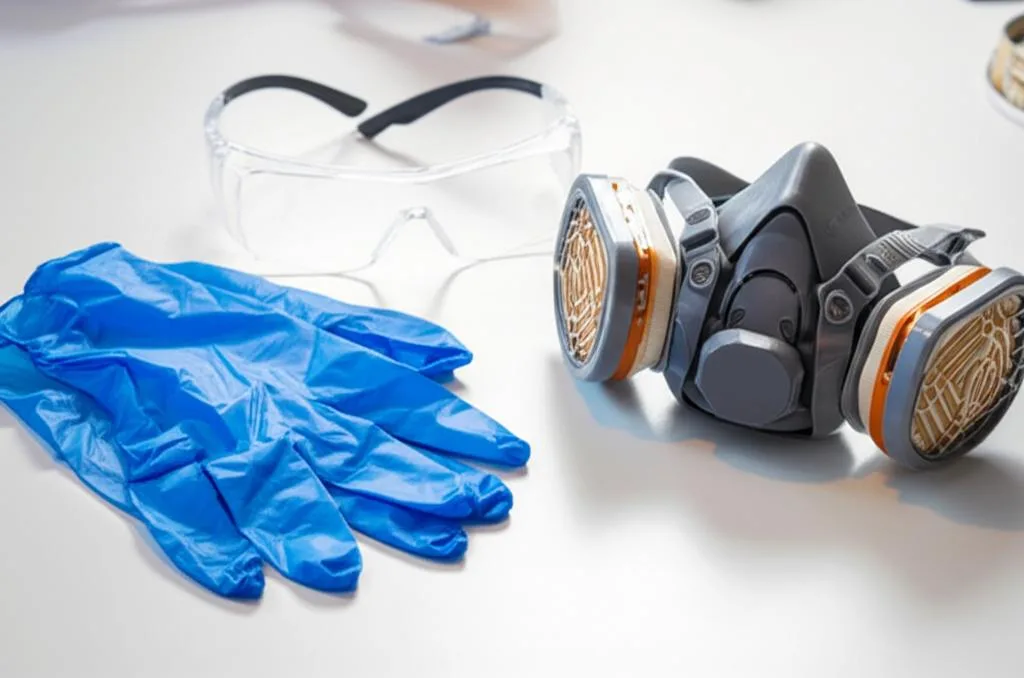
Formlabs tells users to “always wear non-reactive nitrile or neoprene gloves” for liquid resin and wash solvents. The Elegoo SDS is more cautious: it gives no glove material at all, “due to missing tests”, and says breakthrough time has to come from the glove manufacturer. In practice that means:
- Treat disposable gloves as splash protection, not a long barrier. No resin maker we checked publishes a breakthrough time for home resins. The closest data come from dental research: in a 2003 study of 15 medical gloves, the small monomer methyl methacrylate got through every glove material within 3 minutes, and one nitrile glove held back two larger methacrylates for 5.0 and 8.7 minutes. Dental products are not printing resins, but the lesson carries over: change gloves as soon as resin gets on them.
- Use each pair once. Prusa recommends disposing of gloves after every use, or using thick gloves for repeated use, and warns that some gloves may be partly dissolved by isopropanol or resin chemicals.
- Take them off without touching the outside. Formlabs’ SDS asks users to avoid skin contact with used gloves and use proper removal technique. Peel the first glove off inside out, then slide a clean finger under the cuff of the second.
- Inspect before use. The same SDS says gloves must be inspected before use. Pinholes and tears let resin in, and the glove then holds it against your skin.
- For long jobs such as cleaning a vat, thicker reusable nitrile or neoprene gloves, or a double layer, give more margin. Check the glove maker’s chemical resistance data for acrylates and isopropanol.
Latex and vinyl examination gloves are not what resin makers recommend; stick to the materials named by your resin’s manufacturer. If you get resin on your skin, both SDSs say to wash it off with soap and plenty of water. Seek medical advice if irritation or a rash develops.
Eye protection: goggles or safety glasses
- Pouring, washing and cleaning: the Elegoo SDS specifies “tightly sealed goggles”. Resin and IPA are liquids, and a splash can run around the edge of open safety glasses.
- Post-processing: Formlabs recommends safety glasses “particularly during post-processing” against resin, dust and support fragments. Its Clear V4.1 SDS accepts safety glasses or goggles tested to recognised national standards.
- Contact lenses: both SDSs’ eye first aid says to remove them if present and easy to do.
If resin gets in your eye: rinse with plenty of running water for several minutes, removing contact lenses if you can, and keep rinsing. Get medical attention if irritation persists. That is the wording in both SDSs. Formlabs’ SDS also asks for an eyewash station near the work area, which is a workplace requirement; at home, work close to a tap.
Respirators: what they do and don’t protect against
Formlabs says respiratory protection is only needed if the exposure limits in the SDS are exceeded or ventilation is insufficient. Its guidance mentions “an N95 respirator or better”. Be careful with that: NIOSH states that N95 respirators “protect you against particles. They do not protect against gases or vapors.” Resin printing and IPA washing mainly give off vapours, so an N95 does little for fumes. It is useful for sanding dust.
| Respirator | Protects against | Does not protect against | Notes |
|---|---|---|---|
| Disposable N95 (US) or FFP2/FFP3 (EU/UK) | Particles: sanding dust, mist | Gases and vapours | Tight-fitting; needs a good seal |
| Reusable half mask + organic vapour cartridges | Organic gases and vapours, while the cartridge has capacity | Particles, unless a particle filter is added | US: organic vapour cartridges are colour-coded black (OSHA). EU/UK: type A, brown, for organic vapours with a boiling point above 65 °C (HSE) |
| Half mask + combined vapour and particle filter | Vapours and particles | Anything once the cartridge is saturated | Useful if you also sand or spray |
What a respirator can’t do matters as much as what it can:
- It only works if it seals. HSE lists beards, stubble or any hair where the mask seals as a cause of leakage. Every time you put on a reusable mask, do a fit check: cover the filters with your hands and breathe in; the mask should pull towards your face and stay there while you hold your breath for about ten seconds.
- Cartridges run out without warning. HSE explains that vapour filters have a limited capacity; after breakthrough “the RPE offers no protection”. Follow the cartridge maker’s change schedule and change before you can smell or taste the contaminant. HSE’s workplace guidance for low-capacity (class 1) filters is at least every two days, and daily when the substance may cause allergy or breathing symptoms. Treat that as an upper limit for home use, not a target.
- It reduces exposure; it doesn’t remove it. HSE gives a reusable half mask with a gas filter a protection factor of 10, and recommends keeping continuous wear of unpowered tight-fitting masks under an hour.
- It doesn’t protect anyone else. Other people and pets in the room breathe the same air, which is why ventilation comes first.
Ventilation comes before the respirator
Both SDSs ask for good ventilation (Formlabs: “use only with adequate ventilation”), and Formlabs recommends a room with at least three full air changes per hour. An enclosure vented outdoors cuts what everyone in the house breathes; a mask protects one person and only while it is worn and sealed. Our resin printer ventilation guide covers enclosures, carbon filters and fan sizing, so we won’t repeat it here. Keep one rule from it: don’t print or wash in a closet or small closed room. If you ever need a respirator for routine printing, improve the ventilation.
Skin, clothing and workspace habits
- Cover your arms. Long sleeves or a lab coat or apron you keep for resin work. Formlabs’ SDS says to take off contaminated clothing and wash it before reuse.
- No food, drink or phone at the bench. The SDS asks you not to eat, drink or smoke while handling the resin and to wash your hands afterwards and before breaks.
- Protect the surface. A silicone mat or disposable liner makes drips easy to spot and contain.
- Keep IPA away from ignition sources. Formlabs notes that solvents like isopropyl alcohol evaporate quickly and their vapours are flammable, so keep bottles closed.
- Keep containers closed when not in use, as both SDSs require, and store resin away from food.
Common resin PPE mistakes
- Wearing an N95 “for the fumes”. It filters particles only. For vapours you need organic vapour cartridges, and better ventilation first.
- Working for an hour in the same gloves. Resin on a glove is resin working its way through it. Change pairs after every splash.
- Touching door handles, phones and tool grips with resin gloves. This moves resin to places you later touch bare-handed.
- Ignoring a small rash. Redness or itching after resin work can be the start of an allergy. Wash thoroughly, review your glove routine, and get medical advice if it continues.
- Using an old cartridge. If you can smell resin through the mask, the cartridge is spent or the seal leaks.
- Throwing resin-soaked towels and gloves into an open bin. See our guide to resin and IPA disposal.
For the rest of the workflow, see our guides to washing and curing resin prints and resin support removal. Wear gloves until a part is fully washed and cured.
Frequently asked questions
Do I need a respirator for resin printing?
Not if your workspace is well ventilated. Formlabs says respiratory protection is only needed when SDS exposure limits are exceeded or ventilation is insufficient. If you do need one, use a half mask with organic vapour cartridges, fitted properly, and treat it as a stopgap while you improve the ventilation.
Is an N95 mask enough for resin fumes?
No. NIOSH states that N95 respirators protect against particles and do not protect against gases or vapours. Resin and IPA fumes are vapours, so an N95 only helps with dust, for example when sanding cured prints.
What gloves are best for resin printing?
Formlabs recommends nitrile or neoprene gloves for liquid resin and wash solvents. Use disposable gloves once, change them as soon as resin gets on them, and check the glove maker’s chemical resistance data if you handle resin for longer periods.
What should I do if I get resin on my skin?
Wash it off right away with soap and plenty of water, as resin SDSs instruct, and take off any contaminated clothing. Get medical advice if redness, itching or a rash develops. Repeated skin contact can cause a resin allergy, so review your gloves and habits afterwards.
Sources
- Elegoo: Standard Photopolymer Resin safety data sheet (2022, PDF)
- Formlabs: Clear V4.1 Resin safety data sheet (2024, PDF, copy hosted by Northeastern University)
- Formlabs: Safety with Formlabs SLA products
- NIOSH: Types of respirators and masks
- UK HSE: Respiratory protective equipment at work, HSG53 (PDF)