
Computed axial lithography (CAL) is a volumetric 3D printing method: instead of curing a resin layer by layer, it projects a sequence of computed light patterns into a slowly rotating vial of photopolymer, so the whole object solidifies at once. In the original UC Berkeley and Lawrence Livermore paper (Kelly et al., Science, 2019), centimeter-scale objects printed in 30 to 120 seconds with features as small as 0.3 mm. A 2020 EPFL study cut that to under 30 seconds with 80 µm positive and 500 µm negative features.
Those are lab results for small parts in clear, viscous resins, not a desktop product. As of 2026, the volumetric printers you can actually buy are research instruments. Readily3D’s Tomolite, for example, is sold for bioprinting labs with a build diameter of up to 12.5 mm. CAL is fast, needs no supports and can print around existing objects. It also needs transparent resin, is limited to small volumes and still needs post-processing. This guide separates the peer-reviewed results from the marketing claims.
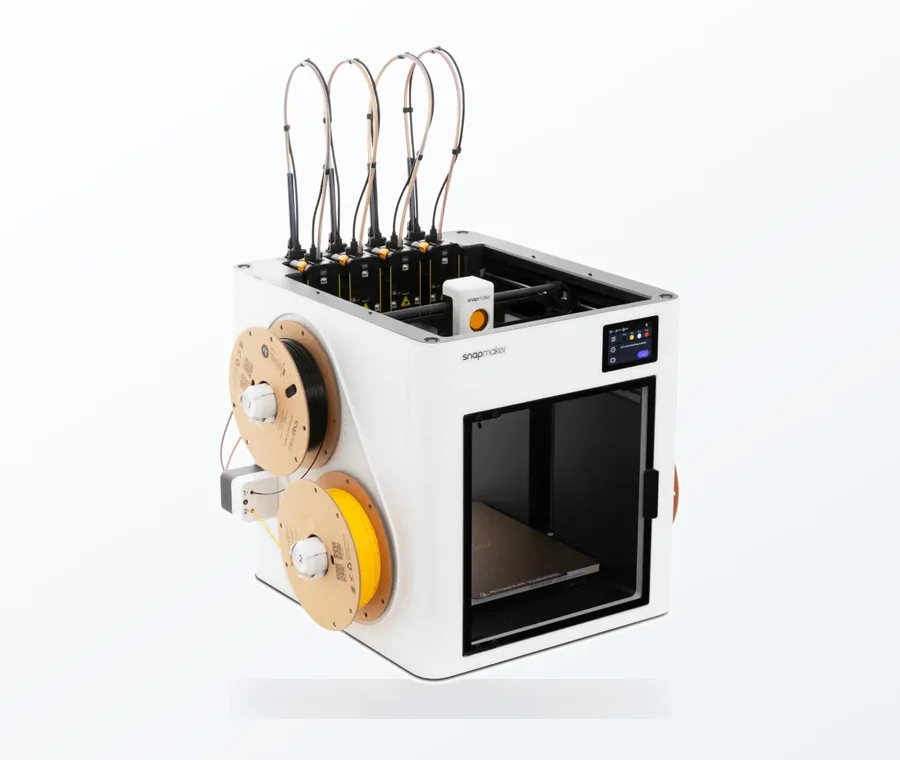
The consumer toolchanger 3D printer: the SnapSwap 4-toolhead system swaps heads in 5 seconds for true multi-color and multi-material printing, with smart calibration and auto filament loading.
- 4 toolheads · 5 s swap
- Up to 500 mm/s · 20,000 mm/s²
- 270 mm cube build volume
- Multi-color & multi-material
CAL in brief: what it can and can’t do today
- Can: print centimeter-scale parts in tens of seconds, with no layers and no support structures.
- Can: use much more viscous resins than layer-based printers, including silicones, hydrogels and glass-filled nanocomposites.
- Can: cure new material around a part that is already in the vial, such as a handle around a metal screwdriver shaft.
- Can’t: work with opaque or strongly scattering resins without special measures; light has to reach the whole volume.
- Can’t (yet): print large parts. Most published prints are a few centimeters across, and light absorption limits the cross-section.
- Not a consumer option: we could not find a hobby-priced CAL printer as of 2026; commercial systems target research labs.
How computed axial lithography works
The researchers describe CAL as computed tomography in reverse. A CT scanner takes X-ray images from many angles and computes a 3D model; CAL starts with the 3D model, computes the images, and projects them back into the resin. The process has these stages:
- Voxelize the model. The STL is converted into a 3D grid that marks where the object is and where it isn’t.
- Compute projections. Software calculates what the object looks like from every angle around the vertical axis. EPFL’s 2020 setup used a projection every 0.6° over 360°, calculated with a Radon transform and then filtered. More recent work uses iterative optimization to reduce stray light outside the part.
- Rotate and project. A cylindrical vial of resin turns while a DLP projector shows the matching pattern for each angle. Berkeley’s first prototype used an off-the-shelf video projector connected to a laptop.
- Build up a light dose. No single pattern is strong enough to cure the resin. Only where the patterns from all angles overlap does the accumulated dose cross the resin’s gelation threshold. In acrylate resins, dissolved oxygen provides that threshold: it inhibits curing until the light has used it up locally.
- Remove and clean. The part is lifted out of the uncured resin and rinsed with a solvent. Depending on the material, further steps follow; the glass parts in the 2022 micro-CAL study were debound and sintered in furnaces.
Because the part is suspended in liquid resin the whole time, it does not need a build plate or support struts, and nothing is peeled away between layers. That is also why print time does not grow with the number of layers the way it does on an SLA, DLP or MSLA printer.
Published speed and resolution figures
The table lists what each source actually reports. Peer-reviewed papers and manufacturer specifications are marked separately, because they are not measured the same way.
| Source | Type | Materials | Print time | Smallest features | Part or build size |
|---|---|---|---|---|---|
| Kelly et al., Science 2019 (UC Berkeley, LLNL) | Peer-reviewed | Acrylate polymers, gelatin methacrylate hydrogel | 30–120 s | 0.3 mm | Centimeter-scale objects; press release: up to four inches in diameter |
| Loterie et al., Nature Communications 2020 (EPFL) | Peer-reviewed | Acrylic, soft silicone | Under 30 s (19.5 s for the Notre Dame model) | 80 µm positive, 500 µm negative | 16 × 16 × 20 mm build volume |
| Toombs et al., Science 2022 (micro-CAL) | Peer-reviewed | Polymer; silica nanocomposite sintered to fused silica glass | About 30–90 s | 20 µm in polymer, 50 µm in glass | Smaller build volume, traded for resolution |
| Zhang et al., Advanced Materials 2025 (NRC Canada) | Peer-reviewed | Methacrylate resin with an amine additive | 54.1 s for 23 small 3DBenchys at once in a 65 mm vial | Not the focus | Structures up to 60 mm; printing validated in a 100 mm vial, a 16-fold increase in volume |
| Readily3D Tomolite | Manufacturer spec | Hydrogels, acrylics, silicones | 30–120 s “indicative” | 14 µm pixel size; “optical resolution below 100 µm” | Build diameter up to 6.3 mm (standard) or 12.5 mm (performance), height 25 mm or more |
A 2023 review of tomographic volumetric printing in MRS Communications sums up the state of the field as “tens of seconds” for centimeter-scale prints, with resolution down to 50–80 µm. The 20 µm micro-CAL result came at the cost of a smaller printable size.
How to read the speed claims
- The times are for small parts. The figures above are for objects a few centimeters across or smaller, or for batches of small parts. Scaling up without losing speed or accuracy is still an active research problem.
- Exposure time depends on the material. Readily3D gives a 30–120 s range “depending on material”. The 2025 NRC study notes that the low photoinitiator levels needed for deep light penetration increase print time.
- Printing is not the whole job. Rinsing, and for ceramics and glass a debinding and sintering cycle, add time that the headline numbers leave out.
Resin requirements: transparency, viscosity and threshold
CAL flips several rules of layer-based resin printing. An SLA or MSLA resin is made to absorb light strongly, so each exposure cures only a thin layer. A CAL resin has to let light reach the whole vial.
- High transparency. The 2023 review calls high optical transparency “a requirement”. Photoinitiators need low absorption but a high polymerization yield.
- Viscous is fine, even helpful. The resin never has to flow back over a layer, so thick formulations work. Earlier volumetric work used resins of 4–93 Pa·s. EPFL found that above 10 Pa·s, parts did not measurably sink during a 20-second print. Resins shrink by 10–15% when they cure, so a freshly cured part is denser than the liquid around it and tends to sink in thin resin.
- A curing threshold. The resin must stay liquid below a certain dose so the stray light outside the part doesn’t cure it. Acrylates get this from oxygen inhibition; thiol-ene resins, which lack it, need a small amount of radical scavenger added.
- Low scattering. Cell-laden hydrogels and filled resins scatter light away from the computed paths. Researchers counter this by matching the refractive indices of the components or by modelling the scattering in the software.
Materials demonstrated so far include acrylates, silicones, epoxies, thiol-enes, polymer-derived ceramics, silica nanocomposites that become glass after sintering, and gelatin-based hydrogels with living cells. Almost all were lab formulations, not bottles you can buy for a desktop resin printer.
Overprinting: curing resin around an existing object
Since the vial is illuminated from the side and nothing moves through the resin, a solid object can sit in the vial while new material cures around it. Kelly et al. demonstrated “components that encase other preexisting solid objects”, and Berkeley showed a handle printed onto a metal screwdriver shaft. Readily3D now lists volumetric overprinting as an upgrade for the Tomolite v2.
This is one of the few ways to combine materials in a volumetric print. For the practical multi-material options on filament and PolyJet printers, see our guide to multi-material gradient 3D printing.
Limits that keep CAL in the lab
- Part size. Light is absorbed as it travels through the resin, which limits the cross-section. Helical and roll-to-roll setups extend the length of parts, but according to the 2025 NRC paper, light attenuation still caps the cross-sectional area. That team also notes that precise glass vials, with tolerances of typically 50–100 µm, get harder to source at larger sizes.
- Resolution tied to optics. The smallest feature can’t be finer than the projected image of one projector micromirror. EPFL showed that the divergence of the light source, not diffraction, set the limit in their system.
- Stray dose and sharp corners. The projections can’t contain negative light, so the surrounding resin always gets some exposure. In the 2020 EPFL prints, sharp corners such as the towers of the Notre Dame model did not print correctly.
- Optical artifacts. Curing changes the resin’s refractive index, which can bend the light and leave striations in the part.
- Computation. The 2025 NRC team downsampled larger prints, typically those over 40 mm long, because of limited computing power.
- Post-processing and shrinkage. Parts still need rinsing. The micro-CAL glass parts shrank by 26% (linear) during sintering, so the models had to be scaled up beforehand.
Commercial status: research instruments, not desktop printers
Readily3D (Switzerland) was co-founded in 2020 by Paul Delrot, who co-invented the volumetric bioprinting method during his PhD at EPFL and co-authored the 2020 Nature Communications paper. Its Tomolite v2 is marketed for biofabrication. Specifications on the product page include a 14 µm pixel size, 405 nm light, sealed glass vials that can be autoclaved, and a footprint of 27 × 30 × 67 cm. The company publishes cell viability figures from its own prints, such as over 95% for human hepatic organoids after 10 days. These are manufacturer data, not independent tests.
Xolo (Germany) sells volumetric printers based on a different method, xolography, published in Nature in 2020. Instead of projecting into a rotating vial, it combines a laser light sheet with projected cross-section images and cures resin only where light of the two different wavelengths intersects, using special dual-color photoinitiators. Xolo’s site claims print times of 5 minutes at most and resolution down to 5 µm; we have not found independent figures to compare.
Open research software exists for labs that build their own setup: the Python library VAMToolbox generates projections and drives the projector, and the original CAL group publishes MATLAB code for education, research and non-profit use. Berkeley’s team filed a patent application on the technique in 2019.
Common misconceptions about volumetric printing
- “CAL works with opaque resins.” The opposite: transparency is required. Berkeley’s opaque prints used a dye that lets through the curing wavelength but absorbs most others, which is a workaround, not a general ability.
- “It will replace your MSLA printer.” Not with current hardware. Build volumes are small, the resins are specialist formulations, and the machines target labs. For detailed parts at home, choosing the right layer height on an MSLA printer is still the practical route.
- “No layers means stronger, isotropic parts.” There are no layer lines, and one thiol-ene study in the 2023 review found isotropic shape-memory behavior. We did not find broad mechanical comparisons against layer-printed parts, so treat general strength claims with caution.
- “Zero waste, no post-processing.” Berkeley’s researchers say the uncured material is reusable, and the micro-CAL team reused surplus resin. Parts still have to be rinsed in solvent and handled as uncured resin. The same precautions apply as with any resin: good ventilation and a proper washing and curing routine.
Frequently asked questions
Is computed axial lithography the same as volumetric 3D printing?
CAL is one type of volumetric 3D printing. It cures a rotating vial of resin with light projected from many angles, a method also called tomographic volumetric additive manufacturing. Other volumetric methods exist, such as xolography, which cures resin where two beams of different wavelengths cross.
Can I buy a CAL 3D printer for home use?
We could not find a consumer CAL printer as of 2026. The commercial tomographic system from Readily3D is sold for biofabrication research, with a build diameter of up to 12.5 mm. The resins also have to be transparent, specially formulated materials rather than standard printer resin.
How fast is volumetric 3D printing?
For small parts, very fast: peer-reviewed studies report 30–120 seconds for centimeter-scale objects in 2019 and under 30 seconds in 2020. Those times are for parts a few centimeters across. Rinsing and any post-curing or sintering come on top.
Does CAL need support structures?
No. The part forms inside the liquid resin, which holds it in place during printing, so overhangs and internal cavities don’t need supports. In low-viscosity resins, parts can sink during printing, which is why researchers usually use thick resins.
Sources
- Kelly et al., Volumetric additive manufacturing via tomographic reconstruction, Science (2019)
- Loterie, Delrot and Moser, High-resolution tomographic volumetric additive manufacturing, Nature Communications (2020)
- Toombs et al., Volumetric additive manufacturing of silica glass with microscale computed axial lithography (Science 2022, preprint)
- Madrid-Wolff et al., A review of materials used in tomographic volumetric additive manufacturing, MRS Communications (2023)
- Readily3D: Tomolite volumetric bioprinter specifications