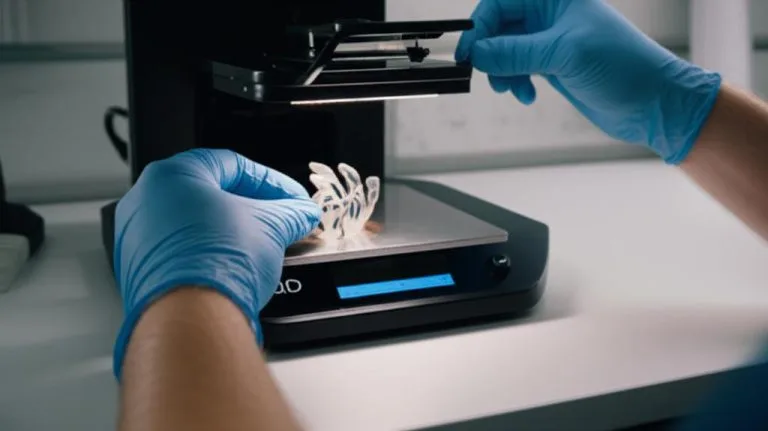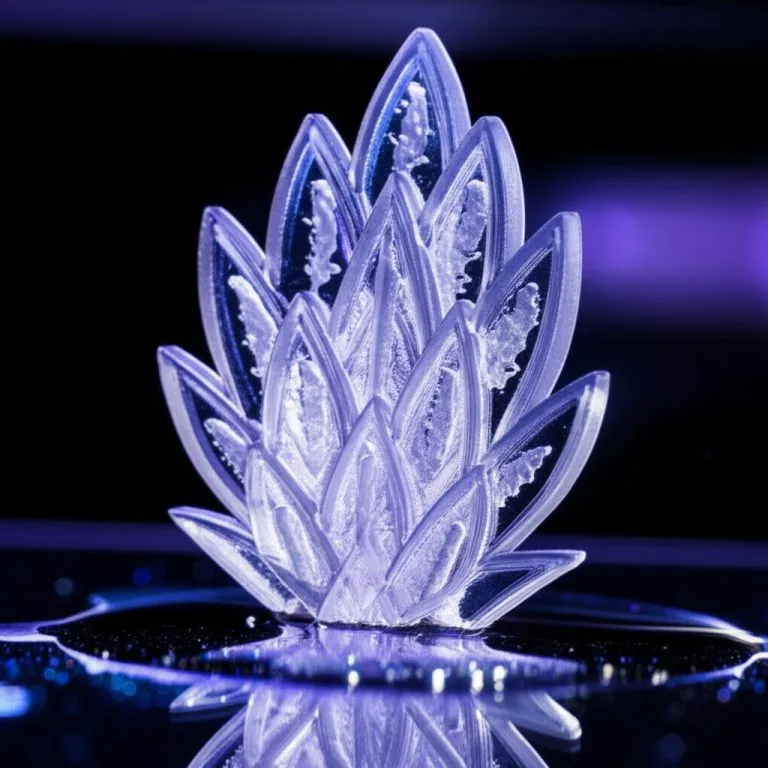

SLA, DLP and MSLA printers all harden liquid photopolymer resin one thin layer at a time. The difference is the light. SLA uses a laser that traces each layer. DLP uses a projector that shows the whole layer at once. MSLA shines an LED backlight through an LCD screen that masks out everything except the layer shape. For most hobbyists buying a first resin printer, the realistic choice is MSLA: it is the cheapest type (Formlabs’ comparison puts low-cost LCD printers at about $200–1,000, as of 2026), it exposes a full build plate as quickly as a single part, and it works with a wide range of 405 nm resins.
What MSLA asks in return is maintenance. The LCD screen and the release film on the bottom of the vat both wear out. Prusa rates the monochrome screen in its SL1S at up to 2,000 hours of printing, against 500 hours for the older RGB screen in the SL1. Anycubic expects a standard FEP film to last about 10,000 layers and its nFEP or ACF films about 30,000. This guide explains what those numbers mean, how resolution and uniformity really differ between the three technologies, and what to check before you buy. The figures come from the Formlabs, Prusa and Anycubic documents linked at the end.
The consumer toolchanger 3D printer: the SnapSwap 4-toolhead system swaps heads in 5 seconds for true multi-color and multi-material printing, with smart calibration and auto filament loading.
- 4 toolheads · 5 s swap
- Up to 500 mm/s · 20,000 mm/s²
- 270 mm cube build volume
- Multi-color & multi-material
Which resin printer type fits you
- First printer, miniatures, props, hobby parts, limited budget: MSLA. It is the most affordable type, and Formlabs notes there are now dozens of low-cost models to choose from.
- You want fewer screen replacements and can accept a smaller build area: a consumer DLP printer. The projector is rated for far longer than an LCD, but affordable projectors have limited pixel counts.
- Professional or production work with a closed material system: professional machines, laser or masked, which Formlabs prices at about $2,500–10,000 (as of 2026). Most hobbyists do not need this tier.
- Any type: budget for a ventilated space, nitrile gloves, eye protection, wash and cure equipment, and replacement film.
How SLA, DLP and MSLA expose each layer
On all three, a build platform dips into a vat with a transparent bottom. Light comes from below and cures a layer against the film, then the platform lifts to peel the layer off and let fresh resin flow in. Only the light engine changes:
- SLA (laser): galvanometer mirrors steer a UV laser across the vat, drawing each layer as a series of points and lines. Formlabs’ laser-based Form 3+ had an 85 micron laser spot and a 25 micron XY resolution.
- DLP (projector): a chip covered in tiny mirrors, called a DMD, reflects light from a few LEDs to project the whole layer image at once. Formlabs notes that most desktop DLP printers have a fixed XY resolution between 35 and 100 microns.
- MSLA or LCD (masked): an array of LEDs lights up an LCD panel, which works as a stencil and blocks light everywhere except the layer shape. The whole layer is exposed at once, like DLP, but the parts are much cheaper. That shift is not limited to budget machines: Formlabs’ own Form 4 is a masked LCD printer with a 50 micron pixel.
SLA vs DLP vs MSLA at a glance
| SLA (laser) | DLP (projector) | MSLA (LCD) | |
|---|---|---|---|
| How a layer is cured | Laser traces the shape | Whole layer projected at once | Whole layer masked by an LCD |
| What limits XY detail | Laser spot size and positioning | Projector pixel count spread over the build area | LCD pixel size and how evenly light passes through it |
| Full plate vs one part | More area to trace means more time per layer | Same exposure per layer | Same exposure per layer |
| Main wear parts | Resin tank or film; laser and mirror optics | Release film; projector (long rated life) | Release film; LCD screen |
| Resin behaviour | Powerful laser suits slower-curing resins | Varies with projector setup | Low-power LEDs suit fast-curing resins |
| Typical price tier | Professional | Consumer and professional | Budget to professional |
The resin behaviour row comes from Liqcreate, a resin maker that explains why a resin tuned for a laser machine may need longer exposure times on an LCD printer. Always check that a resin’s data sheet lists your printer type and wavelength, which is 405 nm on most consumer machines.
Resolution: what the XY number really tells you
On DLP and MSLA printers, XY resolution is simply the width of the exposure area divided by the number of pixels. Larger screen, same pixel count, bigger pixels. Two examples from manufacturer specifications:
- Prusa SL1S (MSLA): a 5.96-inch monochrome LCD with 2560 × 1620 pixels over a 127 × 80 mm area works out to about 50 microns per pixel.
- Anycubic Photon D2 (DLP): a 2560 × 1440 projector over a 130.56 × 73.44 mm area also works out to about 51 microns.
So a consumer DLP and a small MSLA printer can land at the same pixel size. The limit on DLP is the chip: Liqcreate points out that affordable DMD chips are usually 1920 × 1080 pixels, so a bigger build area quickly means coarser pixels. MSLA scales more easily, because a manufacturer can fit a larger or denser LCD.
Smaller pixels are not automatically sharper parts. In Formlabs’ published comparison, its 50 micron Form 4 placed 95.5% of the measured surface within 50 microns of the design, while a competing printer with 28 micron pixels managed 53.9%. That is a manufacturer testing its own product, so treat the numbers with caution. The general point still holds: Formlabs attributes accuracy to how evenly and directly the light reaches the resin, to temperature and to mechanical repeatability, not just to pixel count. Formlabs also notes that no printer can make a positive feature as small as a single pixel. The same article names layer thickness as one of the main drivers of surface finish; for that side of the question, see our guide to resin layer height for miniatures.
Uniformity across the build plate
A printer that cures the centre of the plate well and the corners poorly gives you parts that fit in one position and not in another. Each technology has its own weak spot:
- DLP: Formlabs lists pixel distortion at the edges of the build area as one of the things that affects DLP accuracy. Anycubic advertises light uniformity of more than 92% for the Photon D2 projector, which shows manufacturers measure and correct for it.
- MSLA: the LCD only masks the light, so the backlight has to be even. Formlabs describes the ideal as light that is uniform through every pixel and does not spread as it passes through. Designs differ: Prusa moved from a V-shaped reflector in the SL1 to a lens system in the SL1S, and the Form 4 uses 60 LEDs behind a lens array.
- SLA: a single laser spot is steered across the vat, so there is no grid of pixels. Consistency depends on the optics and calibration of the mirror system.
Pixel edges also create a stepped outline on curves. Slicers smooth this with anti-aliasing, which varies the light at the edge pixels; our guide to anti-aliasing and grayscale settings covers how to use it.
Print speed: whole layers vs laser scanning
DLP and MSLA expose the entire layer in one go, so ten parts take about as long per layer as one. Total time depends mostly on the height of the tallest part and on each layer’s exposure and peel time. A laser has to draw every cross-section, so the more of the plate you fill, the longer each layer takes.
Within MSLA, the screen type matters a lot. Prusa’s comparison of its two printers shows the jump from an RGB to a monochrome screen with a stronger LED array:
| Prusa printer | Screen | Layer exposure | Tilt (peel) time | Rated screen life |
|---|---|---|---|---|
| SL1 | 5.5-inch RGB, 2560 × 1440 | 6–8 s | 5–8 s | 500 hours |
| SL1S Speed | 5.96-inch monochrome, 2560 × 1620 | 1.4–2.5 s | 3 s | 2,000 hours |
If you are offered an older RGB-screen machine second-hand, expect longer exposures and more frequent screen replacements than on a monochrome model.
Consumables: LCD screens, FEP and PFA films, projectors
| Part | Which printers | Published lifetime | What to check before buying |
|---|---|---|---|
| Monochrome LCD screen | MSLA | Up to 2,000 hours (Prusa SL1S); 2,000 hours in Anycubic’s comparison; Formlabs rates the Form 4 light processing unit at 600,000–1,900,000 layers | Price and availability of a replacement screen, and whether you can fit it yourself |
| Standard FEP release film | Most vats | About 10,000 layers (Anycubic) | Whether the vat takes standard film or needs a proprietary part |
| nFEP (PFA) or ACF release film | Many newer vats | About 30,000 layers (Anycubic) | Compatibility with your vat; Phrozen describes ACF as smoother, with less suction force than PFA and FEP |
| DLP projector | DLP | 20,000 hours claimed for the Anycubic Photon D2 | Build area and pixel size, since the projector is fixed |
These are manufacturer figures, not guarantees. Anycubic’s own note says a film that has reached its layer count but is undamaged does not have to be replaced. A film that is punctured and lets resin leak onto the screen must be replaced straight away. On MSLA machines, cured resin on the LCD is the most expensive way to find out that the film was worn. Formlabs also notes that generic LCD panels are not made for the conditions inside a 3D printer and have a reputation for a short lifetime.
Mistakes to avoid with a first resin printer
- Buying on the “K” number alone. Pixel count means little without the screen size, and pixel size alone does not predict accuracy.
- Ignoring running costs. Price the replacement screen, a pack of release film and a year of resin and IPA before comparing printers.
- Using the wrong resin. Check the wavelength and printer types on the data sheet, and start from the resin maker’s profile for your model.
- Planning no space for it. All three technologies release vapours during printing, washing and curing. Read our resin printer ventilation guide and the resin PPE checklist before the printer arrives.
- Choosing resin when FDM would do. For large, functional or low-maintenance parts, a filament printer may suit you better. Our FDM vs resin comparison covers that decision.
If you are comparing the technologies for a specific professional use, our article on SLA versus DLP for dental applications looks at that case.
Frequently asked questions
Is MSLA the same as SLA?
No. Both cure resin with light, but SLA draws each layer with a laser, while MSLA exposes the whole layer at once through an LCD mask. Manufacturers often give their technology their own name, and many LCD printers are marketed simply as SLA, so check the light source in the specifications.
Which is better for miniatures, DLP or MSLA?
Both can print detailed miniatures, and a consumer DLP can have the same pixel size as a small MSLA printer. MSLA offers more choice of build sizes and resolutions. A DLP projector lasts longer, but the pixel size is fixed by the projector and the build area.
How long does an LCD screen last in a resin printer?
Manufacturers publish very different figures. Prusa rates the monochrome screen in the SL1S at up to 2,000 hours of printing and the older RGB screen at 500 hours, and Formlabs rates the Form 4 light unit at 600,000–1,900,000 layers. Protecting the screen with an intact release film and screen protector avoids early damage from leaked resin.
How often should I replace FEP film?
Replace it whenever it is punctured, deeply scratched or cloudy enough to cause failed prints. Anycubic’s layer counts, about 10,000 layers for FEP and 30,000 for nFEP or ACF, are a guide for planning rather than a hard limit.
Sources
- Formlabs: SLA vs. DLP vs. MSLA vs. LCD, guide to resin 3D printers
- Formlabs: How pixel size impacts accuracy, feature size and surface finish
- Prusa Knowledge Base: Original Prusa SL1 vs. SL1S Speed
- Anycubic Wiki: FEP film damaged or at the end of its expected usage life
- Anycubic: Photon D2 DLP 3D printer specifications