Resin printers give off very few particles but a lot of volatile organic compounds (VOCs). UL’s Chemical Insights Research Institute found 40 different VOCs during printing, 34 during washing and 42 during curing, with total VOC emission rates 3 to 6 times the average for filament printers. Ventilation for a resin printer is therefore about moving vapour out of the room, not catching dust.
The practical order of preference is: extract at the source (an enclosure or hood vented outdoors), keep the room itself well ventilated (Formlabs asks for at least three full air changes per hour), and sit away from the printer. In a 2025 study with a Formlabs Form 2, moving the measuring point from 0.5 m to 2 m cut total VOCs by 71%, and an extraction hood with carbon and HEPA filters cut them by 84%. A HEPA-only air purifier does not remove vapours. This guide covers each option, how to size a fan, and what resin safety data sheets ask for.
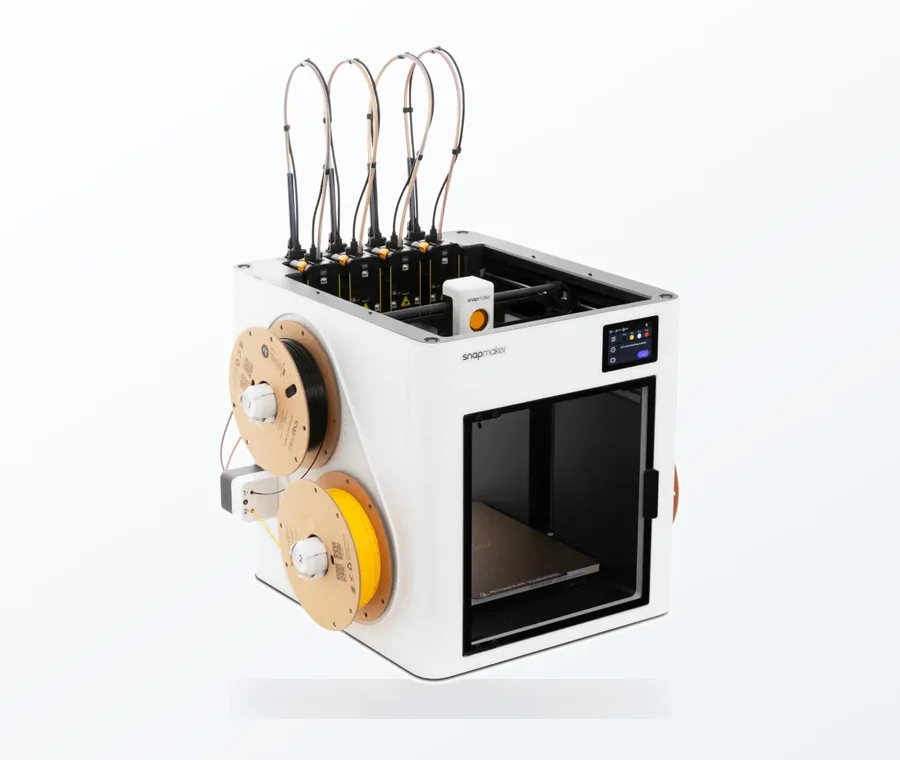
The consumer toolchanger 3D printer: the SnapSwap 4-toolhead system swaps heads in 5 seconds for true multi-color and multi-material printing, with smart calibration and auto filament loading.
- 4 toolheads · 5 s swap
- Up to 500 mm/s · 20,000 mm/s²
- 270 mm cube build volume
- Multi-color & multi-material
Resin printer ventilation: the short version
- Never run a resin printer or wash station in a closet or small closed room.
- Put the printer in a room with good air exchange; Formlabs’ baseline is three or more air changes per hour.
- Best: an enclosure or hood with a fan ducted to the outdoors.
- If you can’t vent outside: an enclosure or hood with a thick activated carbon filter, plus room ventilation.
- Keep lids closed on the printer, wash tank and resin bottles, and don’t sit right next to the machine.
- Read your resin’s safety data sheet (SDS) and follow its handling and PPE sections.
What resin printers actually emit
Two independent studies give a consistent picture.
UL Chemical Insights (2021) tested an enclosed desktop SLA printer with a clear resin, a 15-minute IPA wash and a 10-minute cure in a 1 m³ test chamber:
- Particle levels stayed close to the chamber background, below 100 particles per cm³. Filament printers under the same conditions typically reach 1,000 to 100,000.
- 2-Hydroxypropyl methacrylate, a resin ingredient, was among the top emitters in every step.
- Isopropanol made up over 97% of VOC emissions during washing, and was still high during curing because the washed part carried it into the curing unit.
- Formaldehyde was detected in all three steps at 0.01 mg/h or lower. Emission rates were below the limits in the ANSI/CAN/UL 2904 standard, but the researchers note that the mix of alcohols, aldehydes and acrylates could still cause strong irritation.
University of Leicester and UK HSE researchers (2025) measured a Formlabs Form 2 with four resins:
- VOC emissions peaked at the end of printing, when the build plate rose out of the resin.
- In a small, poorly ventilated test chamber, total VOCs exceeded 128,000 μg/m³, and some methacrylate concentrations exceeded the UK workplace exposure limits the authors used as a benchmark.
- In a ventilated room of about 120 m³ with roughly one air change per hour, total VOCs reached 45–116 μg/m³ at 50 cm from the printer and returned to baseline within 2 hours after printing ended. Individual VOCs were well below workplace limits.
- Many of the compounds have no published exposure limits, so the authors say their acute and chronic health effects remain unknown.
The takeaway is not panic but room size and airflow. The same printer that produced modest levels in a large ventilated room produced far higher concentrations in a small enclosed space.
What resin safety data sheets ask for
Every resin comes with an SDS; read yours, because formulations differ. As an example, Elegoo’s 2022 SDS for its Standard Photopolymer Resin classifies it as:
- H315 causes skin irritation, H319 causes serious eye irritation, H317 may cause an allergic skin reaction, H335 may cause respiratory irritation.
- Precautions include P261 “Avoid breathing dust/fume/gas/mist/vapours/spray” and P280, wear protective gloves and eye or face protection.
- Handling section: “Ensure good ventilation/exhaustion at the workplace.” Eye protection: tightly sealed goggles.
The skin sensitisation warning (H317) is the reason gloves matter as much as airflow. Formlabs recommends nitrile or neoprene gloves for handling liquid resin and wash solvents, and says respiratory protection is only needed when exposure limits in the SDS are exceeded or ventilation is insufficient. Our resin PPE checklist covers gloves, eyewear and respirator choice.
Ventilation options compared
| Setup | What it does to vapours | Limits | Evidence |
|---|---|---|---|
| Enclosure or hood ducted outdoors | Captures at the source and removes vapours from the building | Needs a window or wall outlet; replacement air has to come in from somewhere | EPA: removing sources and ventilating with outdoor air are the most effective ways to improve indoor air |
| Enclosure or hood with carbon and HEPA filters, recirculating | Captures at the source; carbon adsorbs VOCs, HEPA catches particles | Carbon saturates and must be replaced; filtered air returns to the room | 84% lower total VOCs at 50 cm in the 2025 Form 2 study |
| Room ventilation (window exhaust fan, HVAC) | Dilutes and removes vapours from the whole room | You still breathe the air near the printer before it is diluted | Formlabs: at least three air changes per hour |
| Distance | Reduces the concentration you breathe | Only works in a ventilated room | 71% lower total VOCs at 2 m than at 0.5 m in the same study |
| Portable air purifier with activated carbon | Adsorbs some gases from room air | No widely used rating for gas removal; needs a large amount of carbon | EPA guide to air cleaners |
| HEPA-only air purifier | Catches particles, not vapours | Resin printers emit few particles, so it does little here | EPA; UL particle results |
| Open window, no fan | Some dilution | Depends on wind and weather; no directed airflow | No specific data for resin printers |
Avoid air cleaners that intentionally produce ozone. The EPA describes ozone as a lung irritant and advises against these devices.
How to build a vented resin enclosure
The common home setup is a cabinet, box or small grow tent around the printer and wash/cure station, with an inline duct fan pulling air out through a window adapter. The steps below are general good practice rather than a manufacturer procedure; check your printer’s manual for clearance and heat requirements.
- Enclose the whole workflow. Printing, washing and curing all emit VOCs, and in UL’s tests isopropanol made up over 97% of the VOCs from washing. If the wash station sits outside the enclosure, it needs extraction too.
- Put the fan on the outlet side so the enclosure runs at slightly lower pressure than the room. Leaks then pull room air in instead of pushing fumes out. A strip of tissue at a door gap should lean inward.
- Keep ducting short and straight and seal every joint with foil tape. Each bend, extra metre and filter reduces the airflow a fan actually delivers compared with its rating.
- Vent outdoors, away from air intakes, open windows and neighbours.
- Allow make-up air. Air leaving the room must be replaced; a slightly open door or window elsewhere is enough for a small fan.
- Keep the resin warm. Pulling cold outside air through the enclosure can chill the resin, so leave a gap between the fan and the vat, or add a thermostat-controlled heater rated for the space.
- Keep ignition sources away from IPA. Isopropyl alcohol is highly flammable. Store it closed, and don’t place heaters or non-rated electrics next to an open wash tank.
Sizing the fan: air changes per hour
Airflow needed = room or enclosure volume × air changes per hour (ACH). In imperial units, divide by 60 to get CFM:
- Room example: a 10 × 12 × 8 ft room is 960 ft³. At Formlabs’ minimum of 3 ACH that is 2,880 ft³ per hour, or 48 CFM. In metric, a 3 × 4 × 2.5 m room (30 m³) needs 90 m³/h.
- Enclosure: we could not find a manufacturer or regulator figure for home resin enclosures. The goal is steady inward airflow at every gap and opening. Choose a fan with speed control, so you can set it high enough that the tissue test shows inward flow without pulling so much cold air that the resin cools.
If you can’t vent outdoors: carbon filtration
A recirculating enclosure or hood is the next best option, and it performed well in the 2025 study. Keep its limits in mind:
- Carbon handles gases, HEPA handles particles. The EPA notes that most filters are designed for one or the other, and that the CADR rating on air purifiers covers particles only.
- More carbon is better. According to the EPA, activated carbon filters can be effective when they contain a large amount of material, “the thicker the better”. A thin carbon-coated pad won’t last.
- Carbon saturates. All filters need regular replacement. There is no standard lifetime for resin use, so follow the filter maker’s guidance and replace sooner if you start to smell resin outside the enclosure.
- Still ventilate the room. Filtered air returns to the room, and you breathe unfiltered vapour whenever you open the enclosure to handle parts.
For a closer look at fan types, filter media and airflow for both resin and filament printers, see our guide to selecting a fume extraction system.
Common resin ventilation mistakes
- Printing in a closet or small spare room with the door shut. Formlabs explicitly rules out closets and small storage rooms, and the 2025 chamber results show why.
- Venting the printer but not the wash tank. In the UL tests washing emitted almost entirely isopropanol, and it followed the part into the curing unit.
- Trusting “low odour” or “plant-based” labels. Smell is a poor guide: Elegoo’s Standard resin SDS describes its odour as only a “slight smell”, yet the resin still carries a respiratory irritation warning (H335). Check the SDS classification instead.
- Relying on a HEPA air purifier. It catches particles, and resin printers emit very few.
- Leaving vats and wash tanks open between prints, and letting resin-soaked paper towels sit in an open bin. See our resin waste disposal guide.
- Opening the enclosure the moment a print finishes. Emissions peaked when the build plate lifted at the end of the print, so give the fan a few minutes first. This is a precaution based on that finding, not a published wait time.
Ventilation reduces what you breathe; it doesn’t replace careful handling. Washing and curing produce their own vapours, so plan them into the same ventilated space (our washing and curing guide covers the process). If you get headaches or eye or throat irritation while printing, stop, air the room and improve extraction before you continue. See a doctor if symptoms persist.
Frequently asked questions
Do resin 3D printers need ventilation?
Yes. Resin printing, washing and curing all release VOCs, and resin SDSs such as Elegoo’s ask for good ventilation or exhaust. Formlabs recommends a room with at least three air changes per hour and says printers should not be run in closets or small storage rooms.
Is an air purifier enough for resin fumes?
A HEPA-only purifier is not, because it filters particles and resin printers emit mainly vapours. A purifier with a large activated carbon filter can remove some gases, but the EPA ranks source control and ventilation with outdoor air as more effective. Use it as a supplement.
Can I use a resin printer in my bedroom?
It is best avoided. Bedrooms are often small with limited air exchange, and you would spend hours breathing the room air. In the 2025 Form 2 study, concentrations were highest close to the printer and in the smaller, poorly ventilated test space.
How long do resin fumes linger after printing?
In the 2025 study, in a ventilated room of about 120 m³ with roughly one air change per hour, total VOCs returned to baseline within 2 hours after printing ended. A smaller or less ventilated room will take longer, and washing and curing add their own emissions.
Sources
- UL Chemical Insights Research Institute: Particle and chemical emissions from a vat photopolymerization 3D printer (2021, PDF)
- Baguley et al., An experimental study of VOC emissions from a resin 3D printer to assess exposure and exposure mitigation (2025)
- Formlabs: Safety with Formlabs SLA products
- Elegoo: Standard Photopolymer Resin safety data sheet (2022, PDF)
- US EPA: Guide to air cleaners in the home