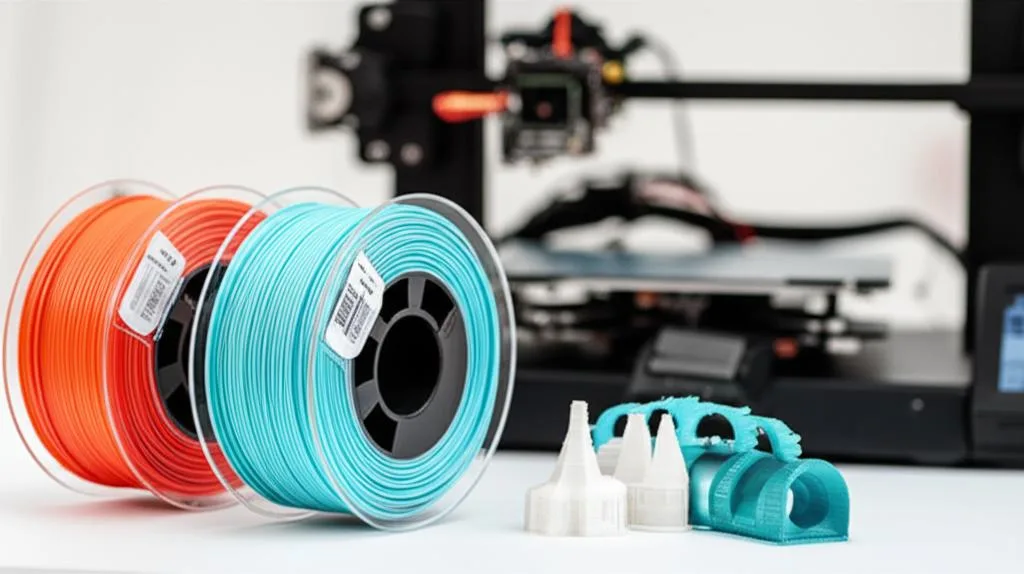
Choosing the right filament is crucial for any 3D printing project. Polylactic Acid (PLA) and Polyethylene Terephthalate Glycol-modified (PETG) are two of the most popular materials, each with distinct properties. Understanding their differences is key to successful prints, especially when considering 3D printing filament PLA vs PETG. This guide compares them to help you decide.
PLA: The User-Friendly Start
PLA, derived from renewable resources, is a common choice for beginners. It’s biodegradable and prints with a low, sweet odor. Its main advantage is ease of use: lower print temperatures, often no heated bed required, and minimal warping. This makes it very forgiving for initial setups and simpler designs.
Pros of PLA:
- Very easy to print, low warping.
- Often no heated bed needed.
- Wide range of colors.
- Biodegradable.
- Low odor.
Cons of PLA:
- Brittle, less durable.
- Low heat resistance (~60°C).
- Poor UV resistance.
- Not ideal for strong functional parts.
PLA is best for aesthetic models, prototypes, educational prints, and non-functional items where visual appeal and print ease are prioritized over mechanical strength or heat resistance.
PETG: The Strong & Versatile Alternative
PETG bridges the gap between PLA and engineering plastics. It offers a great balance of strength, flexibility, and temperature resistance, making it highly versatile for functional parts. More durable and less brittle than PLA, it boasts excellent layer adhesion for strong prints. PETG is generally food-safe (check certifications) and more resistant to chemicals and UV light than PLA.
Pros of PETG:
- High strength and durability.
- Good temperature/chemical resistance.
- Excellent layer adhesion.
- More flexible than PLA.
- Food-safe options.
Cons of PETG:
- More prone to stringing.
- Requires higher print temperatures (230-250°C).
- Can be trickier to print than PLA.
- Can be abrasive to brass nozzles.
PETG excels in applications needing durability, like mechanical parts, outdoor components, protective housings, and anything requiring heat or impact resistance. It’s a top choice for many functional prints.
PLA vs PETG: Making Your Choice
When comparing 3D printing filament PLA vs PETG, consider your project’s specific needs. For quick prototypes or decorative items prioritizing ease and looks, PLA is ideal. For strong, durable parts resistant to heat, chemicals, or impact, PETG is superior. Both Materials and Filaments offer unique benefits, and mastering both expands your 3D printing capabilities significantly. Ultimately, your choice depends on balancing printability, mechanical properties, and intended use.
Frequently asked questions
Can PETG stringing be reduced, or should I switch back to PLA?
Stringing is a known issue with PETG since it prints hotter (230-250°C) and is more prone to oozing than PLA. It doesn’t mean you need to abandon PETG — most cases come down to retraction and temperature tuning rather than the material being unworkable. If a part doesn’t need PETG’s extra strength or heat resistance, printing it in PLA instead sidesteps the problem entirely since PLA is far less prone to stringing.
Will PETG clog or wear out my printer’s nozzle faster than PLA?
Standard PETG is not inherently abrasive, but it can be harder on brass nozzles than PLA over time. This is a maintenance consideration rather than a reason to avoid PETG for functional parts. If you print PETG frequently, keep an eye on nozzle wear, since a worn nozzle affects print quality and dimensional accuracy on parts meant to be strong and durable.
Is it worth learning PETG if I’m just starting out with PLA?
Yes, eventually — PLA is the easier starting point because it needs lower temperatures, often no heated bed, and warps less, so it’s the better choice while you’re still learning your printer. But PLA is brittle, has low heat resistance (around 60°C), and isn’t suited for functional or outdoor parts. Once you need durability, chemical resistance, or heat tolerance, PETG becomes necessary despite being trickier to print, so mastering both materials is what actually expands what you can make.