3DX.info covers 3D printing — the machines, the materials, the people building things one layer at a time. TRETTITRE is not a 3D printing product. It’s a Kickstarter campaign for a retro-styled turntable system, and this piece is a paid sponsored spotlight on something well outside our usual beat. We’re saying that plainly, up front, rather than dressing it up as a normal editorial post, because that distinction matters more here than it usually does.
So why cover it at all? Because the campaign’s own photography shows a level of industrial-design thinking that overlaps with what a lot of our readers care about even when nothing is being printed: a physical object built around a coherent visual language, deliberately unusual enclosure materials, and a modular philosophy where one core unit connects outward to companion pieces instead of standing alone as a sealed box. That’s a maker’s kind of problem to look at, even when the discipline is audio hardware rather than FDM or resin. We’ll stick strictly to what the campaign materials actually show and say — no filled-in specs, no guessed pricing, no invented ship date — and we’ll tell you clearly where the gaps are.
A turntable that wears its influences on its faceplate
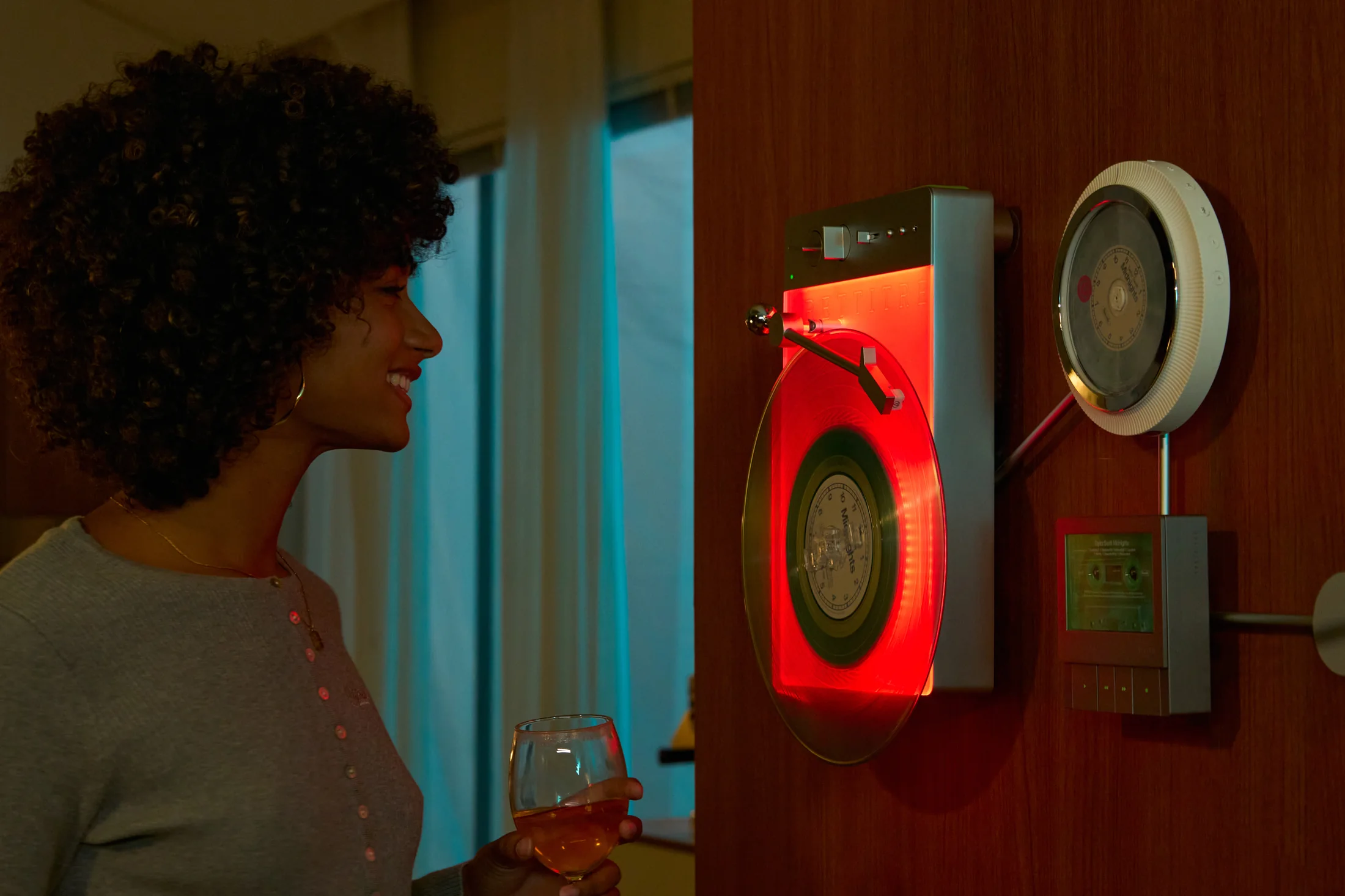
The centerpiece of the campaign is a turntable carrying the model designation TTT-LP3, stamped right on the unit — TTT being the shorthand the brand uses across its hardware for TRETTITRE. The design language is unmistakably vintage hi-fi: a brushed metal control panel, round knobs, toggle switches instead of touch controls, and a chrome tonearm that looks lifted from a component shelf circa the analog era’s peak. Campaign photography pairs the deck with translucent colored vinyl records — cyan and teal turn up repeatedly, along with other translucent hues — which do as much for the product’s visual identity as the hardware itself. A record you can partially see through, spinning under a chrome arm, reads as a deliberate styling choice rather than an incidental prop.
It’s worth naming the tension here directly: this is retro styling applied to a new product, not a restoration of an old one. That’s a legitimate design tradition — plenty of respected audio and camera gear leans on it — but it’s also a tradition that lives or dies on execution, fit, and finish rather than nostalgia alone. Photographs can sell a silhouette; they can’t tell you how a toggle switch feels under your thumb after a year of use. We haven’t touched the hardware, and neither has anyone outside the campaign team at this point, so treat the aesthetic read as exactly that — a read of the images, not a verdict on build quality.
Not a single box — a component rack
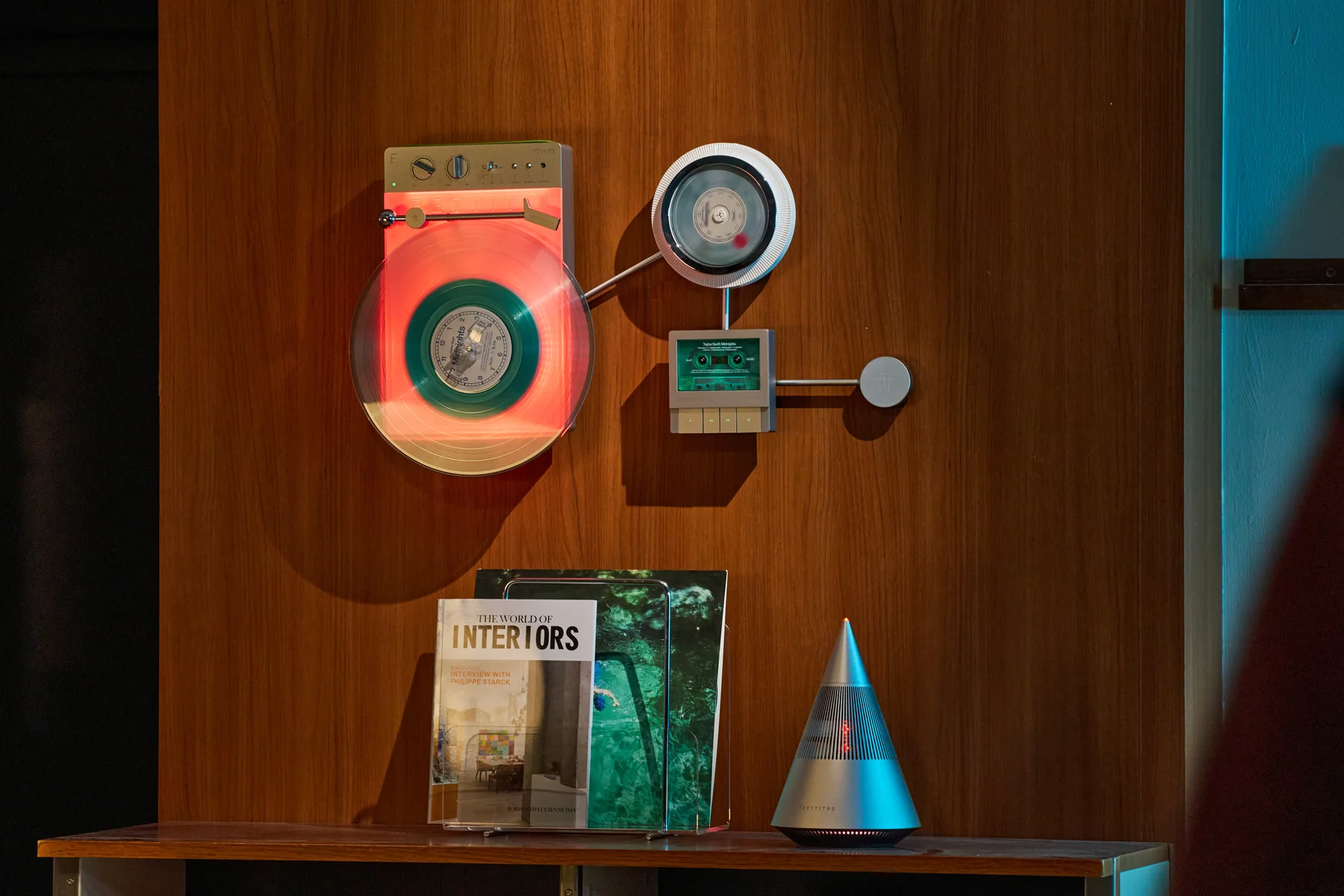
The more interesting design idea, at least from where we sit, isn’t the turntable on its own — it’s the way the campaign photography shows it connected to other things. Images depict the TTT-LP3 linked by slim metal rods to smaller circular companion modules: one styled like a retro radio tuner dial, another built like a cassette-deck front panel complete with physical transport buttons. Mounted together on a wood-panelled wall, the whole assembly reads less like “a turntable” and more like a component rack — a shared physical and visual language that individual modules plug into, the way a modular synth rack or a shelving system accepts different units on a common frame.
We want to be careful about how we describe this, because no functional documentation was part of the material we reviewed. What we can say is that this is an observed design concept from the campaign’s own photography: a family of physical modules sharing a connection method and a design vocabulary, rather than a single standalone product. What we can’t say is which modules do what, how they communicate with each other, or whether the rod-and-disc connectors carry power, signal, both, or are purely a mounting system. That’s a real gap, and it’s the kind of thing a Kickstarter comments section usually gets asked about early — worth checking before you read too much into the concept.
The TreSound speakers, and why the shape is the story
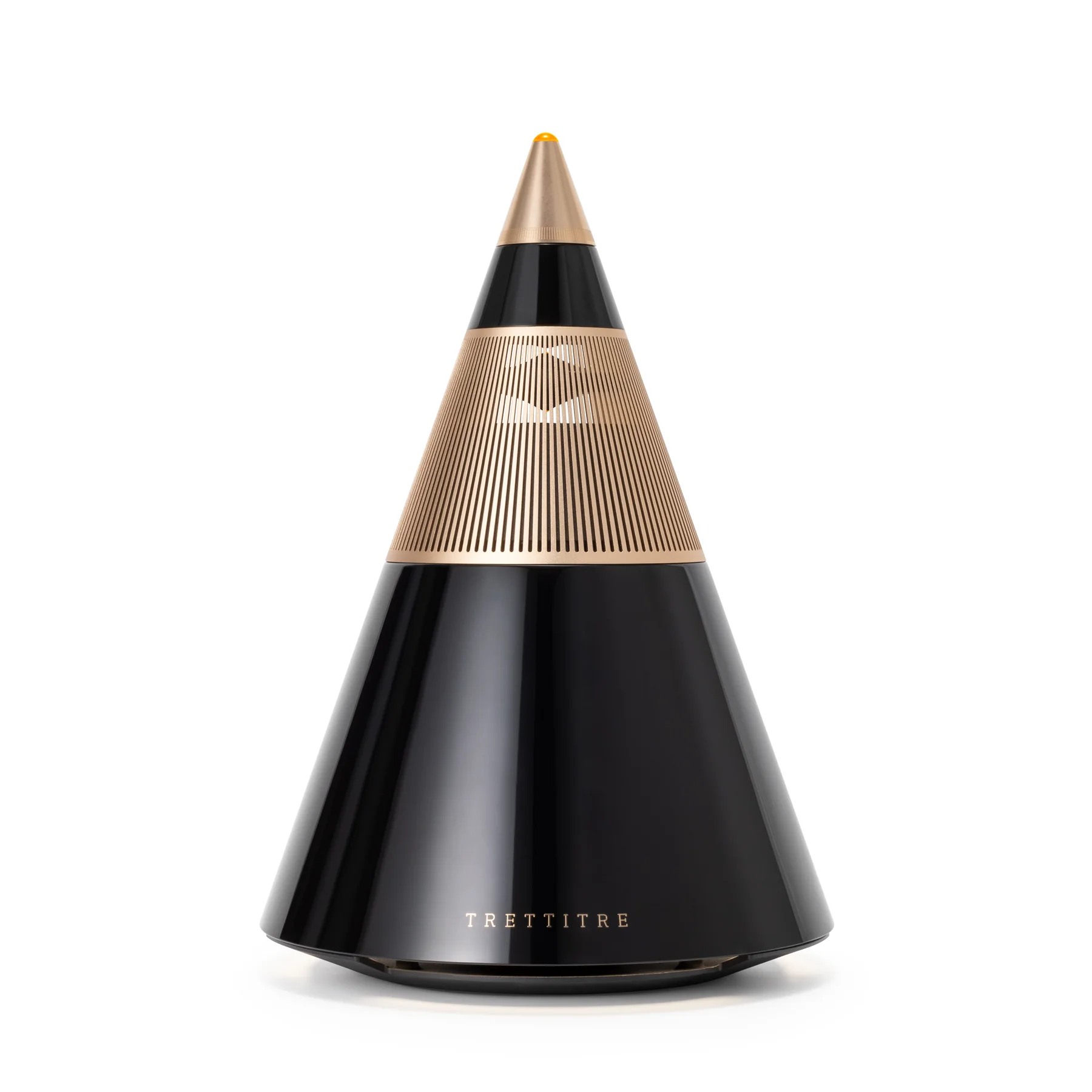
Alongside the turntable, the campaign includes two add-on speakers: TreSound mini and TreSound1. Both share a cone-shaped silhouette — tall and narrow, with a shape that lands somewhere between a small rocket and a bell. A perforated, ribbed acoustic grille band wraps partway up each cone, and a small illuminated tip caps the apex. It’s a shape you don’t see much in speaker design, where the default is still a rectangular bookshelf box or a squat cylinder. A tall cone standing on its point (visually, at least) is a harder shape to manufacture cleanly and a riskier one to put on a shelf next to conventional gear — which is presumably the point. Design choices like this either read as confident or read as gimmicky, and that call tends to depend entirely on finish quality up close, which again is something photographs alone can’t settle.
TreSound mini is offered in black, silver, and gold finishes — a more conventional finish spread for a piece of consumer audio hardware. TreSound1 is where the material story gets more interesting, and that’s worth its own look.
Concrete and wood as speaker enclosures
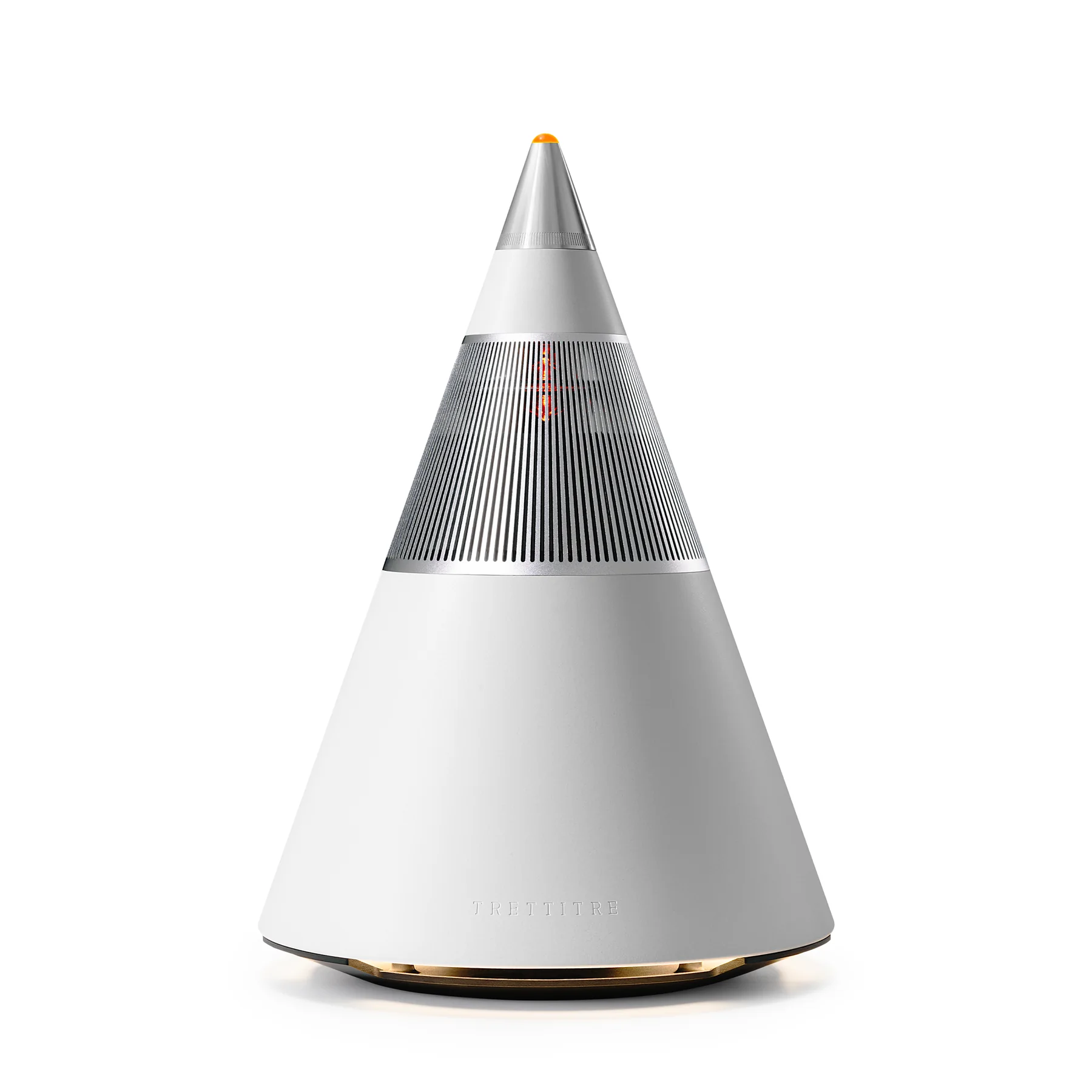
TreSound1 is offered in a concrete finish — both a matte pale gray/white variant and a dark charcoal/black variant — and a wood finish with visible wood grain across multiple colorways, alongside a more conventional glossy black option. That’s a genuinely unusual set of choices. Consumer audio enclosures are almost always injection-molded plastic or machined aluminum, chosen for weight, manufacturing repeatability, and acoustic damping that’s well understood at scale. Concrete and wood are neither of those things by default: concrete is heavy, brittle under the wrong stress, and notoriously hard to cast without visible defects at consumer-product tolerances; wood-grain finishes have to fight moisture, seasonal movement, and consistency across a production run.
None of that makes the choice wrong — it makes it a real engineering bet rather than a marketing wrapper, which is exactly the kind of material-selection story that resonates with people who spend their own time fighting warping, layer adhesion, or finish quality on their own printed parts. A concrete-finish speaker cone and a wood-finish one sitting next to a plain glossy-black version, all built on the same internal shape, is a legitimate case study in how enclosure material changes the personality of an otherwise identical object. We’d genuinely like to know more about how those finishes are actually produced — true poured concrete versus a concrete-look composite, solid wood versus veneer over a substrate — and that distinction wasn’t part of the material we had to work from, so we’re not going to guess at it here.
The aesthetic thesis, and the caveats that matter
The campaign’s subtitle, “Retro Back to the Future,” seems to describe the visual strategy pretty directly. Lifestyle photography leans on warm, wood-panelled interiors, vinyl-shop and mid-century-furniture styling, then cuts that against deliberately futuristic, almost sci-fi lighting — saturated red and teal accents show up repeatedly against those warm wood tones. It’s an old-meets-new contrast used on purpose, not an accident of mismatched shoots, and it’s consistent enough across the images that it reads as the organizing idea behind the whole product family rather than a one-off marketing flourish.
Here’s what we’re not going to do: fill in the blanks the campaign materials left open. We were not given audio specifications, connectivity details, which playback formats the system actually supports, pricing tiers, or a shipping date, and none of that appears anywhere in what we reviewed. If any of those details matter to your decision — and for a piece of audio hardware, they probably do — go read the Kickstarter page itself before forming an opinion on value. We’d also point out the standard crowdfunding caveat, because it’s easy to skip past on a well-photographed campaign page: backing a Kickstarter project is a pledge of support for a pre-launch product, not a guaranteed retail purchase. Campaigns slip, specs change between prototype and production, and “funded” is a milestone, not a delivery confirmation.
What we can say with confidence, based on what was actually shown to us, is that TRETTITRE is thinking about this as an industrial-design problem first — modular connection language, unconventional enclosure materials, a consistent visual world — rather than just skinning a generic turntable in vintage paint. Whether that thinking survives contact with mass production is exactly the kind of question worth asking about any ambitious physical-product campaign, on Kickstarter or off it.