

The landscape of industrial 3D printing is continuously evolving, driven by innovations in both additive manufacturing technologies and the materials they process. For businesses looking to leverage this transformative technology, selecting the right industrial 3D printing materials is paramount. This decision is not merely about cost; it’s a complex interplay of desired part performance, application environment, manufacturing process, and scalability. Understanding the distinct characteristics and cost implications of various polymers and metals is crucial for making informed choices in industrial additive applications.
High-performance polymers in additive manufacturing
The consumer toolchanger 3D printer: the SnapSwap 4-toolhead system swaps heads in 5 seconds for true multi-color and multi-material printing, with smart calibration and auto filament loading.
- 4 toolheads · 5 s swap
- Up to 500 mm/s · 20,000 mm/s²
- 270 mm cube build volume
- Multi-color & multi-material

Polymers have long been a cornerstone of 3D printing, initially for rapid prototyping, but increasingly for functional end-use parts. While general-purpose plastics like ABS and PLA have their place, industrial applications demand high-performance polymers that can withstand rigorous conditions. These include:
- PEEK (Polyether Ether Ketone): Renowned for its exceptional mechanical strength, stiffness, temperature resistance, and chemical inertness. It’s often used in aerospace, medical (implants), and automotive sectors for lightweight, high-stress components.
- PEI (Polyetherimide, e.g., ULTEM™): Offers high heat resistance, flame retardancy, and good strength-to-weight ratio. Common in aerospace interiors, electrical connectors, and fluid handling components.
- PAEK (Polyaryletherketone) family: A broader class including PEEK, known for superior strength, thermal stability, and chemical resistance, making them ideal for demanding environments.
- Polyimides: Valued for extreme temperature resistance, low thermal expansion, and excellent mechanical properties, often found in high-temperature electrical and structural components.
The cost structure for high-performance polymers can vary significantly. While generally more affordable per kilogram than most metals, the specific polymer grade, processing requirements (e.g., heated build chambers for PEEK), and post-processing steps can influence the overall part cost. Their ability to produce lightweight parts with excellent material properties 3D printing can offer long-term operational savings.
Metal additive manufacturing materials
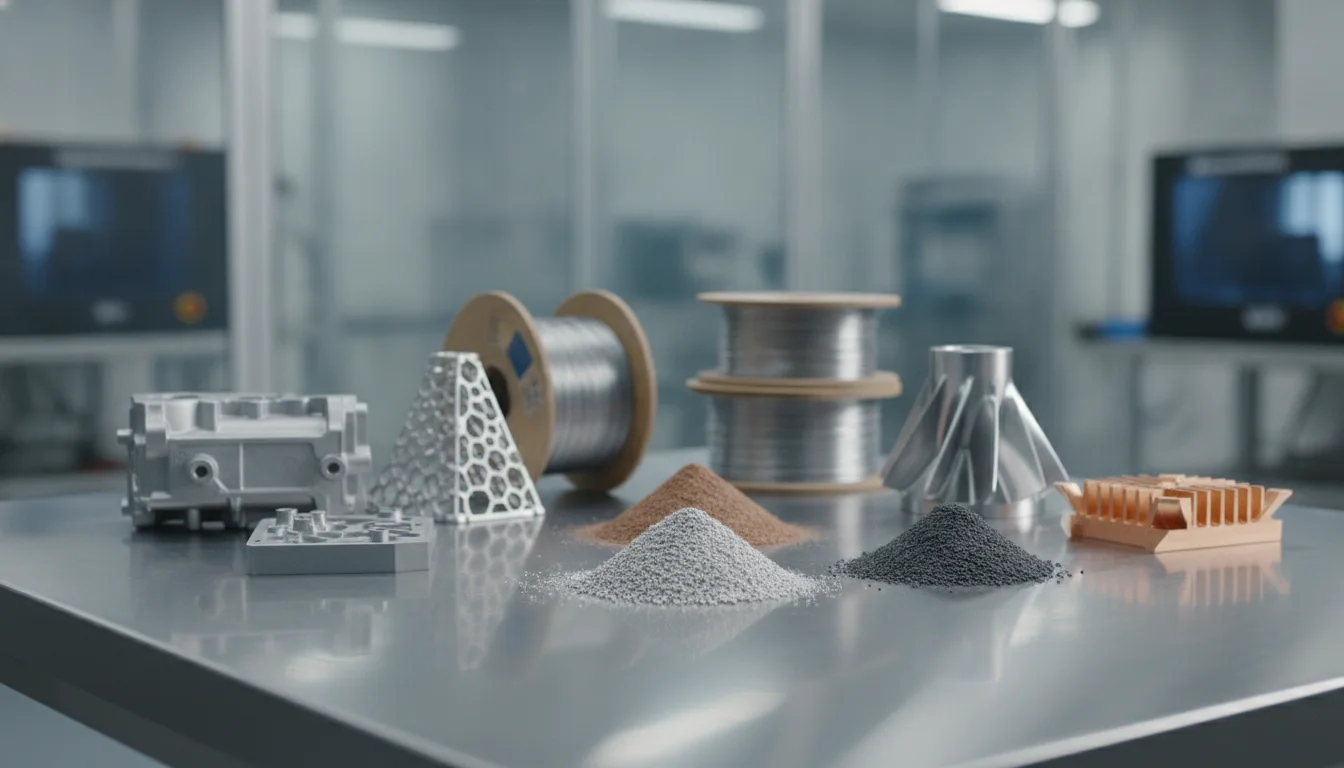
Metal additive manufacturing has revolutionized the production of complex, high-strength components across various industries. Processes like Selective Laser Melting (SLM), Electron Beam Melting (EBM), and Directed Energy Deposition (DED) enable the use of a wide array of metallic materials:
- Stainless Steels (e.g., 316L, 17-4 PH): Offer good corrosion resistance, strength, and biocompatibility, making them suitable for medical instruments, industrial tooling, and consumer goods.
- Titanium Alloys (e.g., Ti6Al4V): Prized for their exceptional strength-to-weight ratio, biocompatibility, and corrosion resistance. Dominant in aerospace for structural components and medical implants.
- Nickel-based Superalloys (e.g., Inconel 718, Hastelloy X): Known for outstanding high-temperature strength, creep resistance, and corrosion resistance. Critical for jet engine components, gas turbines, and high-performance industrial parts.
- Aluminum Alloys (e.g., AlSi10Mg): Valued for their lightweight properties, good thermal conductivity, and decent strength. Increasingly used in automotive and aerospace for lighter components.
The cost structure for metal additive manufacturing is typically higher due to the premium price of metal powders, the substantial investment in machinery, and often intensive post-processing (e.g., heat treatment, Hot Isostatic Pressing (HIP), surface finishing) required to achieve desired mechanical properties and tolerances. However, the ability to create highly complex geometries, consolidate parts, and reduce material waste can offset these initial costs, especially for high-value components.
Critical material properties for industrial 3D printing

Regardless of whether a polymer or metal is chosen, evaluating key material properties 3D printing is essential for successful industrial 3D printing materials selection. These include:
- Mechanical Properties: Tensile strength, yield strength, elongation at break, hardness, fatigue resistance, and impact strength dictate how a part will perform under stress and strain.
- Thermal Properties: Heat deflection temperature (HDT), glass transition temperature (Tg), and thermal conductivity are crucial for parts operating in high-temperature environments or requiring specific thermal management.
- Chemical Resistance: The material’s ability to withstand exposure to various chemicals, solvents, or corrosive agents without degradation.
- Environmental Stability: Resistance to UV radiation, moisture absorption, and oxidation, particularly for parts exposed to outdoor or harsh conditions.
- Biocompatibility: A critical factor for medical implants and devices, ensuring the material does not provoke an adverse reaction in the human body.
- Surface Finish and Post-processing Needs: The inherent surface quality achievable and the extent of post-processing required to meet functional and aesthetic specifications.
Choosing between high-performance polymers and metals for industrial additive applications requires a comprehensive evaluation, weighing various factors without declaring a universal “better” option. Both offer unique advantages depending on the specific use case.
From a cost perspective, polymers generally present a lower entry point regarding raw material expense and sometimes machine cost. However, the total cost of ownership can be influenced by the complexity of the part, build time, and specialized post-processing for advanced manufacturing materials. For instance, a complex metal part that consolidates multiple components might be more cost-effective in the long run than assembling an equivalent polymer solution, despite higher initial material and machine costs.
In terms of features, metals typically offer superior ultimate strength, hardness, and temperature resistance, making them indispensable for critical structural components, tooling, and parts exposed to extreme heat or wear. Polymers, especially high-performance polymers, excel where lightweighting is critical, or where electrical insulation, chemical resistance, or specific aesthetic properties are prioritized. Their design flexibility also allows for intricate geometries that can optimize weight and functionality.
Ultimately, the decision hinges on a detailed understanding of the application’s performance requirements, operating environment, and the desired balance between mechanical properties, weight, and the overall cost structure of manufacturing and deployment. Both material families are continually evolving, with new industrial 3D printing materials and processes emerging, expanding the possibilities for advanced manufacturing materials.
The ongoing advancements in industrial 3D printing materials continue to push the boundaries of what’s possible in manufacturing. From the unparalleled strength of metal alloys to the lightweight versatility of high-performance polymers, the choice is increasingly nuanced. By objectively assessing the material properties 3D printing offers and understanding the cost implications across the entire production lifecycle, businesses can strategically harness the power of metal additive manufacturing and polymer-based solutions to drive innovation and efficiency.
Frequently asked questions
Can high-performance polymers like PEEK completely replace metal parts in industrial applications?
No, not completely. While PEEK offers exceptional strength, chemical resistance, and temperature tolerance, metals like titanium or Inconel still provide superior ultimate strength, hardness, and high-temperature resistance for critical structural or extreme-heat components. Polymers are best where lightweighting, electrical insulation, or chemical resistance is prioritized over maximum mechanical load-bearing capacity.
What is the main factor that makes metal 3D printing more expensive than polymer printing?
The higher cost comes from three sources: metal powders are significantly more expensive per kilogram than polymer filaments or powders; the machinery for processes like SLM or EBM requires substantial capital investment; and intensive post-processing steps such as heat treatment, Hot Isostatic Pressing (HIP), and surface finishing are often mandatory to achieve target mechanical properties and tolerances.
Is biocompatibility a concern only for medical implants, or should other industries consider it?
The article specifically lists biocompatibility as a critical factor for medical implants and devices. For non-medical industrial applications, the focus is instead on mechanical properties, thermal stability, chemical resistance, and environmental stability (UV, moisture, oxidation) rather than biological safety. You would only need to evaluate biocompatibility if the part will contact human tissue or bodily fluids.