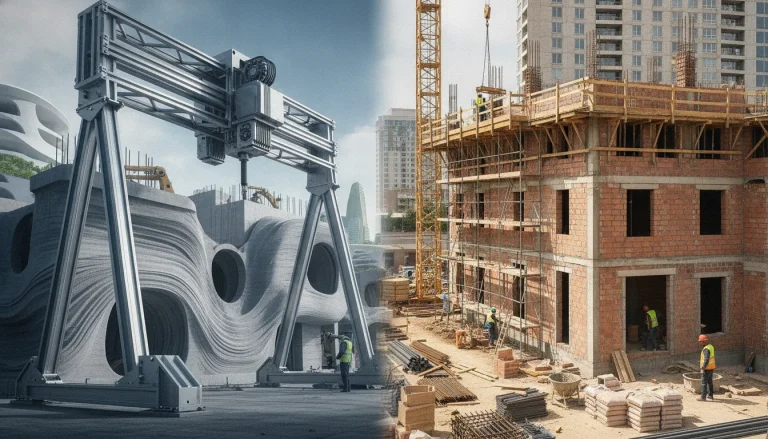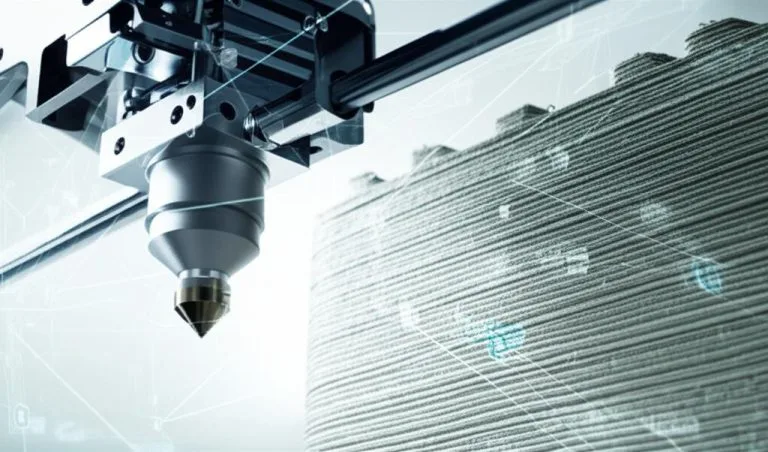

The biggest sustainability problem in 3D printed construction is the binder, not the printer. Printable concrete is usually a fine-aggregate mortar with a lot of cement: a 2024 review in npj Materials Sustainability puts ordinary Portland cement use in 3D printable mixes at 700–800 kg/m³, and cites a life-cycle figure of 583.1 kg CO₂-eq/m³ at the material production stage, 75% of it from cement and other binders. A greener printed wall mostly means using less clinker.
What is reasonably proven: replacing part of the cement with supplementary materials such as fly ash, slag, limestone and calcined clay. A 2025 review reports that life-cycle studies of printable mixes with less clinker and recycled constituents typically show 20–50% lower CO₂ at mix level. What is promising but less settled: geopolymers, where carbon results conflict because of the alkaline activators, and high levels of recycled aggregate or recycled concrete powder, where durability data is thin. Printed earth has real prototypes, such as WASP’s TECLA house, but low strength and water sensitivity limit it. Codes are catching up only slowly, so check the approval route before choosing a material.
The consumer toolchanger 3D printer: the SnapSwap 4-toolhead system swaps heads in 5 seconds for true multi-color and multi-material printing, with smart calibration and auto filament loading.
- 4 toolheads · 5 s swap
- Up to 500 mm/s · 20,000 mm/s²
- 270 mm cube build volume
- Multi-color & multi-material
Sustainable 3D printing construction materials at a glance
| Material route | How it cuts impact | Evidence level | Main limits |
|---|---|---|---|
| Lower-clinker cement mixes (fly ash, slag, silica fume, limestone, calcined clay) | Replaces part of the Portland cement, the main CO₂ source | Widely studied; printable mixes demonstrated in many lab studies | Each replacement changes pumpability and buildability; quantitative CO₂ studies are still limited |
| LC3 (limestone calcined clay cement) | Blends clinker with limestone and calcined low-grade clay | One printable LC3 study reported 45% lower carbon emissions; the LC3 project claims up to 40% CO₂ savings versus OPC for the cement itself | Needs a suitable clay source and calcining |
| Geopolymers / alkali-activated binders | No Portland clinker; uses fly ash, slag or metakaolin with an activator | Printable, with fast early strength; carbon results conflict between studies | Silicate activators add CO₂; sensitive to activator chemistry and curing temperature |
| Recycled fine aggregate and recycled concrete powder | Replaces natural sand; powder can also replace some cement | Lab mixes and at least one printed prototype with 50% cement replacement | Lower strength, higher water absorption, weaker interlayer bond; little freeze-thaw and chloride data |
| Earth and clay mixes | Local soil, very little processing, no cement if unstabilised | Built prototypes (TECLA, 2021) and lab studies | Low strength, drying shrinkage, water sensitivity, slow build-up; few code routes |
Why printable concrete has a high carbon footprint
An extruded mix has to be pumped, pass through a nozzle, hold its shape the moment it leaves the nozzle and carry the layers above it within minutes. According to the npj review by Zhuang and colleagues, most printable mixes use only fine aggregates because of pump and nozzle limits, and the high cement content is the first obstacle it names for sustainable printable materials. In the life-cycle figure it cites, cement and other binders account for 75% of material-stage emissions.
A useful sanity check comes from a study the review cites (Han et al., 2021): raising recycled aggregate content from 0% to 100% lowered the CO₂ figure for a printed building from 5,637.6 kg to 5,499.5 kg. By our calculation that is about a 2.5% reduction. Aggregates matter for resource use and waste, but on their own they barely move the carbon number. The binder does.
Lower-clinker cement mixes and LC3
Supplementary cementitious materials (SCMs) are the most mature route because they work with the same pumps, printers and quality control as ordinary printable mortar. The review sums up their effect on printing behaviour:
- Fly ash and ground granulated blast furnace slag (GGBS) can improve pumpability and extrudability at appropriate dosages, but too much increases water demand and viscosity and can hinder extrusion.
- Silica fume reduces workability because of its high surface area, but improves buildability.
- Limestone and calcined clay improve buildability, which helps with taller walls printed quickly.
- Rice husk ash absorbs water strongly and has also been reported to improve buildability.
On carbon, the evidence is thinner than the enthusiasm. The review points out that most SCM studies measure fresh and hardened properties and few quantify emissions. One study (Long et al.) found that printable limestone calcined clay cement (LC3) composites cut carbon emissions by 45% and energy use by 40%. The LC3 project itself states that LC3 saves up to 40% of CO₂ compared with ordinary Portland cement. Fly ash and slag supply depends on coal power and steelmaking, so check local availability before designing around them.
Geopolymers: printable, but not automatically low carbon
Geopolymers, or alkali-activated materials, replace Portland cement entirely with an aluminosilicate source such as fly ash, slag or metakaolin, activated with an alkaline solution. For printing they have a real advantage. The 2025 review of recycled components by Maroszek, Rudziewicz and Hebda describes fast structural build-up and early green strength that lets layers stack with little deformation.
The same review lists the risks: high sensitivity to activator chemistry and curing temperature, which can shorten the printable window or cause loss of pumpability. It lists a typical global warming potential of roughly 150–250 kg CO₂-eq/m³ for geopolymer concrete, against about 320–450 for conventional Portland cement concrete, while noting the result is strongly influenced by activator type and the regional energy mix. The picture is not settled, though. The npj review cites one study where a printable geopolymer had higher carbon emissions because of the sodium silicate activator, and another where a fly ash cement mix beat the printable geopolymer. Treat “up to 80% less CO₂” style claims as marketing until you see a life-cycle assessment for the actual mix, activator included.
Recycled aggregates and recycled concrete powder
Crushed construction and demolition waste can replace natural sand, and finely ground recycled concrete powder can replace part of the cement. The 2025 review in Materials collects the numbers:
| Change | Reported effect |
|---|---|
| 25% and 50% fine recycled concrete aggregate replacing sand | Higher yield stress and faster structural build-up; buildability up by about 33% and 83% in recycled sand mortars, with lower flowability and shorter open time |
| Increasing recycled fine aggregate content | Compressive strength losses of 9.4–29.2% (X), 12.5–33.1% (Y) and 14.9–40.0% (Z) across the studies reviewed; higher water absorption |
| Recycled concrete powder replacing up to 50% of cement | Yield stress nearly tripled, outside the 280–600 Pa extrusion range the authors cite; a printed prototype with 50% cement replacement was still made |
| Layer bonding | Larger, irregular pores near recycled aggregate disrupt paste continuity across layers and reduce local bond |
| Mix-level CO₂ (cradle to gate, A1–A3) | Typically about 20–50% lower, up to about 48% with fine recycled aggregate plus cement reduction and about 62% with recycled concrete powder |
Note where the big savings come from: the mixes that also cut cement. The authors flag the gaps too. There is little freeze-thaw and chloride data at high recycled contents, directional durability testing is rare, and life-cycle studies use inconsistent system boundaries and functional units. Printing through layers makes this more important, since structural integrity in 3D printed construction depends heavily on the bond between layers.
Printed earth and clay: what TECLA shows
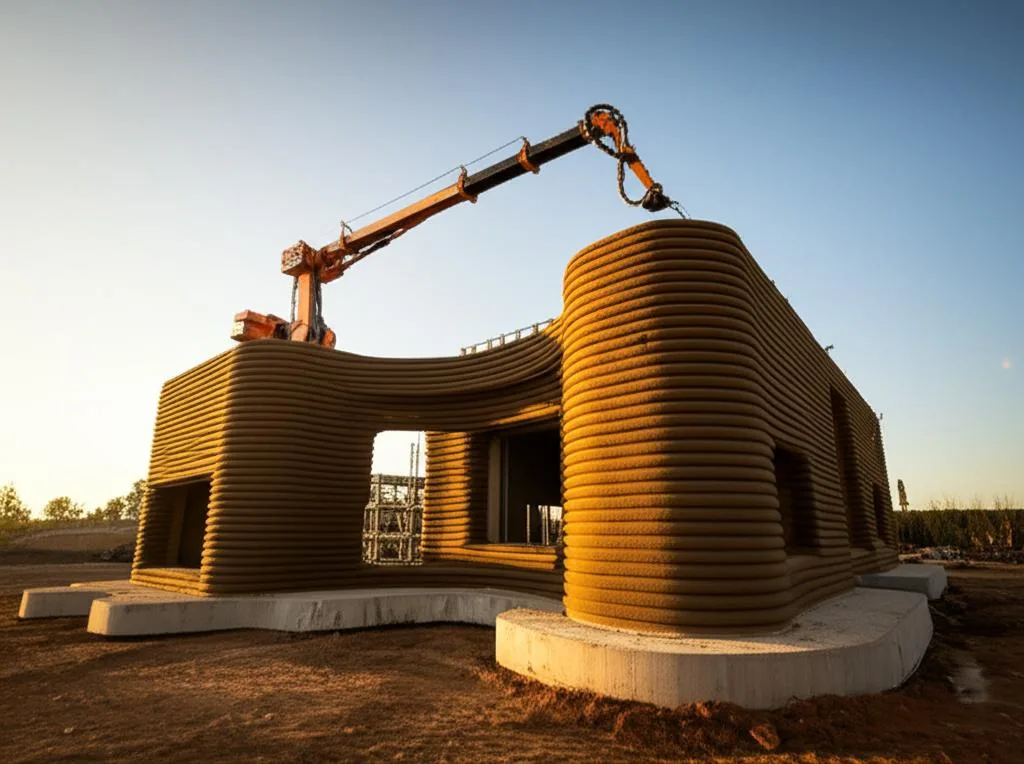
Earth is the lowest-processing option: local soil, sometimes with fibres or a stabiliser, extruded in thick layers. The best documented project is TECLA, designed by Mario Cucinella Architects and built by WASP in Massa Lombarda near Ravenna, Italy. According to WASP it used 60 m³ of natural earth, 350 layers of 12 mm, about 200 hours of printing and an average power draw below 6 kW, with Crane WASP printers working together. WASP describes it as a prototype; structural tests for shape optimisation were carried out by Milan Ingegneria.
The lab data explains why printed earth has stayed at prototype scale. A 2026 study in Scientific Reports by Dhakal and Tiwari lists the known limits of earthen materials as material variability, water sensitivity, excessive settlement, slow structural build-up and low mechanical strength. Their best mix (local soil and sand with 1% xanthan gum and 0.5% polypropylene fibre) printed well, but the printed sample lost 12.66% of its height as it dried. Fibres and biopolymer raised compressive strength 2.2 times, and a water resistance test showed only 0.33% weight loss. Stabilisers improve performance, but cement or lime stabilisation also brings back part of the carbon you were trying to avoid.
What building codes and standards say
A low-carbon mix is only useful if a building official will accept the wall. In the US, the routes are still specific and new:
- 2024 International Residential Code, Appendix BM covers 3D-printed building construction, but its scope has an exception: it does not apply to 3D-printed buildings constructed of concrete. Its provisions are not mandatory unless the local adopting ordinance specifically references them. It requires design by an organisation certified to UL 3401 and inspection of production equipment and the fabrication process.
- UL 3401, the Outline of Investigation for 3D Printed Building Construction, evaluates the printer, fabrication process and materials to verify that they consistently produce building elements with the same properties, according to UL Solutions.
- ICC-ES AC509 is the acceptance criteria for 3D automated construction technology for 3D concrete walls, covering material and durability properties, structural performance and fire resistance. ICC-ES revised it in 2021 to add provisions for multi-story construction. Evaluation reports are issued for specific proprietary mixes and systems.
The practical consequence: an evaluation or certification is tied to a specific material and process. Changing the binder to a geopolymer or raising the recycled content usually means new testing, not a simple substitution. Outside the US, ask your national building authority early. We did not find a single harmonised international standard for printed wall materials, and the reviews above note that even the methods for reporting printability differ between research groups. For the business case, see when to consider 3D printing over traditional construction.
Common mistakes when judging a green printed mix
- Comparing a printed mix with generic concrete. Printable mortars start from a high cement content, 700–800 kg/m³ in the npj review. Ask for kg CO₂-eq per m³ of the actual printed mix, and ideally per metre of finished wall.
- Counting recycled aggregate as the main carbon saving. In the Han et al. example it cut CO₂ by about 2.5%; the binder is what matters.
- Ignoring the activator in geopolymer claims. Sodium silicate can erase much of the benefit.
- Taking lab strength as wall strength. Studies of recycled fine aggregate reported strength losses of up to 40% depending on build direction, and interlayer bond is the weak point.
- Accepting LCAs with different boundaries. Check whether printing energy, waste and admixtures are included (cradle to gate, A1–A3, is the common scope).
- Choosing the material before the approval route. A certified system with an ordinary low-clinker mix may get built; an uncertified earth wall may not. Budget for it with our construction ROI guide.
Frequently asked questions
What is the most sustainable material for 3D printed houses?
There is no single answer, because it depends on local materials and the approval route. For load-bearing walls that need code acceptance today, a printable mix with a high share of supplementary cementitious materials such as calcined clay, limestone or slag is the most proven low-carbon option. Earth has the lowest processing impact but is still mostly at prototype stage.
Are geopolymers better than cement for 3D printing?
They print well and gain early strength quickly, but they are not automatically lower carbon. Studies disagree because the alkaline activators, especially sodium silicate, carry their own emissions. They are also sensitive to activator chemistry and curing temperature, which makes the printable window harder to control.
Can recycled concrete be used in 3D printing?
Yes, in lab mixes and prototypes. Recycled fine aggregate can improve buildability but tends to reduce compressive strength and interlayer bond, and recycled concrete powder has replaced up to 50% of cement in a printed prototype. Long-term durability data at high recycled contents is still limited.
Is there a building code for 3D printed houses?
In the US, the 2024 IRC includes Appendix BM for 3D-printed building construction, based on UL 3401, but it excludes concrete buildings and only applies where a jurisdiction adopts it. Printed concrete wall systems can be evaluated under ICC-ES AC509. Elsewhere, ask your national or local building authority about the approval route before you design.
Sources
- Zhuang et al., A comprehensive review of sustainable materials and toolpath optimization in 3D concrete printing (npj Materials Sustainability, 2024)
- Maroszek, Rudziewicz and Hebda, Recycled components in 3D concrete printing mixes: a review (Materials, 2025)
- Dhakal and Tiwari, Printability and buildability of earth-based fiber–biopolymer composites for 3D printing (Scientific Reports, 2026)
- 2024 International Residential Code, Appendix BM: 3D-printed building construction (UpCodes, Austin edition)
- ICC-ES: Revisions enhance AC509 to include multi-story building construction