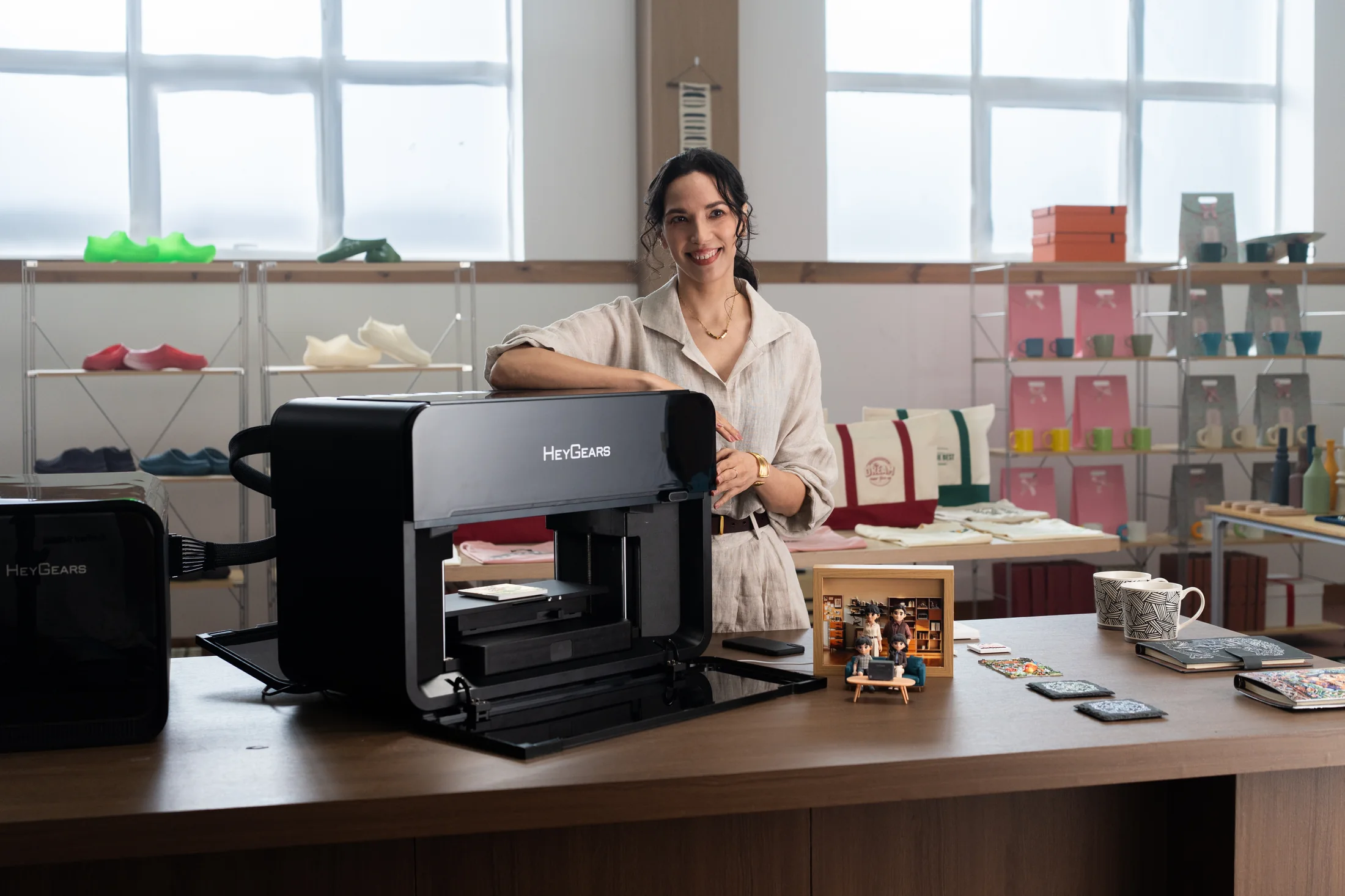
Full-color 3D printing has been an industrial party trick for years — something you saw at a trade show running on a machine that cost as much as a car. HeyGears is now putting a version of that workflow on a desktop for less than $5,000, packaged with a UV relief printer and a flatbed 2D UV printer in the same chassis. The G1 Series just opened a Kickstarter pre-launch deposit program, and since this is a paid placement for that campaign, it’s worth being precise about what’s actually confirmed, what’s HeyGears’ own marketing framing, and what remains a promise until units ship.
What HeyGears is actually shipping
HeyGears was founded in 2015 and has spent roughly a decade building professional and industrial photopolymer 3D printing systems before turning that engineering toward a consumer-facing product. The G1 Series is pitched as the world’s first desktop machine to combine three separate print workflows: full-color 3D printing, 3D-texture (UV relief) printing, and flat 2D UV printing on rigid or flexible substrates.
That’s the pitch that matters most for cost. Industrial full-color 3D systems — the kind that print a multi-material figurine with airbrushed gradients straight off the build plate — typically run into the tens of thousands of dollars. HeyGears is positioning the G1X under $5,000 in list terms, and the company’s own claim is that it delivers around 90% of industrial-level output quality at roughly 10% of the industrial cost. That’s HeyGears’ number, not an independently benchmarked one, so treat it as a marketing anchor rather than a lab result — but the underlying hardware (an actual Epson industrial printhead rather than a repurposed inkjet cartridge) is a real reason to take the comparison seriously instead of dismissing it outright.
Inside the three-in-one workflow
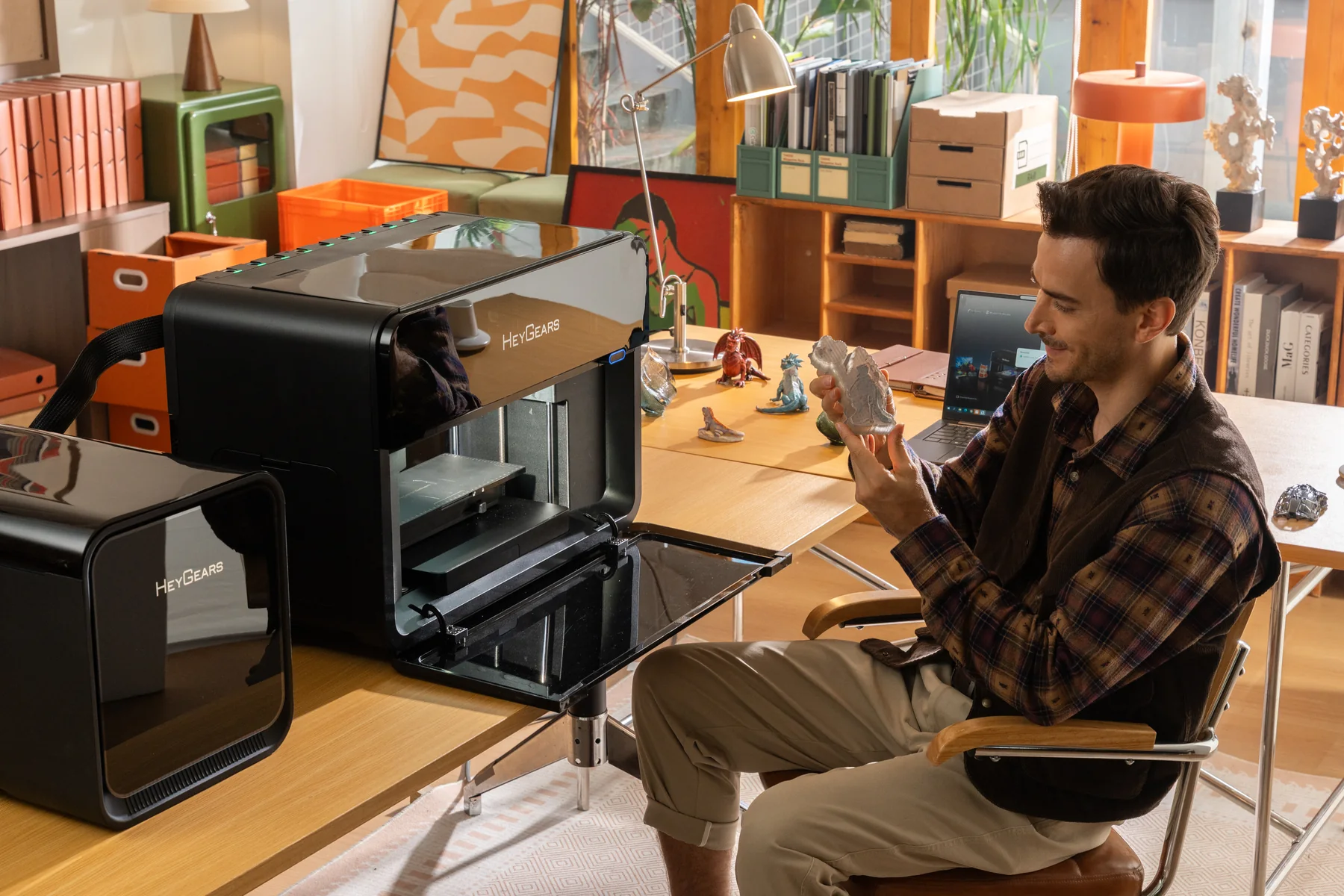
The full-color 3D mode is the headline feature. It runs on an 8-channel ink system built around an Epson i3200 industrial printhead — the G1X specifically uses the i3200-U1HD variant. In practice this means the printer can lay down smooth color gradients across a part, combine transparent and full-color regions in a single continuous build, and do it up to 150mm in build height. Supports are water-soluble, which is a genuinely practical detail rather than a spec-sheet checkbox: on a hollow or intricate model — a skull with internal cavities, an articulated figure with recessed joints — physically reaching in with pliers to strip supports either isn’t possible or wrecks the surface. Dissolving them out solves that.
The 2D and 3D-texture modes share the same color engine: 10+ million colors and up to 1440 x 2400 DPI print resolution, which is a genuinely high-density figure for a desktop UV printer rather than a resin printer’s XY pixel pitch. HeyGears is also bundling AIGC one-tap modeling through its “HeyVerse AI + Blueprint Studio” software — generate a model from a text or image prompt, or convert flat 2D artwork directly into 3D-texture output, without a separate modeling step.
For workshops that outgrow the base configuration, HeyGears has laid out a modular expansion path: rotary, flatbed, roll-to-film, and resin station attachments aimed at different production jobs. A soft white ink for flexible textile printing is on the roadmap as well, but it’s explicitly not shipping yet — worth flagging since it’s easy to read a roadmap slide as a current feature.
UV relief and substrate versatility
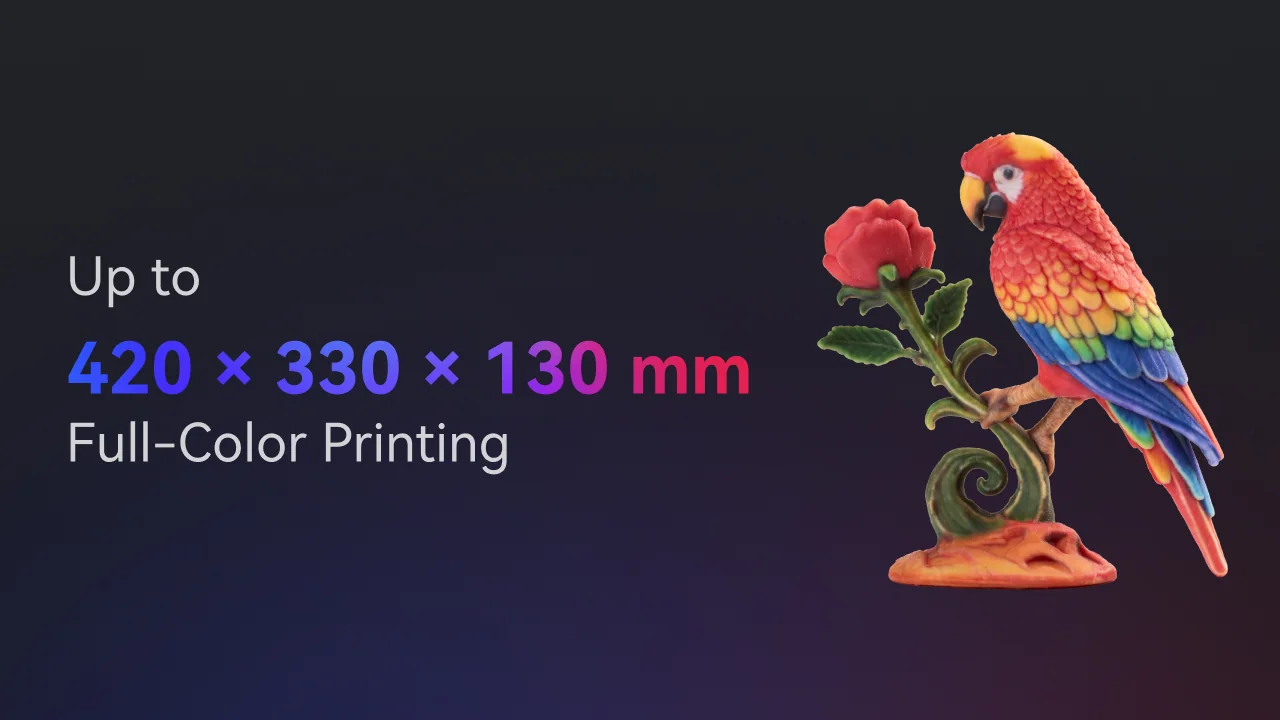
The 3D-texture mode is where this stops looking like a resin printer and starts looking like a UV flatbed. Maximum texture relief height is capped at 5mm across all three product tiers — Full-3D Pack, G1X Starter, and G1 Starter alike — so that’s not a differentiator between the SKUs, just a platform limit. What does vary is substrate range: HeyGears lists 400+ compatible materials, including plastic, metal, wood, glass, ceramic, leather, and acrylic, plus support for holographic and lenticular print effects, which depend on precise registration between multiple print passes.
HeyGears claims the G1 Series prints UV output roughly 3x faster than its previous desktop UV machines, and attributes a meaningful chunk of that to an automatic calibration system rather than raw printhead speed alone. Instead of relying on a single top-mounted wide-angle camera to map an irregular substrate — which introduces barrel distortion and perspective parallax the farther a point sits from the lens center — the G1 Series uses a line-scan camera that captures the substrate’s contour line by line, with a secondary top-mounted wide-angle camera used only for auxiliary positioning. On a flat rigid panel this barely matters; on a curved phone case, a leather wallet, or an uneven wood blank, it’s the difference between registration that holds and a print that visibly drifts across the surface.
Printhead economics — the real cost of ownership
Any printer built around an inkjet-style printhead lives or dies on consumable economics, and this is where the three G1 tiers actually diverge in ways that matter beyond the sticker price. The G1X’s Epson i3200-U1HD printhead — 3,200 nozzles spread across 8 channels — is rated for a 12 to 24+ month service life, and a replacement costs $1,299. The G1 Starter’s Epson F1080 printhead is a different, cheaper part: 1,080 nozzles across 6 channels, rated for a shorter 3 to 9 month lifespan, with a $299 replacement cost.
That’s not a small distinction. Over a two-year window, a G1X owner might replace a printhead once; a G1 Starter owner could be replacing one every few months if it’s run hard. The tradeoff is upfront cost versus running cost, and it’s worth doing that math against your actual print volume before picking a tier on price alone.
On ink itself, HeyGears is pricing UV ink and resin refills during the campaign’s Super Early Bird window at $25 to $35 per bottle depending on color, and frames that against what it describes as “other brand” desktop UV printer ink and resin commonly running $38 to $130 per bottle depending on type. That comparison is HeyGears’ own framing rather than independently verified third-party pricing, so read it as a directional argument, not a citation.
Keeping an inkjet printhead alive between sessions is its own engineering problem — pigment settles, nozzles clog, ink dries in the channel. HeyGears describes a four-layer anti-clogging system: a white-ink stirring mechanism to keep pigment suspended, printhead heating to hold ink viscosity in range, automated cleaning cycles that trigger after the machine sits idle past a set threshold, and a sealed moisturizing state for the printhead during extended downtime. Notably, the G1 Starter’s cheaper F1080 setup skips printhead heating and white-ink agitation entirely — another real reason the F1080 tier costs less, not just a smaller nozzle count.
Three tiers, three different machines
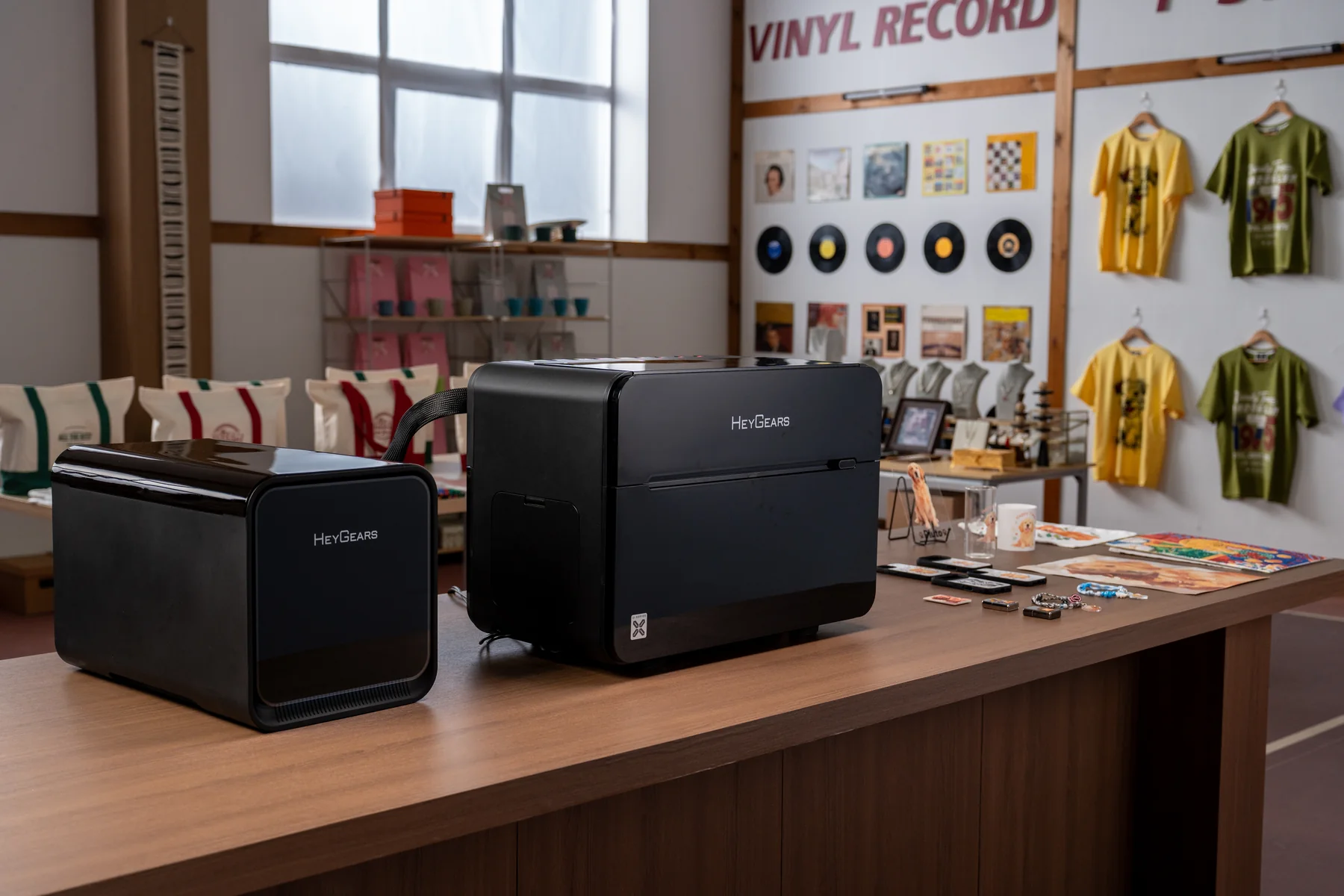
All three tiers ship through the same VIP deposit program and share a common physical footprint: a 420 x 330mm print area (with 150mm of additional build height on the Full-3D Pack), 1440 x 2400 DPI UV precision, a 5mm texture ceiling, 400+ substrate compatibility, roughly 45kg unit weight, and a 6kg supported printing load. Where they split is capability included at the door:
- G1X Full-3D Pack — $3,299 VIP price ($5,499 official MSRP), $3,599 Super Early Bird. Epson i3200 printhead, 8 ink channels, full-color 3D printing and UV/relief both included out of the box, 8 x 1000ml ink cartridges plus a resin station, 3D layer thickness of 10–30 microns.
- G1X Starter Pack — $2,999 VIP price, $3,299 Super Early Bird. Same i3200 printhead and 8-channel ink system, UV printing included from day one, but full-color 3D printing is an upgrade path — you add a Resin Station later rather than getting it in the box. Ships with 8 x 300ml cartridges.
- G1 Starter Pack — $1,699 VIP price, $1,999 Super Early Bird. Runs the cheaper Epson F1080 printhead (6 channels, standard UV speed, not the 3x-faster tier, no printhead heating or white-ink agitation). Both full-color 3D printing and the i3200 printhead itself are upgrade paths here, not included.
Worth noting: only the Full-3D Pack has a published MSRP figure to compare against its VIP price. The two Starter tiers only have VIP and Super Early Bird figures available, so there’s no clean before/after discount number to quote for them — don’t assume the same roughly 40% VIP discount ratio the Full-3D Pack shows applies evenly across the lineup.
What a Kickstarter deposit actually buys you
This is the part that needs to be stated plainly rather than buried in fine print: a Kickstarter deposit is a reservation, not a purchase. HeyGears’ program asks for a refundable $50 deposit, which unlocks VIP pricing (up to $300 off the Super Early Bird price) and reserves a spot in the queue. Backers who convert that deposit into an actual pledge within the first 48 hours of the campaign going live also get a free $39 UV white ink bottle and priority shipping placement. The G1 Series campaign is expected to go live on Kickstarter in July 2026.
Shipping is targeted for Q4 2026, worldwide, with a limited number of territories excluded for logistics reasons. HeyGears states it will cover customs fees for listed regions, plus VAT for EU and UK backers, with backers responsible for a portion of shipping cost only: free for mainland China, Hong Kong, and Taiwan; $50 for the US, Canada, and Australia; $100 for the EU, UK, Japan, South Korea, Singapore, and New Zealand; $200 for other supported regions. Warranty coverage is 1 year on the main body, with the printhead — the part most likely to actually wear out — covered separately for 180 days.
None of that is a guarantee. Crowdfunding campaigns carry execution risk that a retail purchase from stock simply doesn’t: specs, pricing, and the shipping timeline can all still shift between now and when the campaign fully launches, and again between launch and when units actually leave the factory. A $50 deposit is a low-cost way to lock in early pricing and a place in line, but it should be treated as exactly that — not as a receipt for a printer that’s already sitting in a warehouse. If the 3-in-1 workflow solves a real problem you have — full-color prototypes, UV relief signage, small-batch printed substrates — the economics here are unusual enough to be worth watching. Just watch it as a pre-launch bet, not a done deal.