Recycled filament is filament made from reprocessed plastic, either a maker’s own off-spec filament ground up and re-extruded, or collected waste. Every reprocessing cycle can shorten the polymer chains and add variation, which is why most problems fall into four groups: moisture, diameter and roundness variation, contaminants, and brittleness. Dry the spool first (Prusa lists 45 °C for 6 hours for PLA and rPLA and 55 °C for 6 hours for PETG), then measure the diameter at several points, then tune temperature and flow for that spool.
This guide gives a diagnosis table, the published figures for two recycled PLA products, what peer-reviewed studies found when PLA and PETG were recycled several times, and the settings to adjust. Numbers come from Prusa, colorFabb, Spectrum and two open-access studies, linked at the end; where a value is our starting point, it is labelled.
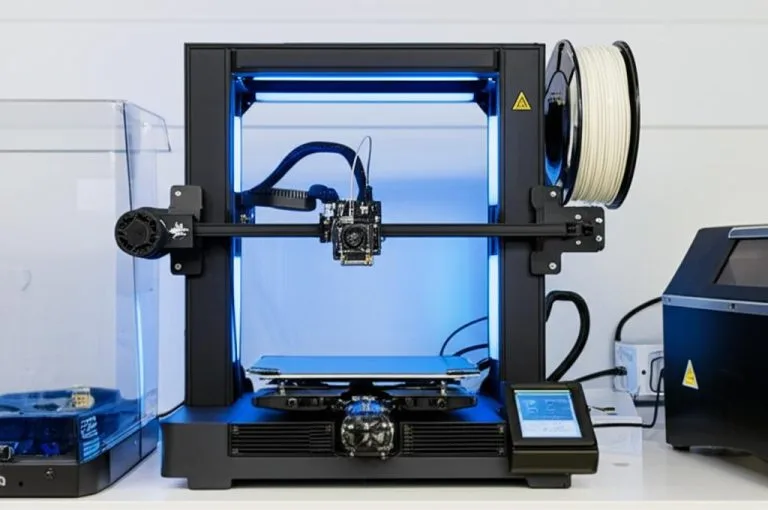
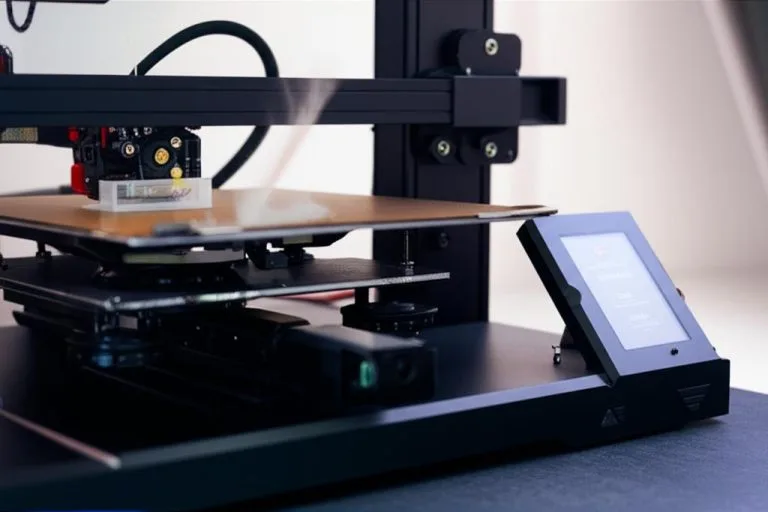
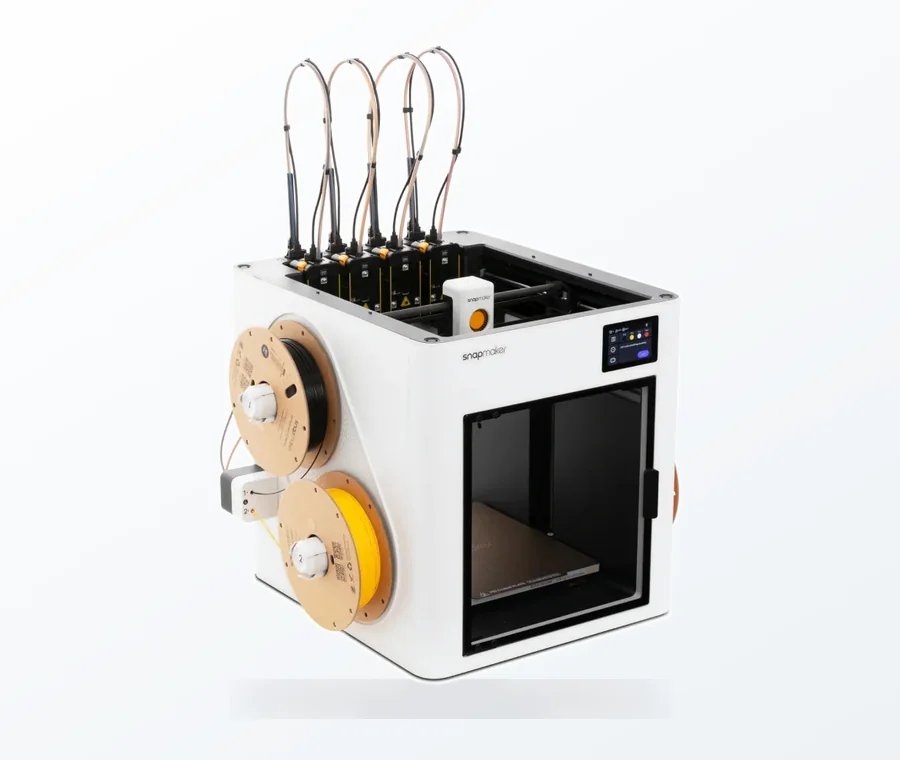
The consumer toolchanger 3D printer: the SnapSwap 4-toolhead system swaps heads in 5 seconds for true multi-color and multi-material printing, with smart calibration and auto filament loading.
- 4 toolheads · 5 s swap
- Up to 500 mm/s · 20,000 mm/s²
- 270 mm cube build volume
- Multi-color & multi-material
Fix a bad recycled spool in 5 steps
- Dry the spool at the maker’s temperature and time before judging it (Prusa: PLA/rPLA 45 °C for 6 h, PETG 55 °C for 6 h).
- Measure the diameter at 5 to 6 points along the filament and enter the average in the slicer.
- Print a temperature tower, then a flow calibration cube, for this spool and colour.
- Check for specks and debris at the extruder and nozzle; do a cold pull if flow is uneven.
- If prints still snap or delaminate, stop tuning: the polymer may be degraded. Use the spool for non-structural parts.
Recycled filament problems at a glance
| Symptom | Likely cause | What to do |
|---|---|---|
| Bubbles, popping, stringing, rough surface | Moisture (Prusa lists poor surface, stringing, blobs, and in some cases bubbling and smoke as wet-filament signs) | Dry at the maker’s figures; store sealed; retest. See the drying section |
| Line width varies in bands, thin walls then bulges | Diameter or roundness variation | Measure at several points; average it in the slicer; calibrate flow per spool |
| Extruder clicks, uneven flow, nozzle clogs | Contaminants or inconsistent diameter (Prusa says both can jam the extruder gears or nozzle) | Cold pull; clear the clog; try another spool or supplier |
| Snaps when loaded, parts shatter | Degraded polymer or hydrolysis of wet material | Dry first; if still brittle, use for non-load parts |
| Weak layer bonding | Lower-viscosity or degraded material, or too cold | Raise nozzle temperature in 5 °C steps within the maker’s range; slow down |
| Strings and ooze even when dry | Material flows more easily (lower viscosity) than the profile expects | Lower temperature in 5 °C steps and retune retraction |
| Colour differs between spools | Batch-to-batch variation (colorFabb states each Regrind batch has a unique colour) | Buy enough of one batch for a project |
| Clogs only in an enclosure with PLA | Heat creep | Prusa advises opening enclosure doors or vents when printing PLA |
What published recycled filaments look like
| Product | Published properties | Source |
|---|---|---|
| colorFabb PLA Regrind | Made from 100% in-house filament extrusion waste; each batch has a unique colour. 1.75 mm filament with max. roundness deviation of ±0.05 mm. Nozzle 195–220 °C, bed 50–60 °C, cooling fan 100%, speed 40–100 mm/s. Printed tensile strength 53 MPa and Charpy impact 2.9 kJ/m², against 70 MPa and 4.0 kJ/m² for colorFabb’s premium PLA | colorFabb TDS, Dec 2023 |
| Spectrum r-PLA | Made from recycled extrusion residual waste. Nozzle 190–215 °C, bed 40–50 °C, melt flow rate 5–7 g/10 min (210 °C, 2.16 kg), speed 30–90 mm/s; the sheet lists a dry box and closed chamber as not necessary | Spectrum TDS, 2022 |
Note the pattern in the colorFabb sheet: even factory regrind, with a known source, shows lower strength and impact than the same maker’s premium filament. Expect that for any recycled spool, and check whether the maker publishes a data sheet. If it does not, treat all temperature and strength claims as unverified.
Drying recycled filament
Moisture is the first thing to rule out because it mimics every other fault. Prusa’s guide lists a poor surface as the first signal of wet filament, followed by stringing, and in some cases low layer adhesion, blobs, bubbling and smoke. Its drying table gives PLA/rPLA 45 °C for 6 hours and PETG (all versions) 55 °C for 6 hours, and says not to exceed the listed temperatures or the filament will soften and stick together. Home ovens are imprecise, and Prusa recommends an external thermometer.
Labs dry harder: Vidakis et al. dried PETG pellets at 80 °C for 24 hours before extruding them. That is raw pellet in a lab, not a wound spool, so use the maker’s figures for a spool. If the spool came without drying guidance, the Prusa values for the same polymer are a reasonable starting point, not a guarantee. Store dried filament sealed with desiccant, as Prusa suggests, and print soon after.
Diameter and roundness variation
A recycled spool may be less consistent than a virgin one, and the slicer assumes one diameter for the whole spool. The colorFabb sheet gives ±0.05 mm roundness deviation for 1.75 mm filament. By our arithmetic, flow scales with cross-section, so 1.70 mm delivers about 94% and 1.80 mm about 106% of the volume of 1.75 mm: a swing of roughly ±6% along the spool, enough to show as banding. For comparison, the PETG recycling study kept diameter within 0.07 mm of target with an optical monitor on the extruder.
- Take a caliper reading at 5 to 6 places along 1 to 2 metres of filament, and rotate the filament between readings to catch an oval profile (our suggestion).
- Average the readings. The Slic3r manual recommends exactly this: multiple measurements along the filament, using the average.
- Enter the average in the filament diameter field of your slicer.
- Print a flow test with this spool; the procedure is in the flow rate calibration guide.
- If readings swing far beyond the maker’s tolerance, the spool is the problem, not your settings; return it or use it for rough prints.
Contaminants and clogs
Prusa’s clogged-nozzle guide says low-quality filament often has inconsistent diameters or impurities that can physically jam the extruder gears or nozzle. Recycled spools are not automatically low quality, but a mixed or poorly cleaned feedstock raises that risk. In the Hidalgo-Carvajal PLA study, waste of unknown origin (PLA-M) degraded faster than a known commercial source (PLA-C): its intrinsic viscosity fell about 22% in three cycles against about 8% for PLA-C.
Specks that clog show up as sudden gaps or a clicking extruder. Clear them with the methods in clearing a clogged nozzle. A bigger nozzle passes bigger specks; that is general practice and our suggestion, not a sourced figure, and it costs fine detail.
Brittleness and what recycling does to strength
| Study | What was recycled | Findings |
|---|---|---|
| Hidalgo-Carvajal et al., Polymers 2023 | PLA from known filament waste (PLA-C) and mixed unknown PLA (PLA-M), re-extruded repeatedly | PLA-C: molecular weight down about 8.9% after 3 cycles and about 48% by cycle 5; tensile strength of films 46.3 to 34.2 MPa by cycle 5; elongation 4.08 to 3.31%. The authors conclude recycling is feasible for up to 3 cycles for PLA-C and 2 for PLA-M |
| Vidakis et al., Materials 2021 | PETG over six extrusion cycles | Tensile and flexural strength peaked around cycle 3 (tensile 46.1 MPa, +15.8% over pure PETG); impact strength declined over the cycles; interlayer gaps appeared in cycles 5 and 6, and flow dropped significantly by cycle 5 |
Two cautions. These are lab studies on specific materials and equipment, and the PLA specimens were films, not printed parts, so they show the trend, not a number you can design with. And PETG’s strength gain did not come with better impact resistance, which is the property that matters when a part snaps. For parts that carry load or take impacts, use virgin filament; see brittle PLA prints for what moisture and storage do to PLA. We have no source showing annealing restores degraded polymer.
Temperature and slicer starting points
Use the maker’s range, then let a temperature tower decide. For PLA recycled products the two data sheets above give 195–220 °C (colorFabb) and 190–215 °C (Spectrum) on a 0.4 mm nozzle; starting in the middle of the range and moving in 5 °C steps is a reasonable method, not a published rule. Run the temperature tower for each new spool, because properties vary between batches. For recycled PETG we did not find a maker data sheet, so begin from your virgin PETG profile and treat it as unverified.
If strings appear on a dry spool, lower the temperature first, then retraction; the usual fixes are in removing strings and blobs. If you make filament yourself, see home recycling of PLA and PETG for what is realistic.
Common mistakes
- Tuning around a wet spool. Dry it first or every setting you change is wrong.
- Trusting the label diameter. Measure it; recycled spools vary more.
- Mixing batches in one print. Colour and flow may differ between spools.
- Overheating the dryer. Exceeding the maker’s temperature softens and fuses the spool.
- Printing structural parts from unknown material. Without a data sheet you do not know its strength.
Frequently asked questions
Is recycled filament weaker than virgin filament?
Usually somewhat. colorFabb’s data sheet lists 53 MPa tensile strength and 2.9 kJ/m² impact for its PLA Regrind against 70 MPa and 4.0 kJ/m² for its premium PLA. Studies on repeatedly recycled PLA also show falling molecular weight and strength, so avoid recycled material for parts that carry load.
How many times can PLA be recycled?
It depends on the source and process. In one 2023 study, PLA from a known filament could be re-extruded up to 3 times and mixed unknown PLA only 2 times before degradation became a problem. The data are for lab re-extrusion, so treat them as a guide rather than a limit.
Why do I get bubbles and stringing with recycled filament?
Wet filament is the most likely cause. Prusa lists poor surface quality, stringing and, in some cases, bubbling and smoke as signs, and recommends drying PLA/rPLA at 45 °C for 6 hours and PETG at 55 °C for 6 hours. If the spool is dry and still strings, lower the nozzle temperature by 5 °C and retune retraction.
Does recycled filament clog nozzles more often?
It can. Prusa notes that impurities and inconsistent diameters in low-quality filament can jam the extruder gears or nozzle, and recycled feedstock from unknown sources carries that risk. A cold pull usually clears small contamination; if it clogs repeatedly, switch spools.
Sources
- Prusa Knowledge Base: Drying filament
- Prusa Knowledge Base: Clogged nozzle
- colorFabb: PLA Regrind technical data sheet (Dec 2023)
- Spectrum Filaments: r-PLA technical data sheet (2022)
- Hidalgo-Carvajal et al., Recycled PLA for 3D Printing (Polymers, 2023)
- Vidakis et al., Mechanical Response of PETG over Multiple Recycling Processes (Materials, 2021)
- Slic3r manual: Configuration wizard (filament diameter)