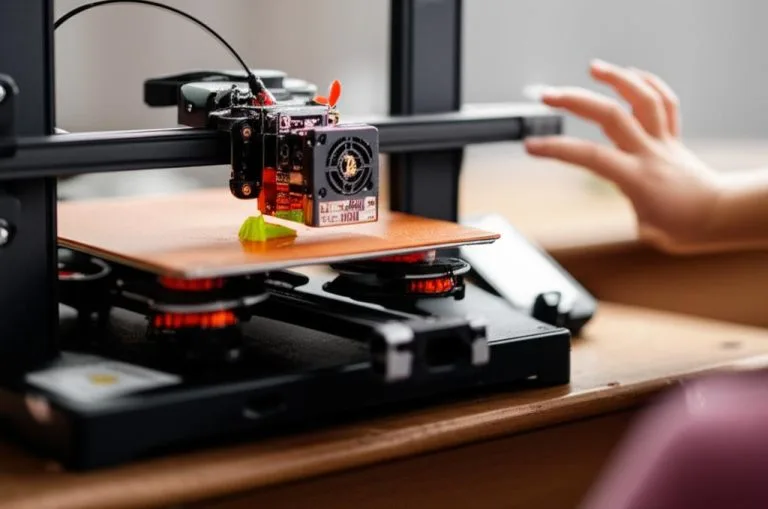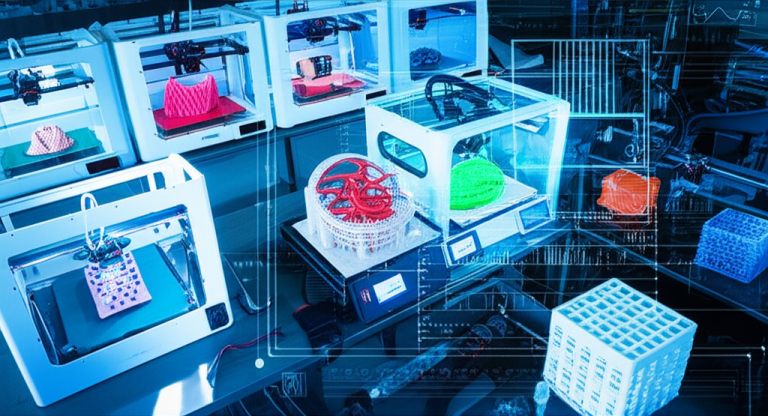
In materials science research, 3D printing is mainly a fast way to make things that are slow or impossible to make otherwise: custom lab hardware, test specimens, lattices and other architected structures, and parts from new materials whose ink or powder the lab has engineered itself. A hobbyist’s FDM printer can realistically cover the first item and, with care, part of the second. The rest needs equipment or chemistry that does not exist at home.
This article sorts what labs print and why, using peer-reviewed papers and open-hardware journals, then spells out what a maker can and cannot replicate. It is explanatory, not a how-to for running a lab. Every claim about a study is limited to what its abstract reports, and no figure here comes from our own testing.
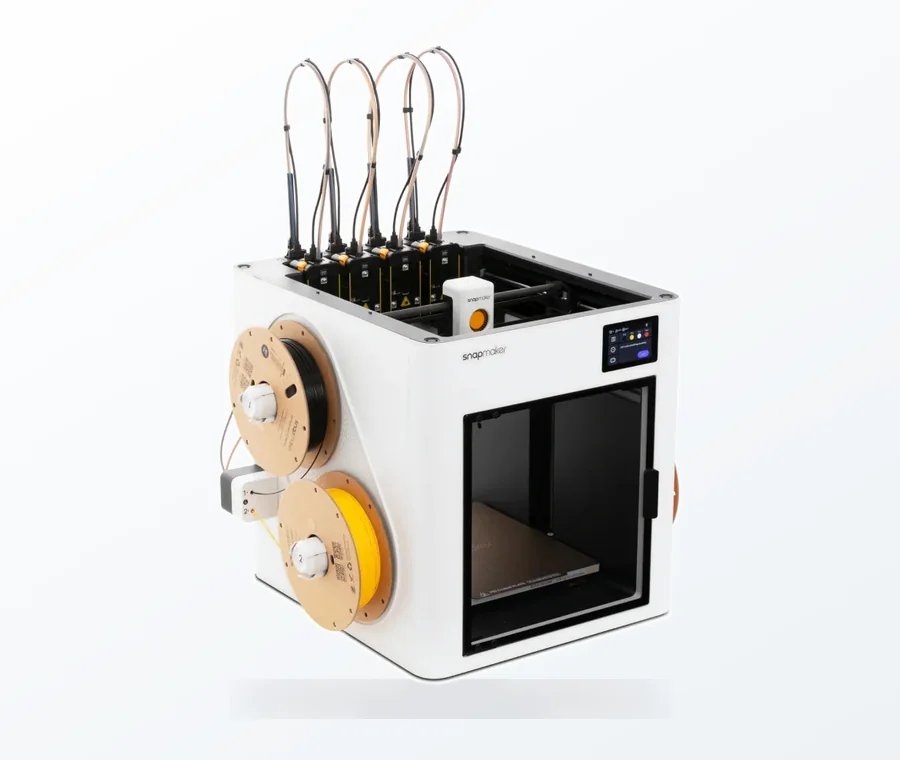
The consumer toolchanger 3D printer: the SnapSwap 4-toolhead system swaps heads in 5 seconds for true multi-color and multi-material printing, with smart calibration and auto filament loading.
- 4 toolheads · 5 s swap
- Up to 500 mm/s · 20,000 mm/s²
- 270 mm cube build volume
- Multi-color & multi-material
What labs print, and what a maker can try
| Use in research | Typical process | Why labs do it | Maker can try it? |
|---|---|---|---|
| Custom fixtures and lab hardware | Desktop FFF/FDM | Cheap, fast iteration on one-off parts | Yes |
| Test specimens for mechanical testing | FFF, resin, powder bed | Specimens of exact geometry, printed in the settings being studied | Partly: you can print them; testing them properly is the hard part |
| Novel inks and composites | Direct ink writing (DIW) | Almost any material can be printed if the ink is engineered for the right flow behaviour | Partly: syringe extruders exist; ink development is the hard part |
| Architected materials (microlattices) | Projection microstereolithography | Lattices that are stiff, strong and light | No |
| Precious and reflective metals | Laser powder bed fusion | Complex metal geometries, jewelry | No (service only) |
| High-throughput design exploration | Printing plus automated testing | Many designs tested with fewer experiments | The idea transfers; the automation does not |
Custom fixtures and lab equipment
The most common use is also the most accessible. A 2012 article in Science (Pearce) describes how a growing selection of laboratory equipment can be fabricated with open-source 3D printers at low cost, and a 2015 PLoS Biology piece (Baden et al.) frames 3D printing as a way to build the “little things” that help a lab get running faster. Holders, adapters, mounts, clamps and enclosures fall here. For the same reason, jigs and test fixtures are a core use in factories; see jigs and fixtures. A maker can do all of this on an FDM printer, and the hobby guidance on high-strength filaments applies when a fixture carries load.
Test specimens and standards
Research groups print specimens to learn how a material, or a print setting, changes strength. The geometry and test method come from standards: the papers cited here use ASTM D638 and ISO 527-2 for polymer tensile specimens (and ASTM D3039 in one study). The standards themselves are paid documents that we did not read, so follow the current edition if you work to them.
Two recent open-access papers show why printing a specimen is not the same as measuring a material:
- ULTEM 9085 (Marquis et al., Polymers 2026). Evaluating printed parts per ASTM D638, the authors note that manufacturer datasheets give no guidance specific to articles printed in the XY plane, and that failures can start at microstructural anomalies rather than reflecting the material itself. Modest changes to print settings, including contour overlap, raised gage-section failures for ±45° infill Type 1 samples from 5% to 100%, and ultimate tensile strength from 49 ± 2 MPa to 61 ± 2 MPa.
- PETG specimen geometry (Özen et al., Materials 2021). The authors compared four tensile specimen geometries based on ASTM D3039 and ISO 527-2 and found that the chosen slicer parameters affect where in the specimen the failure occurs.
The lesson for makers: a printed bar’s result depends on slicer settings, orientation and the machine, not just the filament. Compare your own prints with each other, with identical settings except one variable, and several specimens per condition. A 2025 exploratory study of PLA and polycarbonate (Aldawood et al.) found large practical differences with build orientation but its own power analysis showed that n = 1 per condition was insufficient to establish significance. Do not compare your result with a datasheet number. For practical orientation and strength guidance, see print orientation for strength and layer adhesion.
Testing is also the expensive part. Universal testing machines are costly, and open-hardware journals publish cheaper builds, for example a 2026 HardwareX micro-compression tester under USD 1,500 with 0.01 N force resolution, validated against a commercial machine on soft PDMS samples in the small-strain range. That device suits soft materials, not PLA tensile bars, so match the instrument to the test.
Novel materials and architected structures
Direct ink writing
Direct ink writing extrudes an engineered paste or gel. A 2022 review in Advanced Materials (Saadi et al.) calls DIW the most versatile 3D printing technique for the broadest range of materials, and says it can print practically any material as long as the precursor ink shows appropriate rheological behaviour. The review covers polymers, ceramics, glass, cement, graphene, metals and multimaterial printing, along with its limits.
A maker’s route in is a syringe extruder on an existing printer; the 2026 HardwareX Allstruder, for example, is described as an open syringe extruder configurable for nearly any extrusion-based printer and supporting syringes from 0.1 to 100 mL. The hardware is the easy half. Formulating an ink that flows, holds shape and cures is a materials-science project in itself, and you should check the safety data of every component.
Lattices and metamaterials
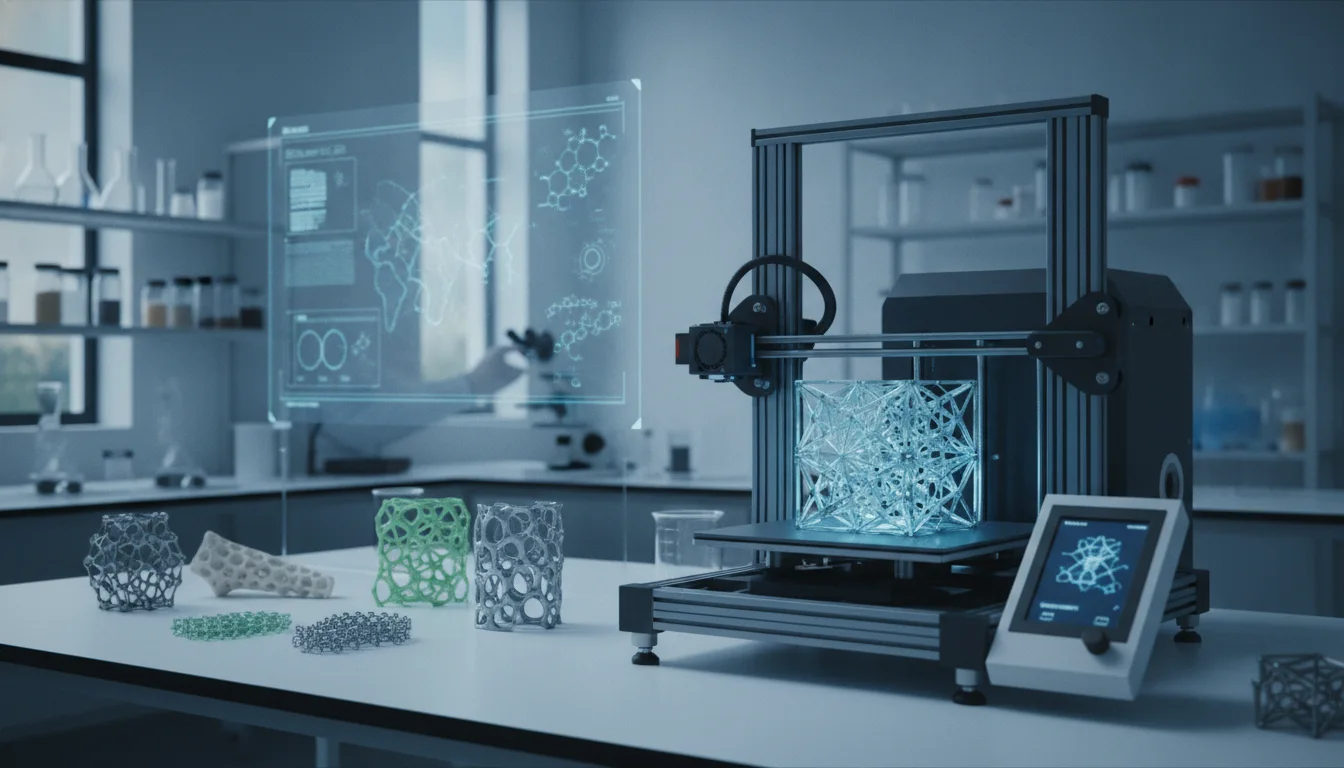
A 2014 Science paper (Zheng et al.) used projection microstereolithography to make octet microlattices from polymers, metals and ceramics. The design meant the individual struts did not bend under pressure, giving materials that were exceptionally stiff, strong and lightweight. Reproducing this needs specialised projection equipment that a hobby resin printer does not provide.
Reflective metals
Laser powder bed fusion of precious metals is hard because gold, silver, copper and platinum alloys are highly reflective and conductive to heat, which leads to poor densification. A 2024 review in Metals (Thangamani et al.) proposes alloying additions, coated powder particles and green or blue lasers as fixes. This is service-bureau territory.
High-throughput and autonomous experiments
Printing is fast, which makes it a good partner for automation. In a 2020 Science Advances paper (Gongora et al.), a system called BEAR combined Bayesian optimization with high-throughput automated experimentation to test the toughness of a parametric family of printed structures. It needed almost 60 times fewer experiments to find high-performing structures than a grid-based search. A maker can borrow the idea without the robot: change one parameter at a time, record every result, and let earlier results guide the next print.
What a maker can and cannot replicate
| Task | At home? | Notes |
|---|---|---|
| Print fixtures, holders and adapters | Yes | Pick a material for the load and temperature |
| Compare two print settings with printed bars | Yes, with limits | Use replicates, change one variable, report spread; relative results only |
| Publish datasheet-style material properties | No | Needs standards, calibrated test machines and controlled specimen preparation |
| Print pastes with a syringe extruder | Yes, as a project | Ink rheology and curing are the research problem |
| Print microlattices or precious metals | No | Specialised equipment; use a research or service facility |
| Test whether a printed part resists a chemical | Limited | Soak a printed coupon in your actual chemical; see chemical resistance data for maker charts, and never assume |
Common mistakes
- Comparing a printed bar’s result to a datasheet. Print orientation, settings and test method all differ.
- One specimen per condition. You cannot separate material effects from print-to-print scatter.
- Changing several settings at once. You will not know which one mattered.
- Using a hobby instrument for a test it was not validated for. The HardwareX tester above is validated for soft materials in the small-strain range only.
- Treating one paper’s numbers as general. Each study used its own material, machine and settings.
Frequently asked questions
Can I use a hobby FDM printer to make tensile test specimens?
Yes, you can print them, and they are useful for comparing your own print settings with each other. They are not a substitute for certified material data, because results depend on slicer settings, orientation and the machine, as the ULTEM and PETG studies cited above show. Print several specimens per condition.
Which standards do researchers use for printed polymer specimens?
The papers cited here use ASTM D638 and ISO 527-2 for tensile specimens, and one also used ASTM D3039. These are paid standards that define specimen geometry and test method. Check the current edition before working to one.
Why are gold and silver hard to 3D print?
A 2024 review in Metals reports that the high reflectivity and thermal conductivity of gold, silver, copper and platinum alloys cause poor densification and mechanical properties in laser powder bed fusion. Proposed fixes include alloying additions, coated powders and green or blue lasers. In practice this is done by specialist services.
Can I try direct ink writing at home?
You can add a syringe extruder to some printers, but the harder part is the ink: it needs suitable rheological behaviour and a way to solidify. Treat it as a project, start with a simple, low-hazard paste, and check the safety data of everything you mix.
Sources
- Pearce, Science 2012: Building research equipment with free, open-source hardware
- Baden et al., PLoS Biology 2015: Open Labware, 3-D printing your own lab equipment
- Marquis et al., Polymers 2026: qualification of additively manufactured ULTEM components
- Ozen et al., Materials 2021: tensile specimen geometry for FDM-printed PETG
- Aldawood et al., Polymers 2025: mechanical properties of FDM polycarbonate and PLA specimens
- Kim et al., HardwareX 2026: low-cost micro compression testing device
- Saadi et al., Advanced Materials 2022: Direct ink writing, a 3D printing technology for diverse materials
- Hinton et al., HardwareX 2026: The Allstruder, an open syringe extruder
- Zheng et al., Science 2014: Ultralight, ultrastiff mechanical metamaterials
- Thangamani et al., Metals 2024: laser powder bed fusion in jewelry
- Gongora et al., Science Advances 2020: A Bayesian experimental autonomous researcher for mechanical design