FDA regulates a 3D printed medical device the same way as one made by any other process: the device’s risk class and intended use decide whether it needs a 510(k) clearance, a De Novo classification or a PMA approval. There is no separate "3D printing approval". FDA’s guidance Technical Considerations for Additive Manufactured Medical Devices (issued 5 December 2017) adds what it expects on design, software workflow, material controls, post-processing, process validation, testing and labeling.
Three further points frame everything below. FDA clears or approves finished devices for an intended use, not printing materials in general. Exemption from 510(k) does not exempt a manufacturer from quality system requirements, which since 2 February 2026 are the Quality Management System Regulation (QMSR) built on ISO 13485:2016. And printing devices at a hospital (point of care) is still described only in a 2021 discussion paper, not in guidance. This article summarizes public FDA texts for orientation; it is not regulatory or legal advice, and it is written for manufacturers, not for hobbyists, who should not make devices for patient use.
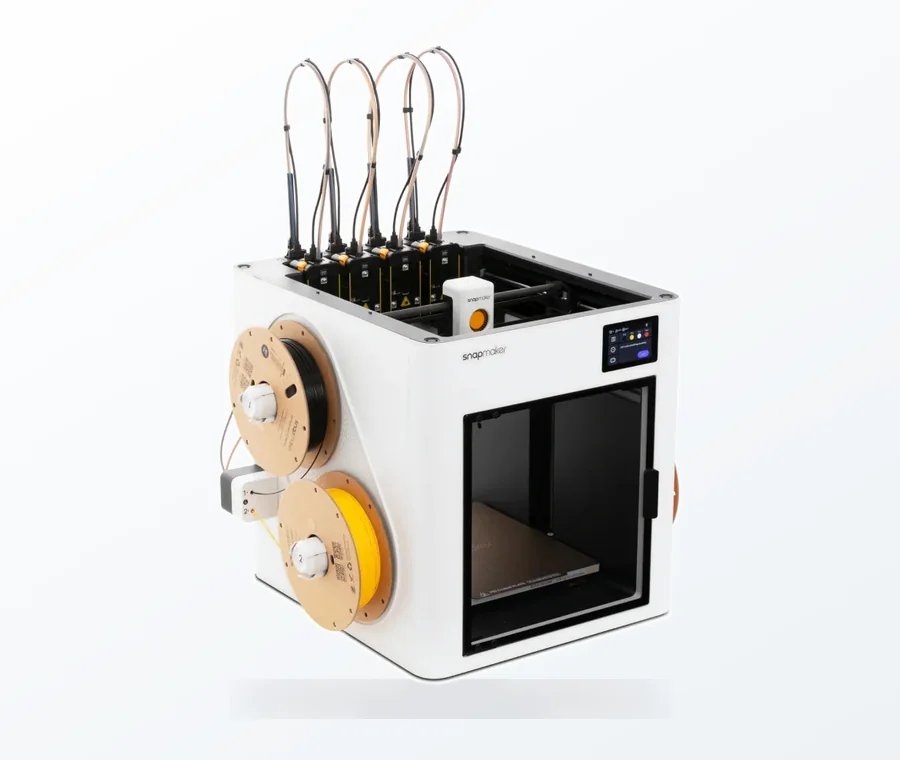
The consumer toolchanger 3D printer: the SnapSwap 4-toolhead system swaps heads in 5 seconds for true multi-color and multi-material printing, with smart calibration and auto filament loading.
- 4 toolheads · 5 s swap
- Up to 500 mm/s · 20,000 mm/s²
- 270 mm cube build volume
- Multi-color & multi-material
The route in five steps
- Define the intended use and indications. Classification depends on both.
- Find the device’s classification (class I, II or III) in FDA’s product code classification database.
- Pick the route that matches: exempt, 510(k), De Novo, PMA, or HDE for rare conditions.
- Address the additive-manufacturing considerations from the 2017 guidance in your design controls and submission.
- Consider a Pre-Submission. FDA ‘strongly encourages’ this if it is unclear what technical information a premarket submission for an additively manufactured device should contain.
510(k), De Novo, PMA and the other pathways compared
| Pathway | For which devices | What FDA looks for | Timeframe stated by FDA |
|---|---|---|---|
| Exempt | Many class I devices (about 74% of class I are exempt) and some class II | No premarket notification; limitations on exemptions and quality system rules still apply | None |
| 510(k) | Class I or II devices that are not exempt | Substantial equivalence to a legally marketed predicate: same intended use, and same or non-problematic different technology. Not required to be identical | Decision usually made within 90 days; you may not market before the order |
| De Novo | Novel devices of low to moderate risk with no predicate | General controls, or general and special controls, give reasonable assurance of safety and effectiveness. If granted: class I or II and a new classification regulation. If declined: stays class III | Review goal: 150 review days, excluding time on hold |
| PMA | Class III devices (support or sustain life, or high risk) | Sufficient valid scientific evidence that the device is safe and effective: non-clinical laboratory studies (e.g. biocompatibility, stress, wear, shelf life) and clinical investigation data | FDA charges a PMA review fee |
| HDE | Humanitarian use devices for conditions affecting not more than 8,000 individuals in the US per year | Exempt from the effectiveness requirement of sections 514 and 515 of the FD&C Act, with profit and use restrictions | Not stated on the page reviewed |
| Breakthrough designation | Devices for life-threatening or irreversibly debilitating conditions that meet further criteria | Voluntary program with prioritized review. Devices must still meet FDA’s standards for safety and effectiveness | Not a pathway on its own |
Classes follow risk: class I is lowest, class III highest. FDA says classification depends on intended use and indications for use, and there are about 1,700 generic device types across 16 panels. A 3D printed implant may therefore end up in a very different route from a 3D printed surgical guide for the same clinic. The overview of products in this field is in our guide to 3D printing in medicine.
What FDA’s additive manufacturing guidance covers
The guidance is non-binding: "should" means suggested, not required. It calls itself a leapfrog guidance, a first look at an emerging technology, and says recommendations may change. It names powder bed fusion, stereolithography, fused filament fabrication and liquid-based extrusion as the most commonly used technologies in medical devices at the time of writing. The device-testing part describes information to include in 510(k), PMA, HDE, De Novo and IDE submissions.
| Topic | What the guidance recommends (paraphrased) |
|---|---|
| Overall design | Compare the feature sizes you need with your process’s minimum feature size and the machine’s tolerances; document dimensional specifications and surface finish requirements |
| Patient-matched devices | Define a design or performance envelope (minimum and maximum dimensions and performance limits) before matching to a patient; software should stop an operator exceeding it; consider imaging resolution, smoothing and anatomy that changes over time |
| Software workflow | Verify critical attributes after file format conversions, especially for patient-matched devices; revalidate if software changes; describe build placement, supports, slicing, build paths and machine parameters |
| Material controls | Control and document starting material; for reuse of powder or resin, describe the reuse process, for example filtering or a limit on percent reuse, and show reuse does not harm the device |
| Post-processing | Document steps such as residue removal, heat treatment and machining, and their effects. Example: hot isostatic pressing can reduce porosity and increase fatigue life but can also reduce modulus and yield strength |
| Process validation | Validate where results cannot be fully verified by inspection. Quality can vary between machines of the same model, so account for variation within a build, between builds and between machines. Includes revalidation, acceptance activities and test coupons |
| Device testing | Mechanical testing, dimensional measurements, material chemistry and physical properties, removal of manufacturing residues, sterilization, biocompatibility (ISO 10993-1) |
| Labeling | For patient-matched devices: patient identifier, use, and final design iteration; expiry may depend on the imaging date; warn that anatomy may have changed since imaging |
Two details matter for porous and lattice parts. Complex geometry makes cleaning and sterilization harder, so residue removal and sterilization validation should consider worst-case geometry, and destructive testing may be needed to validate removal from trapped volumes. FDA also notes that many end-user facilities may lack the equipment or trained staff for such cleaning, so only sufficiently cleaned devices should reach the end user. These points, and the whole safety logic, are why a hobby printer, whose process is not validated and whose parts are not cleaned to a defined level, does not make a medical device.
Quality system: QMSR now includes ISO 13485
FDA’s final rule amending 21 CFR part 820 became effective on 2 February 2026, and the regulation is now called the Quality Management System Regulation. It incorporates ISO 13485:2016 by reference; if a clause conflicts with the FD&C Act or its regulations, the Act and regulations control. The 2017 guidance was issued before this change and cites the old section numbers such as 820.30 (design controls) and 820.75 (process validation); FDA’s note on the guidance asks manufacturers to review the current QMSR. Check the current text rather than older summaries.
Patient-matched is not the same as custom
Devices matched to a patient’s anatomy from imaging are often called customized, but FDA’s guidance says they are not custom devices under the FD&C Act custom device exemption unless they meet all criteria of section 520(b). It adds that most patient-matched devices fall within the existing regulatory pathway for that device type. If you are building a business around patient-specific parts, plan for the normal route first.
Printing at the point of care
In December 2021 FDA’s Center for Devices and Radiological Health (CDRH) published a discussion paper, 3D Printing Medical Devices at the Point of Care. It states that it is not draft or final guidance and conveys no current policy. It sets out three scenarios and asks 16 questions for public comment:
- Scenario 1: a healthcare facility uses a medical device production system with premarket authorization. A facility using it in accordance with its labeling would generally not be considered a manufacturer.
- Scenario 2: a traditional manufacturer, possibly a contract manufacturer, operates on or near the hospital site and is generally responsible for compliance.
- Scenario 3: the facility takes on all traditional manufacturer responsibilities and must comply with the rules for device manufacturers.
The paper lists challenges: assuring safety and effectiveness wherever a device is made, controlling design and production, clarifying who is responsible, and training and capability at the facility. It excludes bioprinting and tissue products. FDA’s printing overview page still presents it only as a discussion paper, so treat the scenarios as a direction of travel, not rules. For the practical side of what is printed in hospitals, see 3D printed dental restorations for one concrete field.
Common planning mistakes
- Treating a cleared material as a cleared device. FDA clears finished devices; a material cleared in one device is not cleared for other uses.
- Assuming exempt means no quality system. The guidance says 510(k) exemption does not exempt a device from quality requirements.
- Validating one printer once. Quality can vary between machines of the same model, even with the same parameters and material.
- Skipping post-processing and cleaning validation. Residues, support removal and sterilization of complex geometry are explicit review topics.
- Ignoring file conversions. Errors in file conversion can change dimensions of the final device; see STL mesh errors for the hobby-level version of the problem.
- Not asking FDA early. The guidance repeatedly points to the Pre-Submission program and the Division of Industry and Consumer Education.
Other regulated applications have their own rules; for food contact, see food contact rules.
Frequently asked questions
Does FDA approve 3D printers or printing materials?
FDA generally clears or approves finished devices for an intended use, not materials for general use. A material is judged as part of the device and its intended use, so clearance in one device does not carry over to other devices. The point-of-care discussion paper floats the idea of a marketed production system but that is not current policy.
Does a 3D printed device need clinical trials?
It depends on the pathway. A 510(k) rests on substantial equivalence to a predicate, while a PMA needs sufficient valid scientific evidence that includes non-clinical and clinical data. FDA expects additively manufactured devices to follow the same requirements as non-additive devices of the same type, with rare exceptions where printing raises different safety questions.
Can a hospital print devices without FDA review?
The 2021 discussion paper is not policy, so there is no blanket permission. FDA says a facility should ensure printed devices are high quality, perform as intended and do not expose patients to unreasonable risk, and the regulatory responsibility depends on how the printing is organized. Questions about a specific product go to FDA’s review branches or DICE.
Is a patient-specific 3D printed device a custom device?
Not automatically. FDA says patient-matched devices are not custom devices under the FD&C Act exemption unless they meet all criteria of section 520(b), and most follow the existing pathway for their device type.
Sources
- FDA: 3D Printing of Medical Devices
- FDA guidance: Technical Considerations for Additive Manufactured Medical Devices (Dec 2017; full text at fda.gov/media/97633/download)
- FDA: Process of 3D Printing Medical Devices
- FDA: 3D Printing Medical Devices at the Point of Care, discussion paper (2021)
- FDA: Classify Your Medical Device
- FDA: Premarket Notification 510(k)
- FDA: De Novo Classification Request
- FDA: Premarket Approval (PMA)
- FDA: Humanitarian Device Exemption
- FDA: Breakthrough Devices Program
- FDA: Quality Management System Regulation (QMSR)