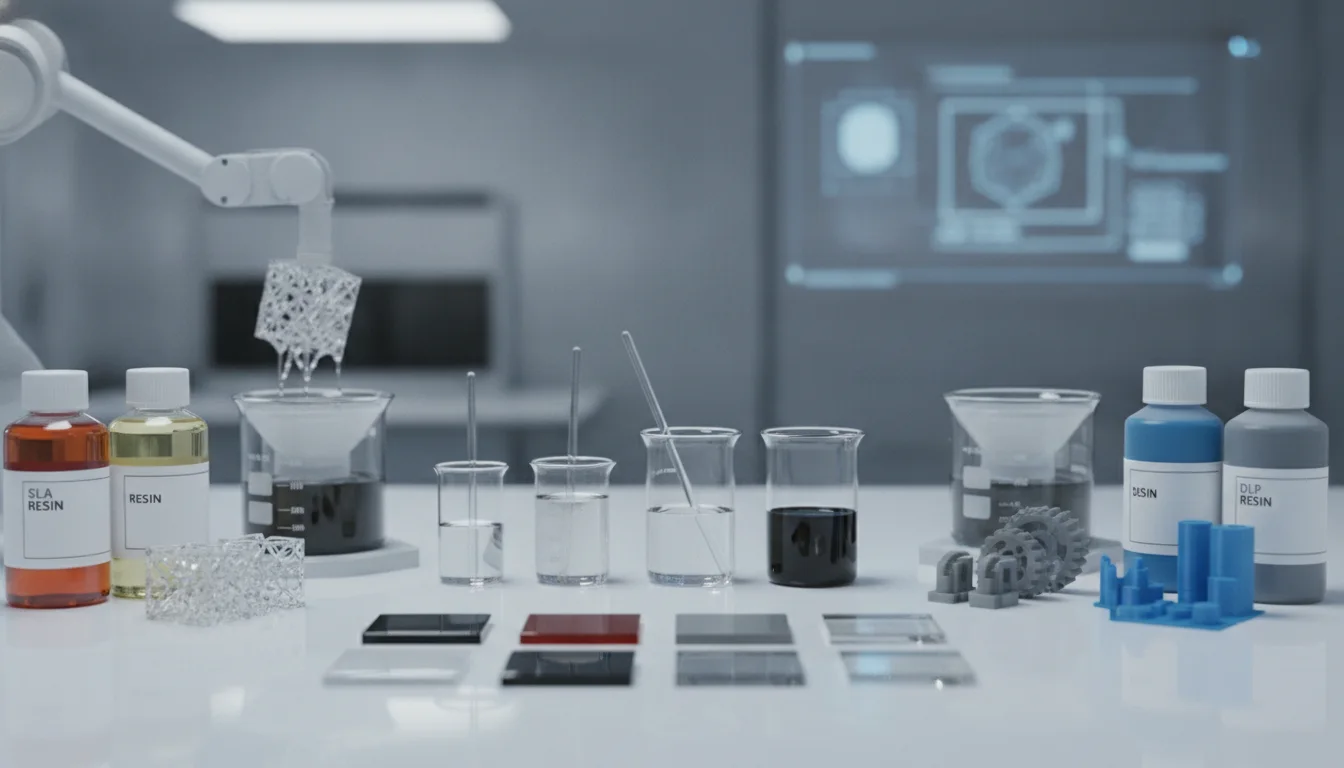
Choosing a resin means matching one cured-material property to the job of the part: stiffness and detail for display models, elongation for parts that must bend or snap, Shore hardness for rubber-like parts, heat deflection temperature for warm environments, clarity for light guides, or clean burnout for casting. Standard resin suits miniatures and display pieces, tough or ABS-like resin suits snap fits and brackets, flexible resin suits gaskets, and high-temperature resin suits heat, at the cost of brittleness.
This guide compares the main resin types with data sheet values from Formlabs and Siraya Tech, shows how to read a data sheet, and covers fine-art choices such as detail, finishing and clear resin. Treat the numbers as examples: they come from different makers, test setups and post-cure procedures, and a hobby resin sold under the same type name can behave differently. Sources are linked at the end.
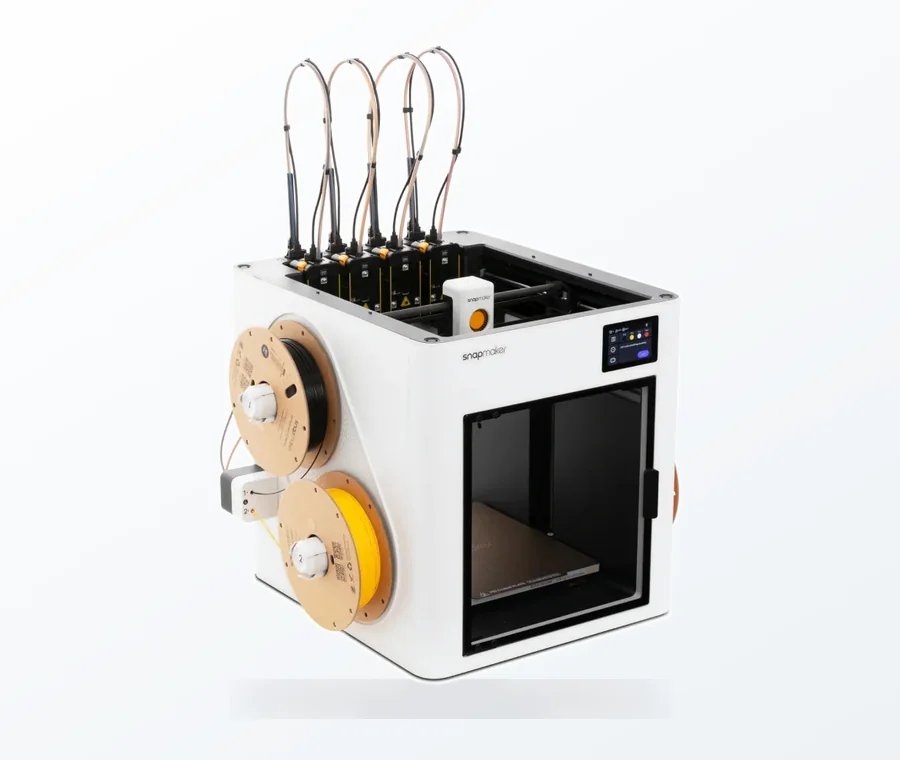
The consumer toolchanger 3D printer: the SnapSwap 4-toolhead system swaps heads in 5 seconds for true multi-color and multi-material printing, with smart calibration and auto filament loading.
- 4 toolheads · 5 s swap
- Up to 500 mm/s · 20,000 mm/s²
- 270 mm cube build volume
- Multi-color & multi-material
Pick by job
- Display models, miniatures, prototypes for looks: standard resin.
- Snap fits, clips, jigs, enclosures: tough or ABS-like resin.
- Gaskets, grips, soft-touch parts: flexible resin, chosen by Shore hardness.
- Parts near heat: high-temperature resin, and check the HDT test conditions.
- Light pipes, lenses, glass-like looks: clear resin, and plan the polishing.
- Jewelry or metal casting: castable resin, matched to your caster’s burnout schedule.
- Skin contact or dental use: only resins sold and documented for that use.
Resin types compared
The table uses Formlabs published values for its own resins as reference points, because Formlabs lists elongation, tensile strength and modulus in one place, plus one hobby resin data sheet from Siraya Tech. Elongation at break tells you how far a part stretches before it breaks; a high figure means tough, a low one means brittle.
| Type | Example and published values | Typical use | Watch out for |
|---|---|---|---|
| Standard / general purpose | Formlabs Grey Resin V5: elongation 13%, tensile strength 62 MPa, flexural modulus 2750 MPa. Clear Resin V5: 8%, 60 MPa, 2700 MPa | Models, figures, visual prototypes | Low elongation, so thin parts break rather than bend |
| Tough / ABS-like | Formlabs Tough 2000 V2: 79%, 40.4 MPa, 1701 MPa, HDT 70 °C. Tough 1500 V2: 155%, 34.0 MPa, 1370 MPa. Siraya Tech Magna Durable Grey: elongation 65, Shore D 74, HDT 57 (ASTM D648, 0.455 MPa) | Snap fits, enclosures, functional prototypes | Soft before full cure, so use dense supports (Siraya Tech). See standard vs tough resin |
| Flexible / elastomeric | Formlabs Flexible 80A V2: elongation 230%, tensile 10 MPa. Flexible 50A: 160%, 3.4 MPa | Gaskets, grips, seals | Needs specific settings; see flexible resin settings |
| High-temperature | Formlabs High Temp: HDT 238 °C at 0.45 MPa, elongation 2.3%, tensile 49 MPa, flexural modulus 2800 MPa | Parts exposed to heat | Brittle at room temperature; values depend on the maker’s post-cure |
| Rigid, glass-filled | Formlabs Rigid 10K: elongation 0.7%, tensile 88 MPa, flexural modulus 9900 MPa | Stiff fixtures, jigs | Very stiff but breaks with almost no stretch |
| Water-washable | Elegoo Water-Washable Resin V2.0: rinse prints under water; described as low viscosity and low shrinkage | Easy cleanup for models | No mechanical data on the product page; the rinse water still contains uncured resin, so handle it as resin waste |
| Clear | Formlabs Clear Resin V5: described as exceptionally clear and color-neutral, polishable to near optical transparency | Light guides, windows, glass looks | Needs sanding and polishing; see polishing resin prints |
| Castable | Formlabs Castable Wax is a 20% wax-filled resin; Formlabs describes True Cast as having minimal ash content and clean burnout | Jewelry and lost-wax casting | Follow the maker’s burnout schedule; not for display parts |
| Dental and biocompatible | Formlabs BioMed resins, made in an FDA-registered, ISO 13485-certified facility | Medical and dental models and devices | Do not use an uncertified hobby resin for skin or body contact |
Two cautions apply to every row. First, the values are for the maker’s own resin, printer and post-cure procedure; the same resin cured on a different light source can differ. Second, HDT is only comparable when the test load matches: Formlabs’ High Temp and Siraya Tech’s Magna Durable are both quoted at roughly 0.45 MPa, which is why that comparison is fair, while a figure at a different load is not.
Reading a data sheet
A technical data sheet (TDS) lists a property, a value and a test method. Siraya Tech’s Magna Durable sheet, for example, names ASTM D638 for tensile, D790 for flexural modulus, D256 for notched Izod impact, D2240 for Shore hardness and D648 for HDT. Check these things before you compare two resins:
- Elongation at break versus tensile strength. A strong resin can still be brittle if elongation is low.
- Flexural modulus is stiffness. Higher means stiffer, not tougher.
- HDT is the temperature at which the material deflects under a stated load. It is not a safe working temperature.
- Post-cure conditions. Values apply after the maker’s wash and cure, so under-cured parts will not match the sheet.
- Storage and shelf life. Formlabs recommends 10–25 °C away from sunlight; Siraya Tech’s Magna Durable sheet gives 15–25 °C in the original opaque bottle.
If a part is brittle even though the sheet looks tough, the cause is often the cure; see why resin prints are brittle. If it must meet chemical or solvent exposure, test the specific chemical; chemical resistance of printing materials has the maker charts that exist.
Choosing a resin for fine art and detailed models

For sculptures and figures, the property that matters most is how the resin handles detail and finishing, and the data sheets say little about it. Here is what we can anchor to maker documentation:
- Color changes exposure. Siraya Tech says its Fast resin colors need longer exposure than the base: about 20% more for Navy Grey and 25% more for Mecha White. Treat every new color as a new resin and calibrate it with an exposure test.
- Printer profiles. Siraya Tech publishes profiles for Elegoo, Anycubic, Phrozen and others. A resin with a profile for your printer saves calibration time.
- Finishing. Clear resin needs sanding, polishing or a clear coat to look clear; Formlabs says its Clear Resin can be polished to near optical transparency. Start with the polishing guide.
- Archival life. We found no maker data on long-term yellowing or aging of cured hobby resins. If a piece is meant to last, ask the maker for ageing data and keep it out of direct sunlight.
Detail comes first from the printer’s pixel size and your exposure and layer-height settings, not from the resin name.
Checks before you buy a resin
- Confirm the maker publishes a profile or exposure table for your printer model.
- Read the data sheet for test methods and post-cure conditions, not just the headline number.
- Check the wash solvent: Siraya Tech’s Fast guide names ethanol or IPA, and Magna Durable gives 90% or higher ethanol or IPA. Water-washable resins skip the solvent but not the safety steps.
- Check shelf life: Siraya Tech’s Fast guide gives 2 years, or 6 months after opening for best performance.
- Read the safety data sheet and plan gloves and airflow; see the resin PPE checklist.
- Buy a small bottle first and calibrate before you commit to a liter.
Common mistakes
- Choosing by the type name alone. “ABS-like” and “tough” are marketing terms; compare elongation and modulus.
- Comparing numbers from different makers as if the tests matched.
- Mixing resins without the maker’s approval. Makers rarely validate blends, so expect to recalibrate exposure.
- Using a functional resin without the right post-cure. The sheet values depend on it.
- Assuming a water-washable resin is a stronger or safer resin. The product page describes cleaning and handling, not strength.
Frequently asked questions
Which resin is best for miniatures?
A standard or high-detail resin with a profile for your printer. For miniatures, calibrate exposure and layer height first, because they affect detail more than the resin’s name does. Choose a tougher resin only if thin parts like swords or ankles break during handling.
What is the difference between standard and ABS-like resin?
Standard resin cures hard but with much lower elongation than tough resins, so it tends to snap under bending. ABS-like or tough resin trades some stiffness for elongation. Formlabs’ Tough 2000 V2, for instance, lists 79% elongation against 13% for Grey Resin V5.
Is water-washable resin good for functional parts?
Elegoo’s product page presents it for easy cleanup and gives no mechanical figures. For load-bearing parts, choose a resin with a data sheet that lists the properties you need.
How long does opened resin last?
It depends on the resin and storage. Siraya Tech’s Fast guide gives 2 years, or 6 months after opening for best performance, and Formlabs advises storing at 10–25 °C away from sunlight. Siraya Tech notes that pigment and components can settle in long storage, so shake well, and if the resin will not remix, replace it.