Automotive 3D printing is the use of additive manufacturing around vehicles: design and fit prototypes, assembly-line tooling and jigs, a small number of series parts, and spare parts for low-volume or old models. The best-documented uses are prototypes and tooling. Ford reports that a prototype that took 4 to 5 months and cost $500,000 with traditional methods can be printed in days or hours for a few thousand dollars, and BMW Group reports about 300,000 printed parts in 2019.
For a hobbyist the useful split is simple. Interior trim, clips, covers and organisers are realistic, and classic-car spare parts can work if the material matches the heat and fluids they will see. Brakes, steering, suspension, seat belts and airbag parts are not a home-printing job. Heat is the first limit: in a US study the dashboard of a car parked in the sun averaged 157 °F (about 69 °C) after one hour, well above the 60 °C where Prusa says PLA gets soft.
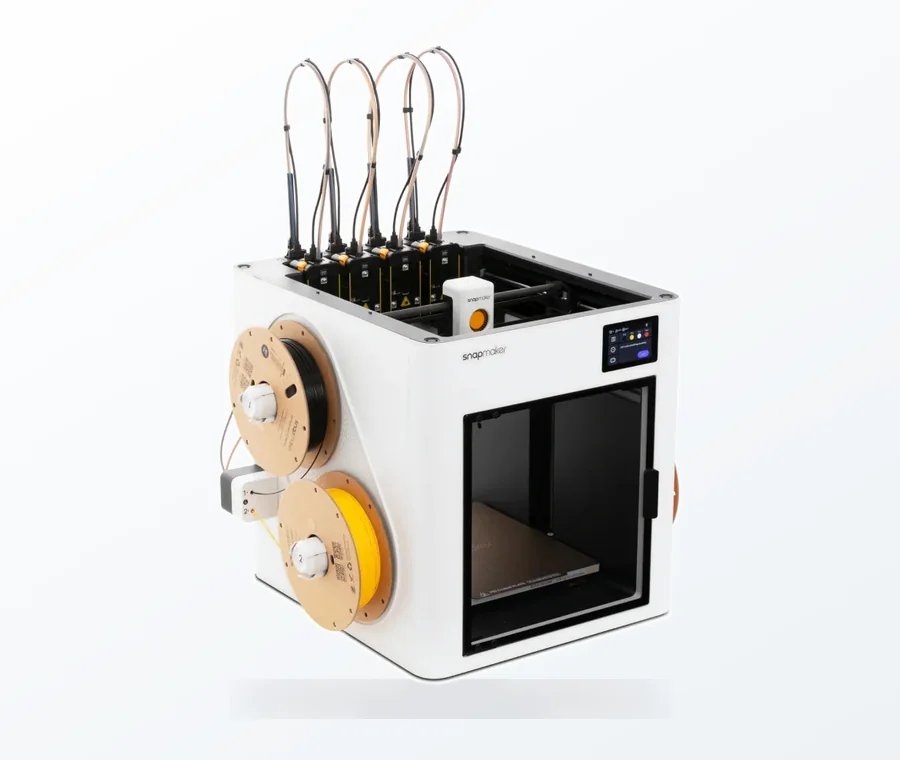
The consumer toolchanger 3D printer: the SnapSwap 4-toolhead system swaps heads in 5 seconds for true multi-color and multi-material printing, with smart calibration and auto filament loading.
- 4 toolheads · 5 s swap
- Up to 500 mm/s · 20,000 mm/s²
- 270 mm cube build volume
- Multi-color & multi-material
What to print, what to think twice about, what to skip
- Print: prototypes and fit checks, jigs and holding fixtures for your own work, storage inserts, cable guides, interior clips and covers away from direct sun.
- Think twice: parts near the windscreen or dashboard top, under-bonnet parts, anything that touches fuel, oil or brake fluid, anything that rattles or flexes all day. Choose a heat-rated material and test it first.
- Skip: brakes, steering, suspension, wheel fixings, seat belts and airbag components, fuel system parts, and any part whose failure can cause loss of control, injury or fire.
What carmakers print
These examples come from the companies themselves or from trade reports of company statements, and the numbers are theirs, not ours.
| Use | Example | What the source says | Source |
|---|---|---|---|
| Prototypes | Ford | Well over 500,000 parts printed over the last few decades; Ford’s example: a prototype that took 4 to 5 months and $500,000 can be printed in days or hours for a few thousand dollars | Ford, September 2019 |
| Prototypes and series parts | BMW Group Additive Manufacturing Campus | About 300,000 parts in 2019; opened 25 June 2020 after a EUR 15 million investment; about 50 industrial systems for metals and plastics on campus and another 50 at production sites | BMW Group, 25 June 2020 |
| Series parts | MINI John Cooper Works GP, Rolls-Royce Phantom, BMW i8 Roadster | The MINI contains four 3D printed components as standard; printed parts also went into the Phantom and the i8 Roadster (2017) | BMW Group, 25 June 2020 |
| Tooling and jigs | Ford, Cologne | More than 50 3D printed tools in use for Ford Focus production, made on Ultimaker printers, with the aim of letting plant-floor workers make simple tools themselves | Digital Engineering 24/7, May 2019 |
| Spare parts | Porsche Classic | 959 clutch release lever printed in tool steel because only 292 cars were built; passed a pressure test of nearly three tonnes and a tomographic check; eight other printed parts in the range and 20 more under test in 2018 | Porsche newsroom, February 2018 |
Prototyping: match the process to the stage
| Stage | Typical process | Why | Check |
|---|---|---|---|
| Concept and ergonomics model | FDM in PLA | Fast and cheap; no heat or load | Shape and size only |
| Fit and snap-fit check | FDM in PETG, or laser-sintered nylon from a service | Needs some toughness; Formlabs lists Nylon 12 at 50 MPa tensile strength and 11% elongation along the layers, 6% across them | Print direction changes strength |
| Appearance prototype | Resin printing | Smooth surfaces and fine detail | Resin parts can be brittle |
| Heat-exposed functional prototype | ASA on FDM, or laser-sintered nylon | See the heat table below; Nylon 12 deflects at 87 °C under 1.8 MPa and 171 °C under 0.45 MPa | Test at the real temperature |
| Metal prototype | Metal printing from a service bureau | Usually bought as a service rather than printed in-house | Cost and lead time |
Tooling and jigs
Tooling is a common first use because the printed part stays in the workshop and never ends up in the vehicle. The Ford Cologne pilot is a good illustration: engineers design tools in CAD, and the plan was to let plant-floor workers make simple tools themselves with desktop printers. BMW describes tool-free production as a goal rather than a finished state. For design rules, materials and costs see our guide to jigs and fixtures.
What a hobbyist can print for a car, by material
Heat is the deciding factor inside a vehicle. The ASU and UC San Diego study measured six parked cars on three hot summer days in Tempe, Arizona: after one hour in the sun the average cabin air was 116 °F, the dashboard 157 °F (about 69 °C), the steering wheel 127 °F and the seats 123 °F. In the shade the dashboard averaged 118 °F. One city, three days and six cars is a small sample, so use it as an order of magnitude. Climate and window tint change the result.
| Material | Heat figure from the maker | Suited to | Not suited to |
|---|---|---|---|
| PLA | Gets soft and deforms above 60 °C (Prusa) | Prototypes, fit checks, garage storage | Anything in a parked car in sun |
| PETG | Interior and most exterior use below 80 °C (Prusa) | Clips and covers away from direct sun, boot trims | Dashboard top in a hot climate; little margin below about 69 °C |
| ASA | UV and temperature resistance up to 93 °C (Prusa) | Dashboard and door-card trim, mirror covers, outdoor parts; needs an enclosure and ventilation | Large flat parts without an enclosure, because ASA warps |
| Nylon 12, laser-sintered (service) | 87 °C at 1.8 MPa, 171 °C at 0.45 MPa; 24-hour immersion weight gain 0.4% in diesel and 0.6% in hydraulic oil (Formlabs) | Clips, brackets and covers; test near fuel and oil | Safety-critical load paths |
Treat these as ceilings. As a starting point, which is our estimate and not a standard, keep the expected temperature at least 15 to 20 °C below the number. Prusa’s pages are for PLA, PETG and ASA; the nylon figures come from the Formlabs Nylon 12 data sheet. The immersion figures are for a short test on a 1 cm cube, not years of service. For more on materials see strong filaments and for sun exposure UV-resistant prints.
Rules and limits to check before fitting a printed part
- Safety-critical parts. Porsche’s lever shows what qualification involves: a pressure test of nearly three tonnes, a tomographic check for internal flaws, then installation and driving tests. A home print has none of that.
- Flammability. In the US, interior materials of new vehicles must not burn faster than 102 mm per minute under 49 CFR 571.302 (FMVSS 302), covering items such as trim panels, headlining and seat parts. That rule is aimed at manufacturers. Check whether the filament data sheet states a result for your material; if it does not, treat it as unknown.
- Chemicals. Fuel, oil, brake fluid and cleaners attack plastics differently; check chemical resistance before printing anything under the bonnet.
- Local rules and insurance. Roadworthiness tests and insurers may care about non-original parts. Check your own country and your policy.
Classic-car spare parts
Low-volume cars are the clearest case, because new tooling for a small batch is hard to justify. That is Porsche’s own explanation for the 959 lever: new tools for small batches would be largely inefficient. For owners, the realistic jobs are knobs, switch caps, trim clips, brackets that do not carry load, and small covers, using the original as a measuring reference. Read classic car parts for what manufacturers offer and where DIY stops, and replacement clip for a worked example of measuring and fitting a small part.
Common mistakes
- Using PLA inside a car. It softens above 60 °C, and dashboards in sun average far above that.
- Printing a bracket flat and loading it across the layers. Strength across layers is lower; Formlabs’ own data shows elongation 6% across the layers against 11% along them for sintered nylon, and FDM parts also tend to be weakest across the layers.
- Skipping the heat test. Leave a sample on the dashboard or in a hot garage before trusting the material.
- Assuming a printed copy equals the original. Original parts are tested to a specification. A copy of the shape is not.
Frequently asked questions
Can I 3D print car parts at home?
Yes for non-critical items such as interior clips, covers, organisers and small trim, if the material suits the heat and fluids. No for brakes, steering, suspension, seat belts, airbag parts and anything else whose failure can cause loss of control, injury or fire.
Which filament survives inside a hot car?
PLA does not: Prusa says it softens above 60 °C, and a US study found dashboards in sun averaging about 69 °C. Prusa gives PETG below 80 °C and ASA up to 93 °C. ASA has the most margin of the three, but it warps and needs ventilation when printed.
Are 3D printed parts used in production cars?
Yes, in small numbers. BMW says the MINI John Cooper Works GP contains four 3D printed components as standard and that printed parts went into the Rolls-Royce Phantom and the i8 Roadster. Porsche Classic prints spare parts for low-volume models.
How much time does 3D printing save in prototyping?
Ford gives one example: a prototype that took 4 to 5 months and $500,000 with traditional methods can be produced in days or hours for a few thousand dollars. That is one company’s example, so your saving depends on the part and on what tooling you would otherwise need.
Sources
- Ford: Rapid prototyping at Ford (11 September 2019)
- BMW Group press release: new technology campus for 3D printing (25 June 2020)
- Porsche Newsroom: Porsche Classic supplies classic parts from a 3D printer (12 February 2018)
- Arizona State University: study on temperatures in parked cars (May 2018)
- Prusa Knowledge Base: PLA, PETG and ASA material guides
- Formlabs: Nylon 12 Powder technical data sheet