Aerospace 3D printing is additive manufacturing of aircraft, engine and spacecraft hardware: mostly small metal parts such as brackets, fuel nozzles and engine fittings, polymer cabin and duct parts, and production tooling. The weight savings are real, but they belong to individual parts, not to whole aircraft. Airbus reports a 3D printed titanium door latch shaft for the A350 that is 45% lighter than the traditional one, and GE Reports describes a printed LEAP fuel nozzle that merged about 20 parts into one and weighs 25% less than its predecessors.
This guide lists what is actually printed, with named examples, the processes and materials behind them, how engineers choose between metal and polymer, and where the weight savings come from. It is general information: parts for certified aircraft need approved design data, and nothing here is a suggestion to print flight parts at home. The old version of this article claimed “up to 50%” weight reduction for aircraft. No source we read supports a single figure like that, so it has been removed.
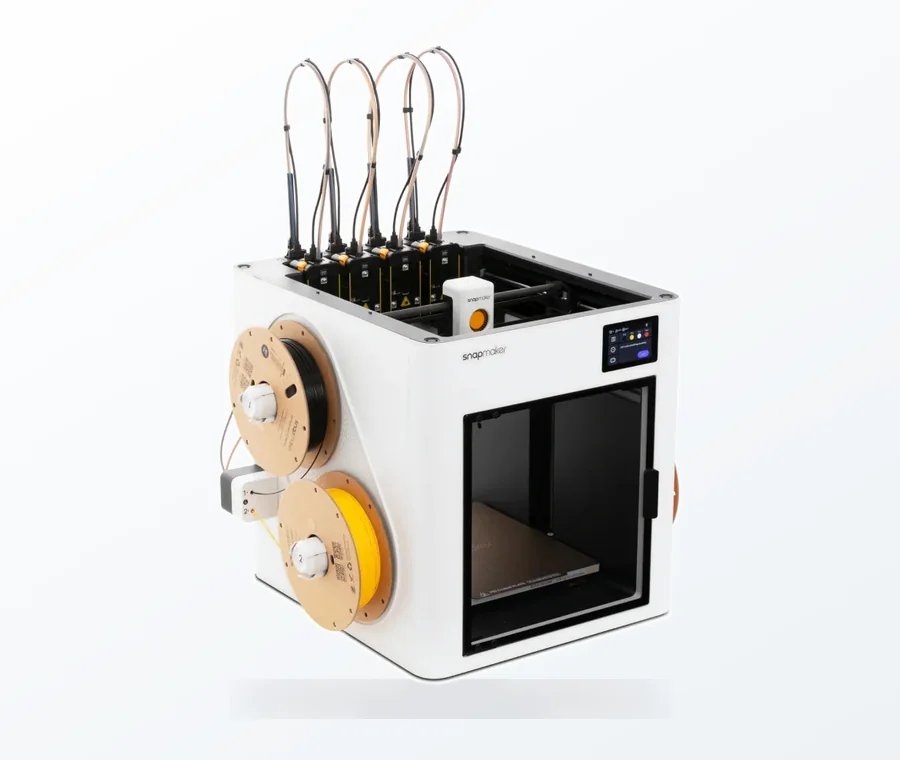
The consumer toolchanger 3D printer: the SnapSwap 4-toolhead system swaps heads in 5 seconds for true multi-color and multi-material printing, with smart calibration and auto filament loading.
- 4 toolheads · 5 s swap
- Up to 500 mm/s · 20,000 mm/s²
- 270 mm cube build volume
- Multi-color & multi-material
Aerospace 3D printing at a glance
- Metal powder bed fusion (titanium, nickel and aluminium alloys): brackets, latch shafts, engine fuel nozzles, casing fittings.
- Polymer FDM and laser sintering (ULTEM 9085, flame-retardant nylon): cabin bumpers and trim, duct parts, repair kits.
- Tooling: drilling templates, jigs and assembly aids used on the production line, not on the aircraft.
- Rocket engines: large welded assemblies replaced by printed ones, as in NASA’s RS-25 pogo accumulator test.
- Not a home project: anything installed on a certified aircraft needs approved data and an approved production chain.
What is actually printed: named examples
Every row below comes from a manufacturer, an agency or a regulator document. Percentages compare the printed part with the earlier design of that same part.
| Part | Process and material | What the source says | Source |
|---|---|---|---|
| LEAP engine fuel nozzle | Metal printing, nickel alloy | About 20 welded and brazed pieces became one unit, 25% lighter than its predecessors; GE calls it more than five times as durable (GE’s own claim) | GE Reports |
| A350 door latch shaft | Titanium powder on an EOS M 400-4 (four lasers) | 16 shafts per aircraft, 45% lighter, saving just over four kilos per aircraft; qualification was planned for the end of 2018 | Airbus Helicopters release, September 2018 |
| A350 engine pylon bracket | Titanium | First titanium 3D printed bracket installed on a series-production A350 XWB; no weight figure given | Airbus, September 2017 |
| A350 nose landing gear lock stay sensor bracket | Ti-6Al-4V, laser powder bed fusion, hot isostatic pressing | One of three brackets around the stay; only one is printed, the other two are machined | EASA supplement to CM-S-008 |
| Engine casing bosses and nozzle guide vane inserts | Inconel 718 and Hastelloy X, laser powder bed fusion | Early certified or near-certified examples shared with EASA by ITP Aero and Safran | EASA supplement to CM-S-008 |
| Seat bumper and monitor bezel | ULTEM 9085, FDM | Safran examples on seat surround furniture; orientation-dependent flammability tests | EASA supplement to CM-S-008 |
| Environmental control duct parts | ULTEM 9085, FDM on Stratasys Fortus 450mc Gen II | Sub-components bonded into composite ducts (Senior Aerospace BWT) | EASA supplement to CM-S-008 |
| RS-25 pogo accumulator assembly | Metal printing | More than 100 welds eliminated, cost down nearly 35%, production time down more than 80% | NASA, December 2017 |
| BelugaXL drilling templates | 3D printing, material not stated | Production aids made for operators; no figures published | Airbus, March 2017 |
Metal or polymer: how engineers choose
The choice follows the job. Metal printing covers loaded structure, heat and engine parts. Polymers are used where loads and temperatures are lower, mainly in the cabin and in ducting, and where flame, smoke and toxicity rules decide the material. The table summarises what the regulator and maker documents say, not a ranking.
| Question | Metal powder bed fusion | Polymer (FDM, laser sintering) |
|---|---|---|
| Materials in the examples above | Ti-6Al-4V, Inconel 718, Hastelloy X, AlSi7Mg0.6; Airbus also describes Scalmalloy, an aluminium-magnesium-scandium alloy designed for 3D printing | ULTEM 9085, PA2241-FR nylon |
| Material standards named | The FAA lists ASTM F2924 (Ti-6Al-4V), F3055 (Inconel 718) and F3184 (316L stainless) in AC 33.15-3 | Stratasys states ULTEM 9085 meets several rail and aerospace flame, smoke and toxicity standards and is qualified for flight parts on its F900 printer, using published NCAMP allowables |
| Post-processing seen in EASA examples | Stress relief or hot isostatic pressing, chemical milling, machined interfaces, EDM cut-off from the plate | Support removal and review against defect criteria |
| Main watch-outs | Porosity, lack of fusion and anisotropy (FAA) | Flammability can change with print orientation, toolpath and dye colour (FAA) |
Standards such as ASTM F2924 are material specifications for a defined process. A part made on a different machine or with different settings does not inherit the result. See FAA AC 33.15-3 and the FAA 2023 TSO workshop presentation for how the FAA treats this.
Where the weight saving comes from
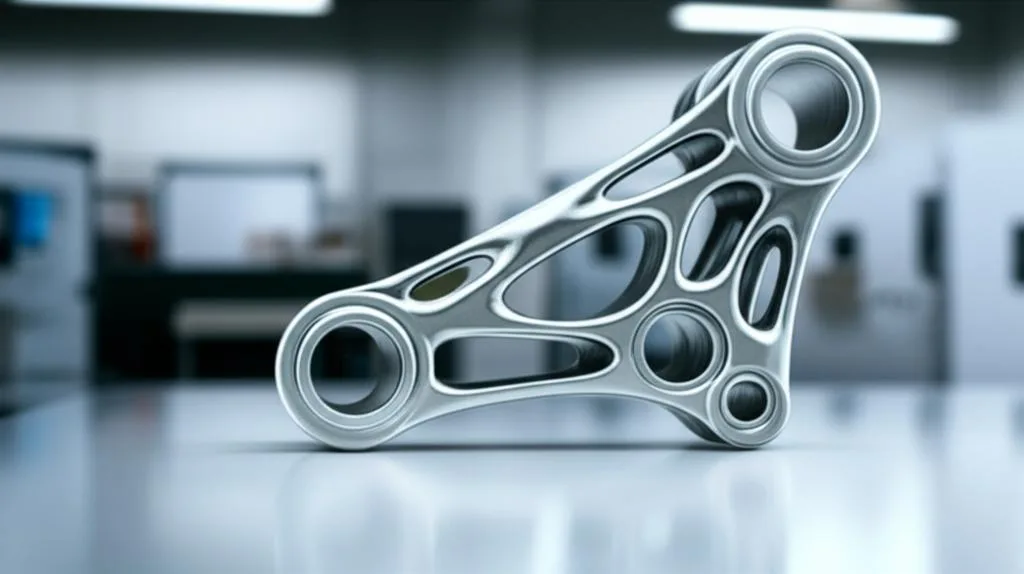
Three mechanisms explain almost every figure in the table above.
- Shape. Topology optimisation software keeps material only where loads travel, and printing can make the resulting organic shape. Airbus’s 2016 “bionic partition”, a cabin partition printed in Scalmalloy, was described as 45% (30 kg) lighter than current designs (Airbus, March 2016).
- Fewer parts. The LEAP nozzle merged about 20 pieces; NASA removed more than 100 welds from the pogo accumulator. Stratasys states that a United Launch Alliance duct assembly went from over 140 parts to 16 production parts. Fewer joints means less fastener and joint mass.
- Material. Titanium and specially designed aluminium alloys give strength at low mass; the printing process is what lets them be used in complex shapes.

Read the percentages carefully. A 45% saving on a latch shaft is 45% of a small part. Airbus puts the aircraft-level effect of printing all 16 shafts at just over four kilos. That is useful, and it is also why “up to 50% aircraft weight reduction” is not a supportable headline.
What stands between a printed part and the aircraft
Regulators do not approve a printer. EASA’s certification memorandum CM-S-008 Issue 04 (3 September 2025) says the certification specifications were not changed for additive manufacturing and that applicants should take a step-by-step approach based on part criticality. The EASA supplement shows how cautious that can be: for one Ti-6Al-4V link in an engine inlet cowl, only every second one (at most four of nine) could be replaced with a printed version until the part had proved itself in service, and approvals in the examples are tied to a specific printer by serial number. The full picture is in our guide to FAA and EASA certification.
What a maker or small shop can do, and what to leave alone
The useful lessons from aerospace transfer to ordinary workshops: design around the process, control the material, and keep records. The parts themselves do not.
- Reasonable: print display and scale models, mock-ups, and jigs and fixtures for your own workshop; redesign a bracket for a non-aviation use with topology optimisation; print test bars to see how much strength drops across layers (see print orientation).
- Reasonable: order metal parts for non-aviation projects from a service bureau instead of trying to print them yourself.
- Leave alone: any part fitted to a certified aircraft. The FAA’s own guidance for parts fabricated during maintenance, FAA AC 43-18 (2006), asks for an equivalent level of safety, and for printed parts the regulators also expect controlled material, a qualified process and traceability, which a home printer cannot provide.
Hobby model aircraft and drones are a separate topic and are not covered here.
Common mistakes when reading aerospace 3D printing claims
- Treating a per-part saving as an aircraft saving. The latch shaft example is 45% of the part and about four kilos per aircraft.
- Comparing against a poor legacy design. Part of a saving can come from redesign, which a conventionally made part could also receive. The sources do not separate the two.
- Assuming “printed” means “approved”. EASA describes its examples as certified or close to being certified at the time of the memo, and as deliberately low-risk first applications.
- Assuming a strong hobby filament is aerospace grade. ULTEM 9085 on a qualified industrial printer is a different system from PETG or nylon on a desktop machine; for hobby materials start with strong filaments.
- Ignoring the design rules. Parts that need supports cost more to finish; support-free design applies to metal as much as to plastic. For the production side, see end-use parts.
Frequently asked questions
Does 3D printing cut aircraft weight by 50%?
No source we read supports that for an aircraft. The documented figures are per part: 45% for the A350 latch shaft, 25% for the LEAP fuel nozzle and 45% (30 kg) for Airbus’s 2016 cabin partition. Airbus puts the A350 latch shaft saving at just over four kilos per aircraft.
Which metals are used in aerospace 3D printing?
The examples in EASA and Airbus documents include Ti-6Al-4V titanium, Inconel 718 and Hastelloy X nickel alloys, AlSi7Mg0.6 aluminium and Scalmalloy. The FAA lists ASTM material specifications for Ti-6Al-4V, Inconel 718 and 316L stainless steel for powder bed fusion in AC 33.15-3.
Can a desktop printer make aircraft parts?
Not for certified aircraft. The polymer examples in the EASA supplement use ULTEM 9085 on industrial Stratasys machines under controlled material and process specifications. A desktop printer with PLA or PETG is a different material and process with no qualification behind it.
Are 3D printed parts already flying?
Yes. Airbus installed a printed titanium bracket on a series-production A350 XWB in 2017, and GE says printed fuel nozzles are in LEAP engines. These are specific parts that went through certification with the authorities, not a general permission to print.
Sources
- GE Reports: how GE and the founder of a metal 3D printing company built the LEAP fuel nozzle
- Airbus Helicopters: large-scale printing of A350 XWB latch shafts (21 September 2018)
- EASA: supplement to CM-S-008 Issue 04, with early AM examples in certified parts
- NASA: hot-fire test of the 3-D printed RS-25 pogo accumulator (21 December 2017)
- Stratasys: ULTEM 9085 resin materials page