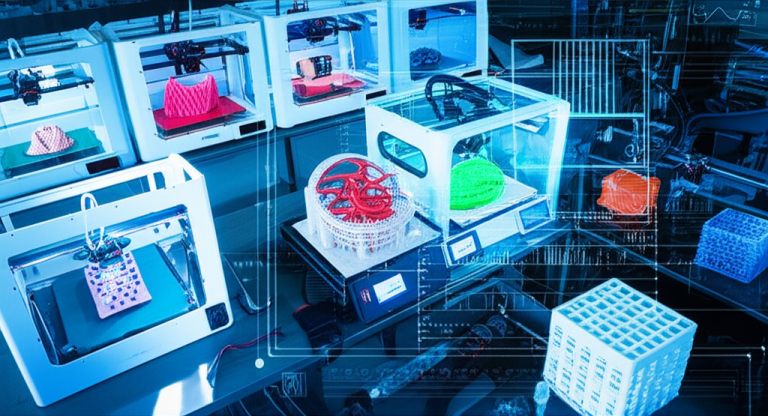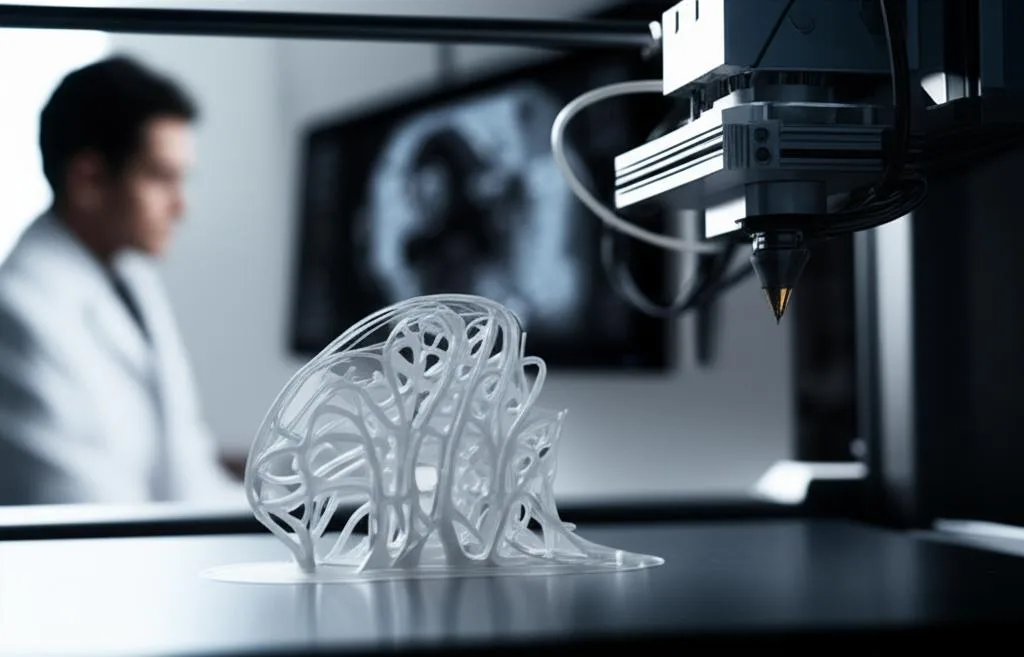
Medical 3D printing means making anatomical models, surgical guides, prosthetic and orthotic parts and implants from a patient’s own imaging or scan data, layer by layer. FDA’s overview page lists orthopedic and cranial implants, surgical instruments, dental restorations and external prosthetics as examples of devices made this way, alongside printed models of organs and blood vessels.
In practice the answer depends on the product. Anatomical models are mostly printed in hospital 3D labs or by service bureaus. Prosthetic and orthotic parts are designed and fitted by clinicians such as prosthetists and orthotists. Implants are made by regulated manufacturers, mainly in metal powder-bed machines or, less often, in PEEK. FDA’s guidance expects additively manufactured devices to follow the same regulatory requirements as the same type of device made any other way. This is general information, not medical or regulatory advice, and none of it is a suggestion to print patient-use devices on a hobby printer.
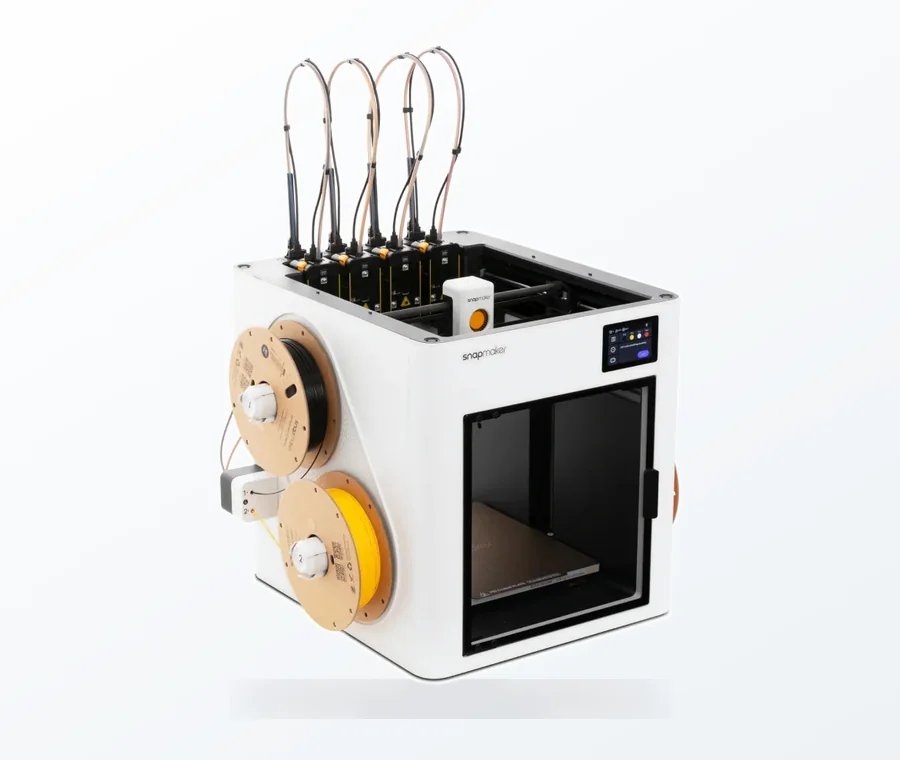
The consumer toolchanger 3D printer: the SnapSwap 4-toolhead system swaps heads in 5 seconds for true multi-color and multi-material printing, with smart calibration and auto filament loading.
- 4 toolheads · 5 s swap
- Up to 500 mm/s · 20,000 mm/s²
- 270 mm cube build volume
- Multi-color & multi-material
3D printing in medicine at a glance
- Anatomical models and surgical guides: printed from CT or MRI data for planning, teaching and patient communication. Technologies named in the sources are fused filament fabrication (FFF), stereolithography (SLA) and PolyJet-type material jetting.
- Prosthetics and orthotics: a 3D scan replaces the plaster cast, the socket or brace is designed in CAD and then printed. The clinical evidence is promising but still thin.
- Implants: titanium alloys and PEEK are the materials discussed most in the reviews. Each implant needs its own regulatory route and validated production.
- Bioprinting: printing with living cells is outside the scope of FDA’s additive manufacturing guidance and is handled differently. It is not covered here.
- Dental devices: a large field of its own, covered in our guide to 3D printed dental restorations.
What is printed, who prints it and how it is regulated
| Product | Typical technology and material (as named in sources) | Who makes it | Regulatory note |
|---|---|---|---|
| Anatomical models for planning and teaching | FFF, SLA, PolyJet-type jetting. Vendors list soft resins such as Formlabs BioMed Flex 80A and multi-material jetting such as Stratasys Digital Anatomy | Hospital 3D lab, service bureau, device maker | Models for diagnostic use are a regulated area. RSNA guidelines advise FDA-cleared segmentation software |
| Surgical guides and drilling templates | Biocompatible resins. Formlabs sells a Surgical Guide Resin for Class I devices | Hospital lab or dental lab, device maker | Maker says it complies with ISO 10993-1:2018 and must be washed and post-cured exactly as instructed |
| Prosthetic sockets, hands, limb parts | Methods vary by study; in ankle-foot orthosis studies FFF and SLS are used and nylon 12 is the most tested material | Prosthetist or orthotist, specialist clinics | Fitted and supervised by a clinician; the evidence base is small |
| Orthoses: insoles, ankle-foot orthoses, spinal braces, helmets | FFF and SLS | Orthotist, specialist clinics | A 2025 review found 62 clinical studies, mostly small |
| Implants (spine, hip, knee, cranial) | Titanium alloys by electron beam or laser melting; PEEK | Regulated device manufacturers | Normally 510(k), De Novo or PMA; see the pathways below |
Anatomical models and surgical guides
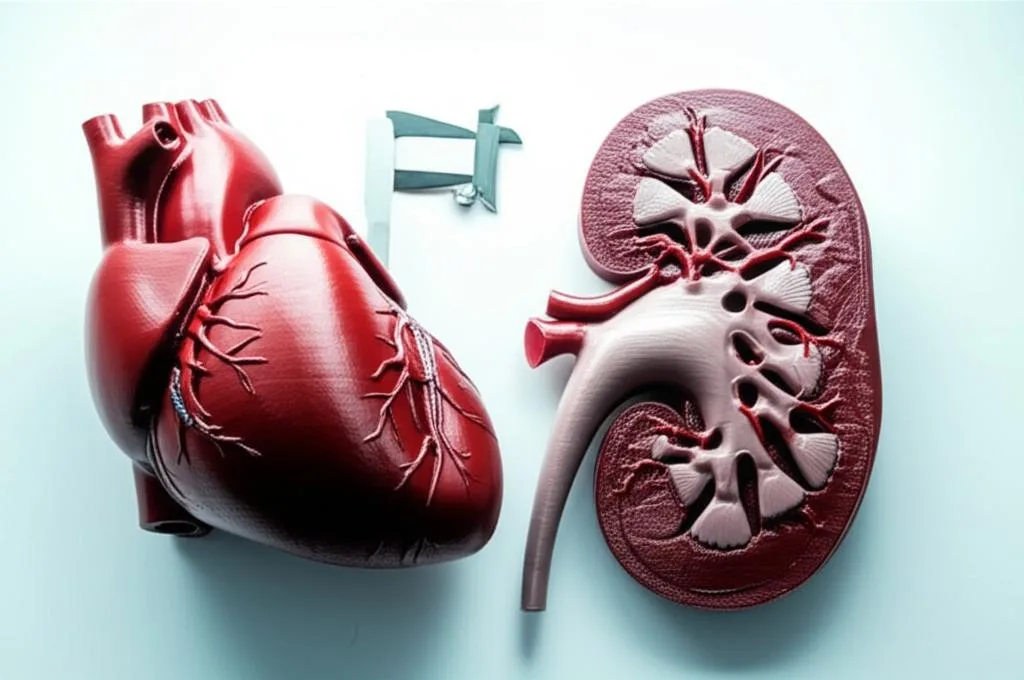
A model starts as a scan. The Radiological Society of North America (RSNA) 3D Printing Special Interest Group describes the chain as image acquisition, segmentation of the anatomy, creation of a printable model and post-processing. The STL file is the most widely used format, and the group says the contours of the exported STL should be routinely checked against the source imaging, because reduction or smoothing during export can change anatomical accuracy. The same STL problems you meet in hobby printing apply here too; see our STL mesh errors checklist for the general ones.
The SIG also recommends that segmentation software used for models for diagnostic use is FDA cleared, and it points out that biocompatibility depends on the base material, the printing process, post-processing and the hospital’s own cleaning and sterilization. Anything that may enter a surgical field needs that chain validated; a model that stays on the desk has lower demands.
What the evidence says
A 2016 systematic review of 3D printing in neurosurgery included 36 articles and concluded that printing is a practical and anatomically accurate way to make patient-specific models for planning, simulation and training. That is a review of the literature on models, not proof of better surgical outcomes, and it is now several years old.
Vendor examples
Stratasys positions its J5 Digital Anatomy printer, a PolyJet system, for hospitals and point-of-care labs. Its page quotes layers down to 18 microns and a dimensional deviation of ±150 microns for rigid parts under 100 mm, and lists tissue-simulating materials named BoneMatrix, GelMatrix, TissueMatrix and RadioMatrix. These are vendor figures, and the page does not state an FDA clearance for the printer itself. Formlabs lists SLA printers and two soft resins, BioMed Flex 80A and BioMed Elastic 50A, for soft anatomical models, plus a Surgical Guide Resin intended for Class I devices that requires a dedicated resin tank, build platform and finishing kit. If you want the resin technologies explained, see SLA vs DLP vs MSLA.
Prosthetics and orthotics
The workflow differs from the traditional plaster cast: the residual limb or foot is scanned, the socket or brace is modeled in CAD, then printed. The reviews agree on the evidence: encouraging, but small.
- Prostheses, 2025 review: 1,420 records screened, 11 studies included. Upper-limb studies reported better dexterity, range of motion and user satisfaction, with durability problems such as component breakage in four studies. Lower-limb studies reported better comfort and gait parameters. The authors cite small samples and variable assessment tools.
- Upper-limb prostheses, 2017 review: eight human studies, no controls, five case studies and three small case series. The authors found no statistically significant improvement over conventional prostheses and called for randomized controlled trials.
- Orthoses, 2025 review: 62 studies of insoles, ankle-foot orthoses, spinal orthoses, upper-limb orthoses and helmets. Reported benefits include plantar pressure redistribution (insoles), gait symmetry (ankle-foot orthoses) and reduced Cobb angles (spinal orthoses). Limits named: small samples, no standard assessment methods and durability.
- Ankle-foot orthoses, 2025 update: 28 papers. FFF was more common than SLS in recent studies, nylon 12 was the most tested material, and all sample sizes were under 12.
A socket or brace is a body-worn device whose fit, load path and skin contact decide whether it helps or harms. That is why these are made and adjusted by trained clinicians, not copied from a model file.
Implants: titanium, PEEK and what the guidance expects
Metal implants are made in powder-bed machines. A 2012 paper described knee and hip components with porous structures built in one piece by electron beam melting in Ti-6Al-4V and Co-29Cr-6Mo, with open-cell structures designed to match bone stiffness and allow bone ingrowth. A 2025 laboratory study compared selective laser melting and electron beam melting of Ti-6Al-4V hip implant samples with heat treatment and hot isostatic pressing (HIP); porosity was below 0.2% in all of its samples. FDA’s guidance adds that HIP can reduce residual porosity and increase fatigue life but has also been shown to reduce modulus and yield strength, so the whole process chain has to be checked.
| Material | Process (as named in reviews) | Stated advantage | Stated limit |
|---|---|---|---|
| Titanium alloy (Ti-6Al-4V) | Electron beam melting, selective laser melting | High strength; porous structures possible; used for hip and knee components | A 2025 review notes titanium stiffness (about 102-110 GPa) can lead to stress shielding |
| PEEK | FFF on specialized high-temperature printers; nozzle temperatures above 340 °C | Modulus of about 3-4 GPa, closer to cortical bone (about 14 GPa); radiolucent, fewer imaging artifacts | Bioinert, does not bond to bone without surface modification; a 2021 review found most printed PEEK uses still at research stage |
PEEK has been used in implants since the late 1990s, according to a 2025 review, which also notes that most off-the-shelf PEEK devices went through 510(k) while novel constructs without a predicate need the more demanding PMA route. The same review says PEEK’s high melting point (about 343 °C) limits compatibility with standard 3D printers.
Regulation in brief
In the United States, FDA regulates 3D printed medical devices under the same framework as other devices. It generally clears or approves a finished device for an intended use, not a printing material in general. FDA’s 2017 guidance, Technical Considerations for Additive Manufactured Medical Devices, is non-binding and covers design, software workflow, material controls, post-processing, process validation, testing and labeling. It does not address biologics or cell-based products, and it says point-of-care manufacturing may raise additional considerations. Our guide to FDA pathways covers 510(k), De Novo and PMA.
Two points matter for patient-specific products. First, FDA states that patient-matched devices are not "custom devices" in the legal sense unless they meet all criteria of section 520(b) of the FD&C Act. Second, in December 2021 FDA published a discussion paper on printing at the point of care. It is explicitly not guidance and sets no policy; it explores scenarios in which a hospital uses a manufacturer’s validated production system, hosts a co-located manufacturer, or takes on all manufacturer responsibilities itself.
In the European Union, Regulation (EU) 2017/745 defines a custom-made device as one made to a written prescription of an authorized person for the sole use of one patient. It states that mass-produced devices adapted for a professional user, and devices mass-produced by industrial processes to written prescriptions, are not custom-made devices. Anyone outside the US or EU should check their national rules.
What a maker can and cannot do with this
- Reasonable: read the literature, learn the CAD and scan-to-STL workflow on non-medical subjects, or print teaching or display models that are clearly labeled as not for clinical use. FDA’s overview page points to the NIH 3D Print Exchange as a source of biomedical models.
- Not reasonable: printing prosthetics, orthoses, splints, implants or surgical guides for use on a person, or any part that goes into or touches the mouth or a wound. A printer and a filament do not make a part biocompatible, cleanable or sterilizable.
- For small shops: contract manufacturing for medical customers means a quality system and validated processes, not just a better printer. FDA’s quality system rule changed in February 2026; see the FDA article linked above.
Frequently asked questions
Are 3D printed prosthetics better than conventional ones?
The reviews say they show promise for fit, comfort and function, but the studies are small and mostly uncontrolled. A 2017 review of upper-limb devices found no controlled trials, and a 2025 review still cites small samples and durability problems. Whether a printed device suits a person is a decision for their prosthetist.
Are 3D printed medical devices FDA approved?
It depends on the device. FDA clears or approves finished devices for a specific intended use, and 3D printed devices follow the same requirements as conventionally made ones. A class II device is typically cleared through 510(k), a novel moderate-risk device may go through De Novo, and class III devices need PMA.
What are 3D printed implants made of?
The reviews discuss titanium alloys such as Ti-6Al-4V, printed by electron beam or laser melting, and PEEK, a polymer that is radiolucent and closer to bone in stiffness. The choice is made by the manufacturer and surgeon for each indication, and each product has its own regulatory file.
Can I print an anatomical model from my own scan at home?
A model for personal curiosity or teaching is a different thing from a model used for diagnosis or surgical planning, which relies on validated software, materials and workflows. Treat a home-printed model as a non-clinical prop and never base a medical decision on it.
Sources
- FDA: 3D Printing of Medical Devices
- FDA guidance: Technical Considerations for Additive Manufactured Medical Devices (Dec 2017)
- FDA: 3D Printing Medical Devices at the Point of Care, discussion paper (2021)
- EUR-Lex: Regulation (EU) 2017/745 on medical devices, Article 2(3)
- RSNA 3D Printing SIG: guidelines for medical 3D printing and appropriateness (3D Printing in Medicine, 2018)
- The Current State of 3D-Printed Prostheses Clinical Outcomes: A Systematic Review (J Funct Biomater, 2025)
- The current state of 3D-printed orthoses clinical outcomes: a systematic review (BMC Musculoskelet Disord, 2025)
- Recent Advances in PEEK for Biomedical Applications (Polymers, 2025)
- Stratasys: J5 Digital Anatomy printer (vendor page)
- Formlabs: medical 3D printing (vendor page)