Most 3D printed metal jewelry is not printed in metal. The usual route is lost-wax casting: you print a pattern in castable resin, surround it with plaster-like investment, burn the resin out in an oven, and pour metal into the empty mold. Printing directly in gold or silver exists (laser powder bed fusion), but it is industrial equipment and, for a maker, a service you order rather than a machine you own.
This guide follows that chain: design, castable resin choice, printing and prep, burnout and casting, plus the direct-print and plastic options, and what a small jewelry business has to decide about outsourcing. The numbers come from Formlabs and Siraya Tech documentation and a 2024 peer-reviewed review, linked at the end. Burnout schedules differ between resins and investments, so treat every temperature here as an example and follow the schedule from your resin and investment makers.
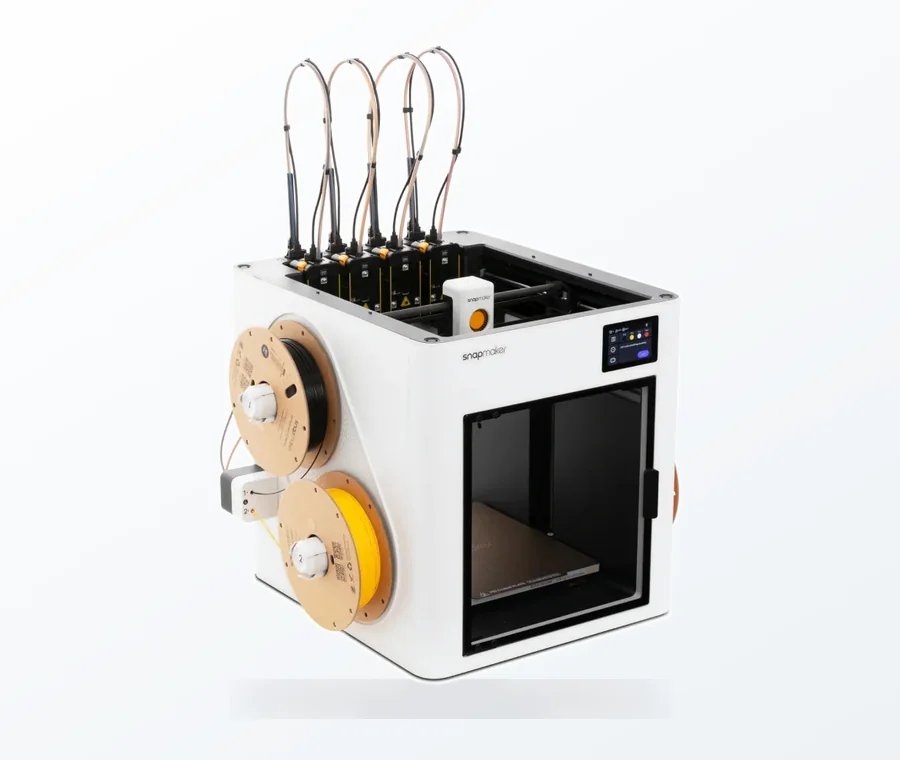
The consumer toolchanger 3D printer: the SnapSwap 4-toolhead system swaps heads in 5 seconds for true multi-color and multi-material printing, with smart calibration and auto filament loading.
- 4 toolheads · 5 s swap
- Up to 500 mm/s · 20,000 mm/s²
- 270 mm cube build volume
- Multi-color & multi-material
The jewelry workflow in six steps
- Design the piece in CAD and export a watertight mesh. Check wall thickness against the resin maker’s limits.
- Print the pattern in a castable resin on a resin printer, with supports placed away from visible surfaces.
- Wash and dry the pattern completely. Post-cure only if your resin’s documentation says so.
- Attach patterns to a wax sprue tree, place it in a flask and pour investment.
- Burn the resin out following the investment maker’s schedule, then cast the metal.
- Devest, remove sprues, then sand, polish, plate and set stones.
Four ways to get a printed design into metal
Which route fits depends on volume, budget and how much of the process you want to own. None of these rows carries a price, because casting quotes depend on metal weight, finish and location; ask for quotes.
| Route | What you do | What others do | Main limit |
|---|---|---|---|
| Cast it yourself | Print patterns, sprue, invest, burn out, cast, finish | Nothing | Needs a burnout oven, a casting setup, investment powder and metal handling skill |
| Print patterns, outsource casting | Design and print patterns | A casting house invests, burns out and casts | Formlabs’ jewelry page covers the in-house workflow only and gives no guidance on sending patterns out, so ask the house what it accepts |
| Order cast jewelry from a service | Upload the design | The service prints a pattern, casts and polishes | Less control over finish; check the service’s design rules |
| Direct metal printing (service) | Upload the design | A service prints in metal powder and finishes | Industrial process; not every alloy is offered |
A fifth route skips metal: print the piece in plastic or resin as costume jewelry or as a fit sample for a client. That has its own skin-contact questions, covered further down.
Designing for castable resin
Design rules come from what survives the mold, not from what the printer can print. Formlabs recommends wall thickness between 500 microns and 5 mm for its True Cast resin, smooth surface flow and no sharp corners or edges, because sharp edges increase metal turbulence and concentrate expansion stress in the mold. Filled-in negative features such as engraving and stone holes, often with rough or pitted surfaces, are signs of investment breakage.
- Hollow thick parts and add vent holes. Formlabs advises hollowing thicker parts and closing the vent holes with wax before adding sprues, so air can leave during burnout.
- Keep the airflow path short. Smaller trees with less resin burn out more easily.
- Match sprue diameter to the adjacent section. Thicker parts go at the bottom of the tree, thinner at the top.
- Space patterns further apart than wax ones, so more investment fills the gaps and resists thermal expansion.
- Prongs, filigree, engraving and milgrain have their own minimums. Formlabs keeps those in a separate white paper, so read the maker’s sheet for your resin rather than relying on a general figure.
CAD choice matters less than a clean export. Whatever program you use, check units, scale and mesh integrity before printing; the export and slicing checklist covers that. Allow for shrinkage per your resin’s data (Siraya Tech, for example, lists 6% shrinkage per volume for its Cast resin) and test-print a ring size before committing metal.
Castable resin types compared
All of these are patterns for casting, not wearable materials. The values below come from the makers’ own pages and apply to their resins and printers only. For general resin types and how to read a data sheet, see choosing a resin.
| Resin | What the maker says | Watch out for |
|---|---|---|
| Formlabs Castable Wax | 20% wax-filled; for smaller parts and wire filigree; no post-cure required (post-curing may shrink parts by under 1%) | IPA must evaporate completely before casting, or it can interact with the investment and cause pitting |
| Formlabs True Cast | Wax-filled; for medium to heavy jewelry; 0.03% ash content; walls from 500 microns to 5 mm; layer heights 25 and 50 microns | Post-cure the patterns; heat the resin so the wax is fully liquid, then shake the bottle for 30 seconds |
| Formlabs Castable Wax 40 | More freedom in choosing investments; tested by Formlabs in gold, silver and bronze | Do not dip the patterns in a casting barrier film |
| Formlabs Clear Cast | For larger investment casting; latticing software recommended above 3 mm thickness | Described as extremely low thermal expansion and low ash; follow its own usage guide, not the wax-resin schedule |
| Siraya Tech Cast | Wax content 16% (purple), 20% (royal blue) or 24% (true blue); ignition around 450 °C; shrinkage 6% per volume; for MSLA, LCD and DLP printers | Print at least 25 °C (77 °F); cured parts are soft, so use at least medium supports; the print does not melt like real wax |
One pitfall is mixing up the two families. Formlabs’ original Castable Resin (a pure polymer, July 2018 usage guide) needs a different burnout than wax-filled resins, and its guide has you post-cure the patterns for 4 hours at 60 °C. The wax-based resins above follow a wax-like schedule instead. Check which family your resin belongs to before you copy anyone’s schedule.
Printing, washing and prep
- Resin temperature. Wax-filled resins separate when cold. Formlabs says wax solidifying at room temperature is normal and not a sign of expired resin; its True Cast page says to heat and mix before printing, and suggests warming cartridges (for example 45 °C for one hour) as needed. Siraya Tech asks for printing above 25 °C.
- Washing. Formlabs washes patterns in IPA for 5 minutes, then rinses in clean IPA, and dries with compressed air. Siraya Tech specifies 95% ethanol or IPA for 4 to 5 minutes in an ultrasonic cleaner, no more than 5 minutes in alcohol, and advises against all-in-one wash and cure machines.
- Curing. Resin-specific: not needed for Formlabs Castable Wax, required for True Cast. Siraya Tech cures at 395 to 405 nm for about 10 minutes, at least 15 minutes for larger models.
- Drying. Dry completely before sprueing. Siraya Tech’s check: if the surface is still sticky, wash and dry again.
Safety does not stop at the printer. Uncured resin can irritate or sensitize skin, so use gloves and good airflow; the resin PPE checklist and the resin printer ventilation guide cover the details.
Burnout and casting
Formlabs publishes a standard and a short burnout schedule for its wax-filled resins. The short one suits parts under 1 g each in flasks less than 6 in (15.24 cm) tall and is validated only for Castable Wax and Castable Wax 40; use the standard schedule for Castable Resin. Formlabs lists a burnout oven capable of 750 °C as equipment, says its direct-casting resins need burnout temperatures of at least 732 °C, and tells you to start from its schedule and then follow the investment manufacturer’s instructions.
For comparison, here is the tested schedule listed on Siraya Tech’s Cast TDS page, where it also recommends Plasticast-type investment. It is an example, not a universal program:
| Hour | 0 | 1 | 2 | 3 | 4 | 5 | 6 |
|---|---|---|---|---|---|---|---|
| Oven temperature | 50 °C | 150 °C | 371 °C | 732 °C | 732 °C | 732 °C | 510 °C |
- Investment. Mix to the manufacturer’s instructions, pour slowly down the side of the flask, and use a vacuum chamber to remove bubbles. Let the flask set in a vibration-free place for 2 to 6 hours (Formlabs). Wear a dust mask or respirator while it sets.
- Airflow. Formlabs suggests venting, active ventilation or blowing out molds. If pieces are missing from the cast, ash may remain in the cavity, so review the burnout steps and recalibrate the oven.
- Casting. Centrifugal or vacuum casting fills the mold quickly. Metal compatibility depends mainly on the investment’s temperature resistance, then quench, devest and process the parts.
This is a real studio setup with an oven, a caster and molten metal. If you only want the design and the finishing, the print-patterns-and-outsource route above removes the hot, hazardous part. Burnout fumes and metal handling need their own risk assessment; this article does not replace one.
Direct-printed jewelry: metal and plastic
Direct metal printing
A 2024 review in Metals (Thangamani et al.) examined laser powder bed fusion for jewelry. It reports that gold, silver, copper and platinum alloys are hard to process because of their high reflectivity and thermal conductivity, which leads to poor densification and mechanical properties. The authors discuss three fixes: adding alloying elements, coating the powder particles, and using green or blue lasers. The review also stresses post-processing to improve surface quality. For a maker this means service-only territory; if a service offers your alloy, ask what finish the part arrives with.
Plastic and resin pieces on skin
Costume pieces printed in resin or filament are easy to make, but skin contact is a separate question. Formlabs’ skin-contact certification for its Tough 1500 resin (ISO 10993-1 testing: not cytotoxic, not an irritant, not a sensitizer) holds only when the stated workflow is followed without deviation: wash in at least 99% IPA for 20 minutes, dry for at least 30 minutes, post-cure for 60 minutes at 70 °C. Formlabs adds that other engineering and standard resins may pass similar testing, but this has not been evaluated. Without a maker’s skin-contact statement, treat a printed resin ring as a prototype, not as something to sell for daily wear.
Finishing the cast piece
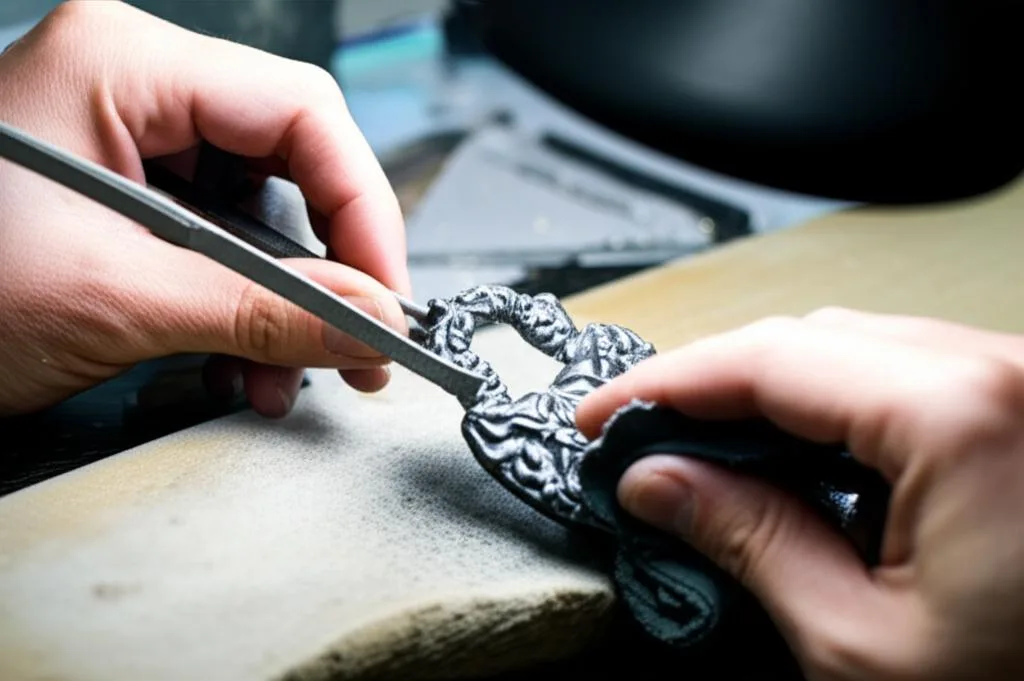
Cast metal needs sprue removal, sanding, polishing and often plating or stone setting. Polishing resin patterns and polishing metal are different jobs; the resin polishing guide applies to printed resin parts, not to cast silver. If you plate pieces, the electroplating guide explains the process on printed parts.
Selling it: hallmarks and what to outsource
If you sell precious-metal pieces, check hallmarking rules before the first order. In the UK, the Assay Offices’ guidance notes (November 2022) state that hallmarking is a legal requirement for articles consisting of platinum, gold, palladium or silver if they are to be described as such, and that this applies equally to e-commerce, distance selling and market stalls. Items below a minimum weight are exempt: platinum 0.5 g, gold 1.0 g, palladium 1.0 g, silver 7.78 g, and for mixed metals the threshold of the most precious metal applies. The notes themselves say not to rely on them for legal interpretation. Other countries have different rules, so check yours.
- Outsource first, bring casting in-house later if volume justifies an oven and caster. Casting houses charge by metal and labour, so get written quotes.
- Keep a master pattern per design. A proven pattern is the asset; re-casting from it avoids reprinting.
- Resin is a recurring cost and so are consumables like FEP film; price them from current maker lists, not from a fixed figure.
- Printer type matters less than process control. The SLA, DLP and MSLA comparison explains how resin printers differ.
Common mistakes
| Symptom | Likely cause | What to do |
|---|---|---|
| Pitted or rough cast surface | IPA still in the pattern, or investment breakage | Dry patterns completely; check investment mixing and set time |
| Missing details or pieces in the cast | Ash left in the cavity from incomplete burnout | Review the schedule, airflow and oven calibration (Formlabs) |
| Engraving or stone holes filled in | Investment broke from expansion stress | Smooth design transitions, avoid sharp edges, follow the resin’s wall limits |
| Cracked investment mold | Heating too fast for the resin and investment | Follow the maker schedule; Formlabs’ 2018 Castable Resin guide notes a slow initial ramp reduces cracking risk. The short schedule is not validated for Castable Resin |
| Sticky pattern surface | Uncured resin left on the part | Wash again and dry fully (Siraya Tech’s check); cure only where the maker requires it |
Frequently asked questions
Can I print a ring directly in silver or gold at home?
No, not with a desktop printer. Direct printing in precious metals uses laser powder bed fusion, which is industrial equipment, and the 2024 Metals review notes that gold and silver are hard to process because of their reflectivity and thermal conductivity. The accessible route is a castable resin pattern that you cast yourself or send to a casting house.
Do I need to post-cure castable resin patterns?
It depends on the resin. Formlabs says no post-curing is required for Castable Wax, while its True Cast guidance says to post-cure, and Siraya Tech’s Cast resin sheet specifies about 10 minutes at 395 to 405 nm. Always follow the sheet for your specific resin.
Is a printed resin ring safe to wear?
Not by default. Uncured resin can irritate skin, and a cured part is only documented as skin-safe if the maker says so and you follow its exact wash and cure steps, as with Formlabs’ Tough 1500 certification. Standard resins have not been evaluated for this, so use castable resin only as a pattern.
Do I need a hallmark to sell silver jewelry?
In the UK, yes, unless the item is below the exempt weight (silver 7.78 g) or otherwise exempt, and the rule covers online sales. Other countries differ, so check your national assay or consumer-protection authority before selling.
Sources
- Formlabs: Introduction to casting with Formlabs resins
- Formlabs: Using True Cast Resin
- Formlabs: Using Castable Wax Resin
- Siraya Tech: Cast castable resin TDS
- Thangamani et al., Metals 2024: A comprehensive review of laser powder bed fusion in jewelry
- UK Assay Offices: Hallmarking guidance notes (November 2022)