A 3D food printer builds an edible object layer by layer, most often by pushing a paste, puree or melted chocolate through a nozzle that moves along a digital design. Extrusion is the most common method; the other main techniques (binder jetting, inkjet and laser sintering of powders) cover narrower jobs such as sugar structures and surface decoration. The practical limits are speed, the need for a printable paste, short shelf life and hygiene, and claims that printers deliver individualised nutrition are not yet backed by data on health outcomes in people.
This guide explains how food printers work, what has been printed and by whom, what chocolate printing needs, and what a pastry or catering business should check before buying. Food-contact safety and compliance are covered in our food safety rules guide and are not repeated here. This article is general information, not medical, dietary or food-safety advice.
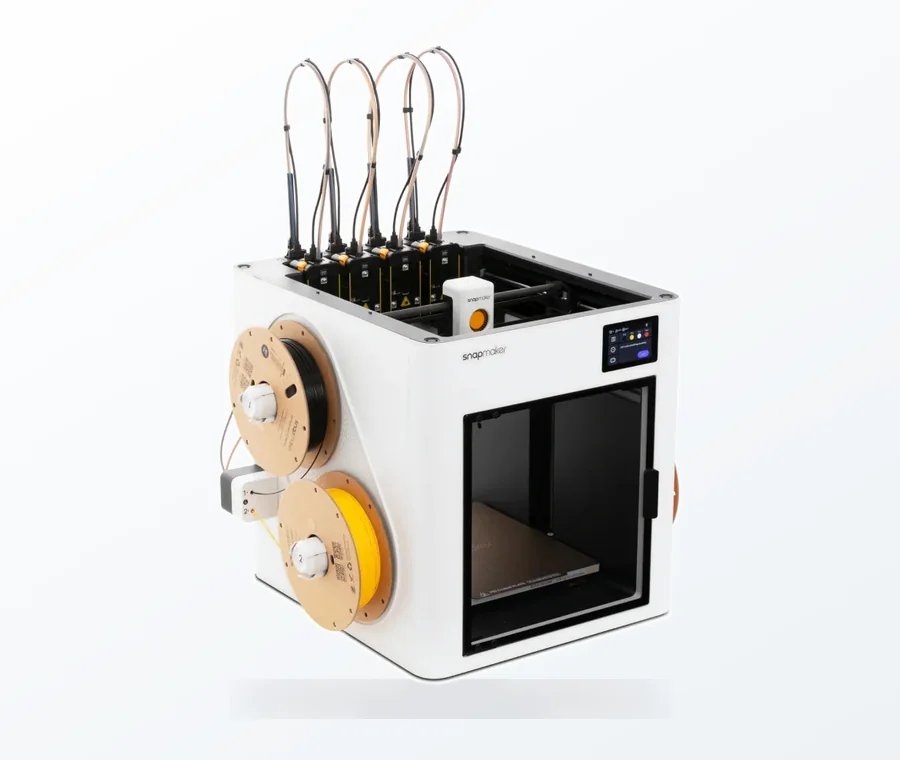
The consumer toolchanger 3D printer: the SnapSwap 4-toolhead system swaps heads in 5 seconds for true multi-color and multi-material printing, with smart calibration and auto filament loading.
- 4 toolheads · 5 s swap
- Up to 500 mm/s · 20,000 mm/s²
- 270 mm cube build volume
- Multi-color & multi-material
3D food printing in short
- Method: extrusion of pastes, doughs, purees, cheese and chocolate is the most common approach; powder and droplet methods are less common.
- Printable means paste-like: the food must flow under pressure and then hold its shape. Foods that do not are usually modified with additives such as xanthan gum or gelatine.
- Chocolate: needs a heated syringe or cartridge and a cool plate. One study found the best resolution at a 32 °C nozzle and a plate below 10 °C.
- Speed and cost: extrusion is described as slow, and consumables and printers as expensive.
- Evidence: published work is mostly lab-scale tests of printability, texture and nutrient content. Health benefits for people are not established.
- Safety: every food-contact surface must be treated as a hygiene risk. See the food safety guide linked above.
How food printers work: four techniques
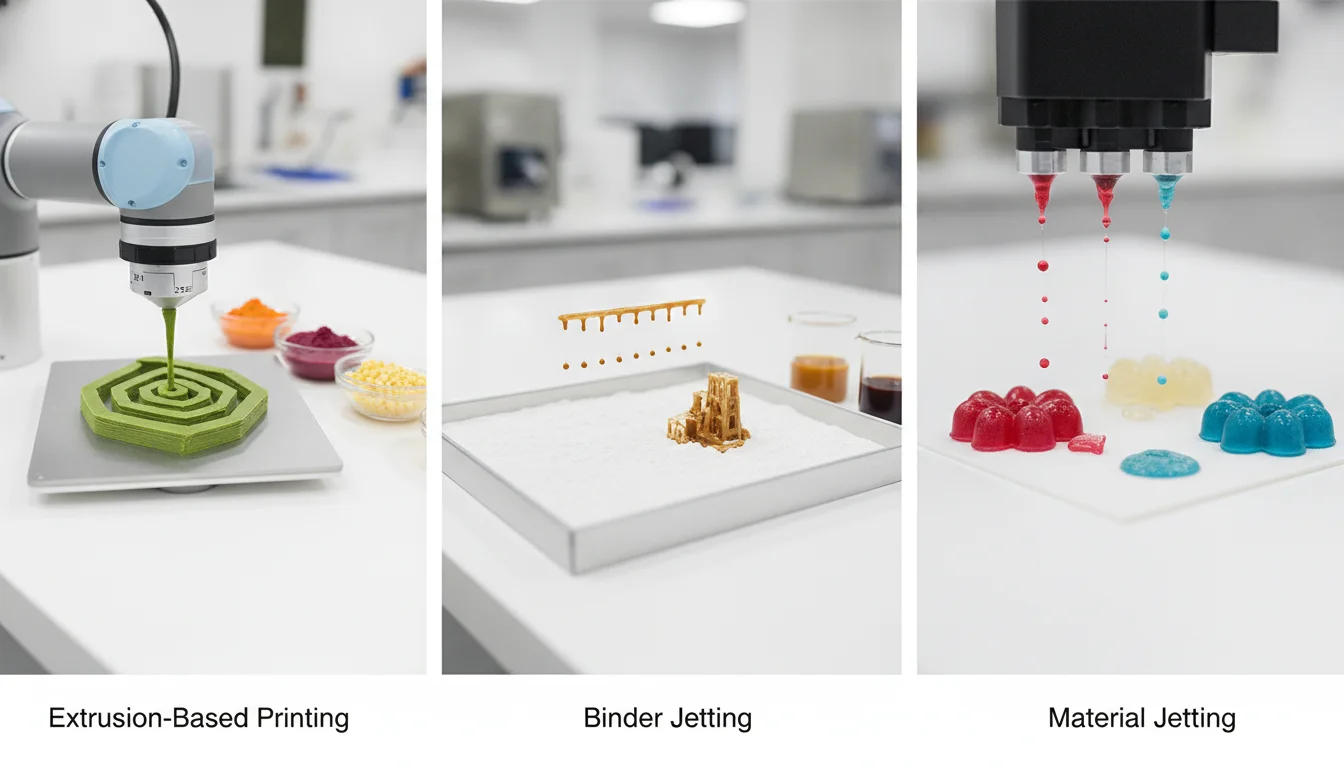
A 2025 review in Food Technology and Biotechnology lists four techniques. It describes extrusion as the most common, with food forced through a nozzle under pressure.
| Technique | How it works | Typical foods | Limits named in the review |
|---|---|---|---|
| Extrusion | Food is pushed through a nozzle layer by layer; works for solids and low-viscosity pastes | Dough, meat, paste, cheese, fish surimi, chocolate | Lower precision, long build times, difficulty holding shape after printing |
| Binder jetting | Powder layers are spread and a binder is dropped on them; a heat lamp can strengthen the structure | Sugar and starch powders | Rough or grainy surface, hard to make fine soft textures, often needs post-processing |
| Inkjet | Material is dispensed drop by drop from a heated multi-channel head, mainly making 2.5D images | Decorating cookies, cakes and pizza | Poor for complex structures; delicate features can be damaged afterwards |
| Selective laser sintering | Hot air or a laser fuses powder particles; unfused powder supports the shape | Sugar and fat-containing powders with low melting points | Only low-melting sugar and fat particles; expensive; needs post-printing |
The same review notes that extrusion machines have a low initial cost compared with sintering, and that a reliable low-cost, large-scale printer remains a challenge.
What makes a food printable
The review gives the requirements in food-science terms: an extrudable consistency, viscosity and strength suited to deposition and layer adhesion, and shear-thinning behaviour (the paste flows easily while pushed and then stiffens), often provided by hydrocolloids. For doughs it lists high extrudability, gel strength, elasticity and low ductility. Nozzle diameter, extrusion rate and deposition speed all matter, and a higher flow stress needs more extrusion pressure.
This is why savoury printing is harder than it looks. Meat, fish and vegetable purees often need thickeners or binders to hold shape, and a 2022 dysphagia review notes that heat-activated hydrocolloids can clog nozzles before they activate. Anything that works in a recipe may fail in a nozzle.
Printing chocolate: one study’s settings
Chocolate is the classic first project because it solidifies by cooling. A 2021 study in Innovative Food Technologies fitted a commercial printer with a temperature-controlled syringe head and reported these values. They come from one chocolate and one machine, so use them as a starting point, not a recipe.
| Setting | Reported value | Why it matters |
|---|---|---|
| Tempering range (found by DSC) | 32–40 °C | The temperature window in which this chocolate was properly tempered. |
| Nozzle temperature for best resolution | 32 °C | Higher temperature lowers viscosity, which increases flow and reduces shape resolution. |
| Build plate temperature | below 10 °C | Part of the settings that gave the best resolution. |
| Nozzle height above the plate | equal to the nozzle diameter | The reported optimum for this setup. |
The practical lesson is that a chocolate printer needs two things a plastic printer does not: a heated, temperature-controlled cartridge and a cooled surface.
Who uses food printers and for what
- Decoration: inkjet-style printing of images on cookies, cakes and pizza, and extruded chocolate or sugar paste for toppers and logos.
- Research labs: most published work tests printability, texture, sensory traits and nutrient content on lab-scale prints.
- Texture-modified foods: researchers study printing purees into shaped foods for people who have difficulty swallowing (next section).
- Caterers and pastry kitchens: the sources we read give no independent usage figures. An academic study of 12 senior industry practitioners (2022) lists slow production, expensive consumables and uncertain demand among the challenges, so treat printers as a niche tool for custom or decorative items rather than a production line.
Texture-modified foods and dysphagia: research, not a recommendation
Dysphagia means difficulty swallowing, and texture-modified diets are part of its management. A 2022 narrative review in Foods found extrusion to be the only one of the four techniques useful for these foods. It reports printed pork fitting IDDSI texture levels 7 to 6, printed beef levels 7 to 5, and pureed peas, carrots and bok choy levels 7 to 5, and it notes that meat has not been printed across all texture levels.
The review is clear about the limits: the printed-food studies are small, lab-scale proofs of concept, and "whether these foods increase patient food intake and improve their nutritional status remains to be researched". It also raises the ultra-processed nature of printed foods as a nutritional concern. Anyone managing dysphagia should follow their clinician or dietitian, not a printer’s marketing.
Personalised nutrition: what is and is not shown
The 2025 review summarises 3D printing as a promising route to personalised nutrition, but its own conclusion is that printing of foods is still in its early stages. The studies it covers test printability, texture, sensory traits and nutrient content in lab-scale prints, and it reports no health outcomes in people. A printer can control the composition of a printed portion; whether that changes anyone’s health is a separate question that the evidence does not yet answer, so be sceptical of claims of cures or tailored therapeutic meals.
Buying for a catering or pastry business: what to check
| Question | Why it matters, from the sources | What to ask the maker |
|---|---|---|
| What does it extrude, and what consistency? | Printable foods are paste-like; others need additives | Which ingredients and viscosities are supported, and does it need proprietary cartridges? |
| Does it control temperature? | Chocolate resolution depended on nozzle temperature and a cold plate | Heated cartridge, cooled plate, temperature range |
| How is it cleaned? | The dysphagia review cites a study that found 4.28 log CFU/g in a printed smoothie, and its authors say every food-contact surface should be sanitised before printing | Which parts touch food, are they removable, and what do the maker’s cleaning instructions say? |
| How long does a print take? | Extrusion is described as slow with long build times | Print time for your typical item, not a demo piece |
| What are the consumable and software costs? | Consumables are described as expensive | Cartridge and nozzle prices, and whether design software is included |
| What are the legal and labelling rules? | The 2025 review calls for standards and distinct labelling of printed foods | Your local food authority; start with our food safety checklist. |
To judge whether a printer pays for itself, use the method in our printer ROI guide with your own volumes. We give no price ranges, because the sources we read give none that are current.
Designing for food printing
Food printers take the same kind of model files as plastic printers, so basic modelling skills transfer. As a rule of thumb (not from the sources above), keep features wide compared with the nozzle and avoid long overhangs, because a soft paste has little strength before it sets. Expect to adjust the design to the paste rather than the other way round. If you are new to modelling, start with a first 3D model walkthrough and the overview of types of 3D modeling.
Common mistakes
- Assuming any recipe will print. If a paste is too runny it slumps, and if it is too stiff it needs more pressure than the printer provides.
- Using a plastic-filament printer for food without checking. Do not assume its nozzle, bed or tubing are suitable for food contact. Read the food safety guide first.
- Skipping cleaning between batches. The dysphagia review links printed-food contamination to food-contact surfaces and repeated heating and cooling.
- Believing health claims. Printability and nutrient content in a lab do not show a benefit to a person.
Frequently asked questions
Can a 3D food printer print any food?
No. Extrusion printers need a paste-like food that flows under pressure and then holds its shape, and many foods only work after adding thickeners such as xanthan gum or gelatine. Powder-based methods are limited to sugar and similar low-melting powders.
Can I use a normal 3D printer to print food?
Do not assume it is safe. A plastic-filament printer’s nozzle, bed and feed path were not designed for food contact, and the safe route depends on the parts and local rules. Our food safety guide covers what to check before any food contact.
How long does it take to print chocolate or a food item?
It varies with size and detail, and extrusion is described in the literature as slow with long build times. Ask the maker for print times of your own typical items. We found no independent, current figures to quote.
Is 3D printed food healthier or personalised nutrition proven?
Not proven. Reviews describe personalised nutrition as a promising idea at an early stage, based on lab-scale tests of printability, texture and nutrient content, with no health outcomes reported in people. Talk to a dietitian or doctor for dietary needs.
Sources
- Meembidi et al. (2025), Food Technology and Biotechnology 63(4): Recent advances in 3D food printing, with focus on personalized nutrition
- Lorenz et al. (2022), Foods 11(12): 3D food printing applications related to dysphagia, a narrative review
- Saeedi et al. (2021), Innovative Food Technologies 8(2): Investigation of process variables in 3D printing of chocolate
- Kamble (EDHEC, 2022): 3D food printing, the main adoption challenges